NZ
 IND
 NAM
 IRE
 Como
 Venezia
 Mumbai City
 SC Delhi
 Getafe
 Sevilla
 Frosinone
 Torino
 Lazio
 Cagliari
 Strasbourg
 Auxerre
 AVL1
 FUL1
 BAR6
 ALA1
 MIL3
 INT1
 TRY2
 MNS0
 OTAGO
 CD
 BRB
 MIS114/5 (16.3/19 ov)
 TAS427
 NSW202 & 7/1 (4.1 ov) (f/o)
 NZ-A37/3 (12 ov)
 IND-A346
 QLD13/0 (6.2 ov)
 VIC307
 DHA
 BAR
 SYL218
 CHATT64/1 (15 ov)
 MYMS
 KHU280/8 (82 ov)
 RAN
 RAJ155/6 (59 ov)
 AFG
 ZIM
 NED
 OMA
 ST-W
 BH-W
 SS-W
 HH-W
 MS-W
 PS-W
 BAN
 PAK331/7 (48.3/50 ov, target 326)
 SL325/8
 UAE266/5 (49/50 ov, target 264)
 MR-W136/6
 AS-W185/2
 WAR133/6 (16.3/20 ov, target 131)
 WPR130/8
 MOW171/8
 VAG101 (18.4/20 ov, target 172)
 Inter Kashi
 GOA
 Union Berlin
 Cologne
 HIL2
 FAT0
 TOT2
 CRY0

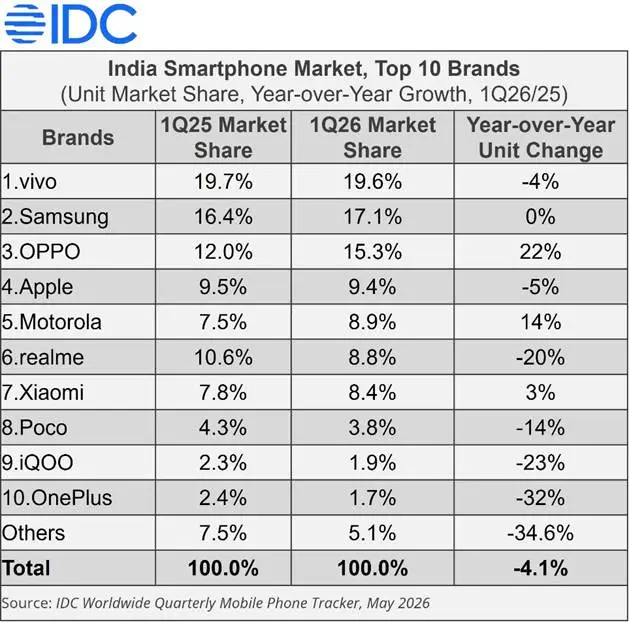
Vivo Leads the Indian Smartphone Market: The brand continues to dominate the Indian smartphone landscape, holding a 19.6% market share despite a broader 4.1% year-over-year decline in shipments during the first quarter of 2026.
While the overall sector faces significant headwinds, major players are navigating shifts in consumer demand. We are seeing a complex environment where established leaders face pressure, while emerging challengers like Motorola and OPPO continue to capture growth in specific segments of the domestic market.
Market Dynamics: What Happened in Q1 2026
The Indian smartphone market experienced a contraction of 4.1% in Q1 2026, according to recent industry reports. This downturn reflects broader challenges in consumer spending and hardware upgrade cycles. Despite this, it maintained its leadership position with a 19.6% market share.
Samsung remains firmly in the second position, continuing a long-standing rivalry that mirrors trends seen in global markets reported by Android Authority. Apple remains a key player, securing a top-four position with a 9.4% market share, proving that premium segments remain resilient even when the total market volume dips. The data, accurate as of May 12, 2026, highlights a market in flux where brands must innovate to maintain their footing.
Why This Matters for the Indian Ecosystem
This shift is critical because it signals a maturing market where growth is no longer guaranteed by sheer volume alone. For consumers, this means companies must focus on value-added services, much like the AI products recently introduced by other tech giants. When the market shrinks, the battle for every percentage point of share becomes intense.
We believe this pressure forces brands to optimise their supply chains and pricing strategies, which could eventually benefit buyers through more competitive mid-range offerings. The growth of brands like OPPO and Motorola, which reportedly saw 22% and 14% increases respectively, suggests that consumers are actively searching for alternatives to the traditional market leaders. This diversification is a healthy sign for the industry, as noted by observers tracking the TechCrunch market analysis.
Analysis of Shipment Numbers and Trends
While the aggregate market is down, the divergence between leading and growing brands is striking. It is worth noting that no detailed technical specifications, such as RAM, storage, or processor architecture, have been confirmed for the specific devices driving these Q1 numbers.
The reliance on legacy models or the timing of new product launches often dictates these quarterly fluctuations. As we wait for further updates, it is clear that the 4.1% decline is not uniform across all tiers. The rise of OPPO and Motorola points to a shift in loyalty that could reshape the hierarchy by the end of the year. Vivo, in particular, deserves more attention than the headline suggests.
Stakeholder Reactions and Market Sentiment
Industry analysts suggest that the current dip is a temporary adjustment phase rather than a long-term slump. Brands are focusing on inventory management and preparing for the next wave of releases to stimulate demand. Vivo, specifically, plays a bigger role than most coverage suggests.
Looking Ahead: Trends to Watch
We expect the competition to heat up as brands prepare for the second half of 2026. The real question is whether the market will return to growth or if this cooling trend will persist throughout the year. The picture for Vivo is more nuanced than headlines indicate.
FAQs
Does Vivo still lead the market?
Yes, it remains the leader with a 19.6% share.
Which brands grew in Q1 2026?
OPPO and Motorola reportedly saw significant growth, increasing their numbers by 22% and 14% respectively.
What caused the 4.1% market decline?
The decline is attributed to reduced consumer demand and broader economic pressures affecting smartphone sales. Understanding VIVO fully means staying ahead of these developments.
Source: IDC