SA329 & 232/5 (82.4 ov)
 AUS429
 BAN272 & 79/6 (29 ov)
 WI245
 NAM1/1 (3.2/50 ov, target 299)
 IRE298/8
 ABH
 ITT
 NEU
 BFC
 DIR
 NEOM
 HAC
 PSG
 NICE
 REN
 SHA
 AHL
 ELV
 M05
 VIL
 ESP
 NZ259/7
 IND172/9 (20 ov, target 260)
 Fiorentina2
 Atalanta2
 Al Nassr5
 Al Kholood3
 Al Riyadh0
 Al Qadsiah6
 DEN
 JER
 RHINO215
 MOUNT11/1 (2.4/50 ov, target 216)
 EAGLE5/0 (0.5/50 ov, target 275)
 TUSK274/9
 SOA154 & 182/1 (48 ov, target 422)
 WA406/5d & 169
 TAS335/5 (96 ov)
 NSW
 Omn19
 AFG19
 UAE
 NED
 PAK
 SL
 AS-W
 MS-W
 PS-W
 MR-W
 BRB
 VAG
 ND
 AUCK
 OTAGO
 CD
 WELL
 CANT
 AFG221/7
 ZIM202/5 (20 ov, target 222)
 ENG386/5
 OMA196
 BH-W154/5
 SS-W157/6 (20 ov, target 155)
 HH-W174/8 (20 ov, target 193)
 Frosinone5
 Lecce1
 Al Khaleej4
 Al Hazem2
 Grêmio2
 Athletico-PR0

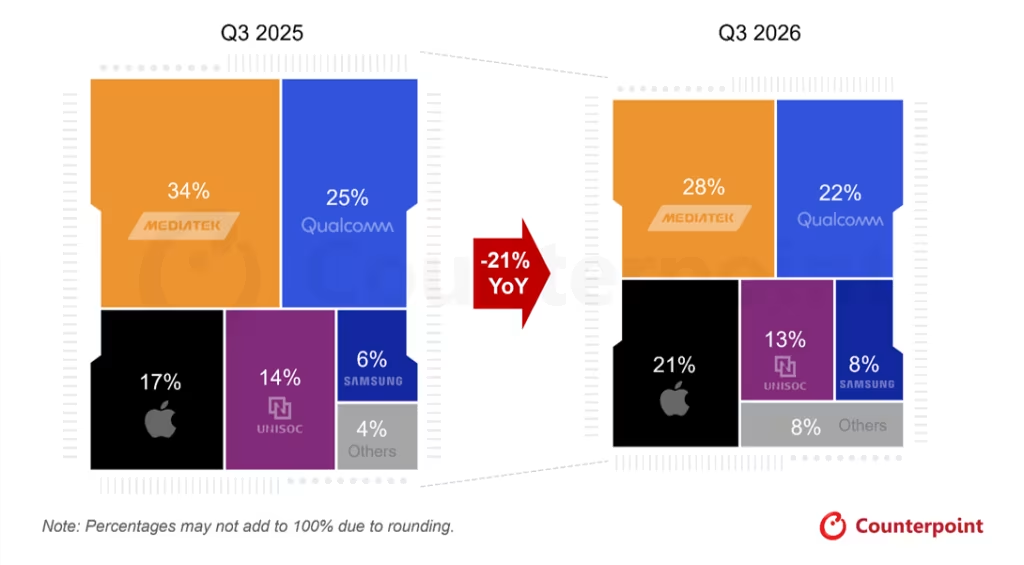
Global smartphone System-on-Chip (SoC) shipments experienced a 21% year-over-year decline in the third quarter of 2026, driven by rising memory costs, extended smartphone replacement cycles, and cautious inventory management by original equipment manufacturers (OEMs). The downturn primarily affected the mid and entry-price segments, as OEMs reduced entry-level model offerings to safeguard profit margins.
According to Counterpoint Research’s latest [Global Smartphone SoC Shipments Preliminary View report(https://counterpointresearch.com/en/reports/smartphone-soc-model-shipments-tracker-q3-2026), while the premium SoC segment was also impacted, it demonstrated greater resilience compared to lower-tier categories. Apple and Samsung proved better equipped to navigate the market disruption, supported by integrated supply chains and a sustained focus on premium product offerings.
Market Dynamics and Vendor Performance
UNISOC and MediaTek encountered significant challenges due to their substantial presence in the mid and low-end market segments. Qualcomm also faced headwinds, partly due to Samsung’s decision to integrate a mix of Snapdragon 8 Elite Gen 5 and its proprietary Exynos 2600 chipsets in the Galaxy S26 series, alongside softer sales from Chinese smartphone OEMs.
Senior Analyst Shivani Parashar commented on the competitive landscape, noting, “September 2026 saw three significant flagship chipset introductions built on TSMC’s 2nm process node: Apple’s A20 series, MediaTek’s Dimensity 9600 Pro, and Qualcomm’s Snapdragon 8 Elite Gen 6 series. These launches are anticipated to bolster premium smartphone SoC shipments in Q4 2026, though volumes are expected to remain below Q4 2025 levels.”
Memory Costs and Future Outlook
Smartphone memory price increases slowed to 5%-10% in Q3 2026 compared to the previous quarter, but are projected to rise by an additional 5% quarter-over-quarter in Q4 2026. While most memory suppliers are managing these price adjustments discreetly, some entry-level smartphone manufacturers have begun incorporating recycled memory to control overall Bill of Materials (BoM) costs. However, technical barriers, such as the deep integration of SoCs with peripheral circuitry and RF components, continue to limit the widespread adoption of recycled memory.
Principal Analyst Soumen Mandal provided a forward-looking perspective, stating, “Global smartphone SoC shipments are projected to decrease by 20% year-over-year in 2026, with an additional 3%-4% decline expected in 2027. Memory prices are forecast to maintain an upward trend, though volatility is likely to moderate next year. Flagship SoCs are expected to remain relatively stable in 2027 despite higher prices stemming from the migration to 2nm process nodes, while rising memory and component costs will continue to exert pressure on overall costs.”
For more on evolving chipset industry dynamics and other latest tech appliance news(https://technosports.co.in/), visit TechnoSports.