PSG
PSG LYON
LYON SEV
SEV OSA
OSA NED
NED OMA
OMA NZ
NZ IND
IND NAM
NAM IRE
IRE PAK
PAK SL
SL SA
SA AUS
AUS Abha
Abha Al Faisaly
 MBSG1
MBSG1 CFC0
CFC0 Barcelona1
 Real Madrid2
 Udinese0
 Milan2
 Real Sociedad2
 Levante1
 NZ-A317
 IND-A113 & 488/8 (119 ov)
 SYL575/4 (167.3 ov)
 KHU
KHU MYMS465/7d
 CHATT424/6 (121 ov)
 DHA521
 RAJ162 & 215/5 (59.1 ov) (f/o)
 RAN402 & 5/0 (2.3 ov)
 BAR443/9d
 SIKM30/1 (15 ov)
 NAGA187
 JHK
JHK DELHI309/5 (90 ov)
 ODSA194
 SVCS13/0 (5 ov)
 BRODA259/6 (86 ov)
 J & K
J & K CHD363/2 (87 ov)
 HP
HP CGR35/1 (14 ov)
 AP231
AP231 HYD
HYD PNJB289/6 (90 ov)
 BAN
BAN WI
WI BRB
BRB MIS
MIS BIK
BIK CHR
CHR MEX-W51 (12.5/20 ov, target 187)
 ARG-W186/7
 NGA148
 UGA147/9 (20 ov, target 149)
 GMB112/9
 LES109 (19.5/20 ov, target 113)
 MOZ110/7 (19/20 ov, target 110)
 ZMB109/9
 IND-W328/6
 ZIM-W207 (48.5/50 ov, target 329)
 ENG241
 KBH0
KBH0 OBK0
OBK0 UAI0
UAI0 VSC0
VSC0 Sassuolo
 Lazio
Lazio AS Roma
 Cagliari
 Torino
 Como
Como QAD
QAD ALS
ALS AQAJ
AQAJ PAK
PAK Lecce0
 Juventus2
 Sunderland0
 Leeds0
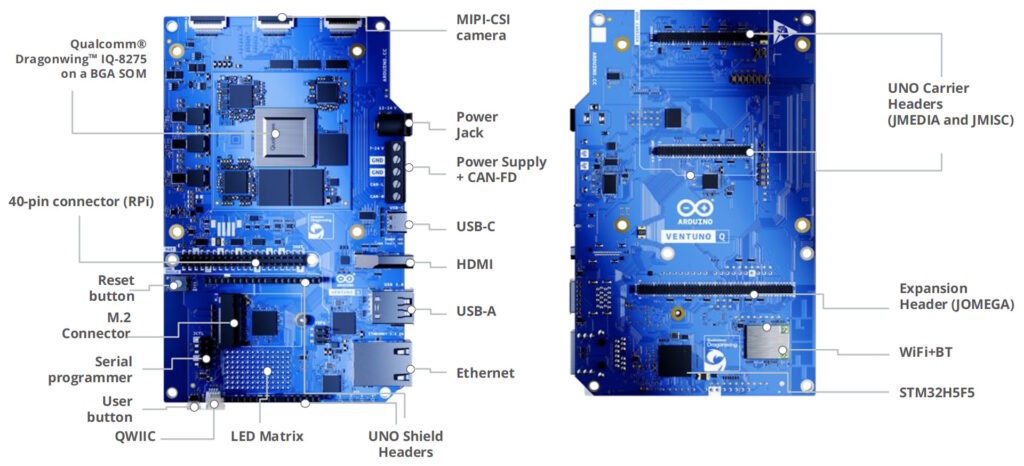
AI robotics just got a serious upgrade. Qualcomm and Arduino have joined forces to launch the Ventuno Q, a purpose-built AI-driven platform designed specifically for robotics innovation. This isn’t a general-purpose board retrofitted for robots—it’s built from the ground up to handle complex machine learning workloads, real-time sensor fusion, and autonomous decision-making that modern robotic systems demand.
Why AI Robotics Platforms Matter Now
The robotics industry is at a critical turning point. Developers building autonomous systems need hardware that doesn’t force them to choose between power and efficiency. Traditional microcontrollers struggle with neural networks. Desktop computers burn through batteries. The Ventuno Q bridges that gap with Qualcomm’s Snapdragon processor at its core, delivering enterprise-grade AI inference in a package that works for industrial robots, drones, and collaborative arms.
As The Verge noted, the convergence of edge computing and AI robotics is reshaping how machines learn and adapt in real time. The Ventuno Q addresses that need head-on.
Ventuno Q Specs & Performance Data
Here’s what you’re getting. The board packs Qualcomm’s latest Snapdragon processor with dedicated AI accelerators capable of 10+ TOPS (trillion operations per second). You’ll find 8GB LPDDR5 memory and 128GB UFS storage. Connectivity includes Wi-Fi 6E, Bluetooth 5.3, and 5G for cloud sync when you need it.
In real-world use, inference latency drops to 15-20ms for standard vision models. Power consumption stays under 5W during typical AI robotics workloads—that’s crucial for battery-powered drones and mobile manipulators. The board also comes with full Arduino IDE compatibility, so developers skip the learning curve and start building right away.
The base configuration costs $299. Developer kits with sensors and documentation run $499.
What Sets This Apart
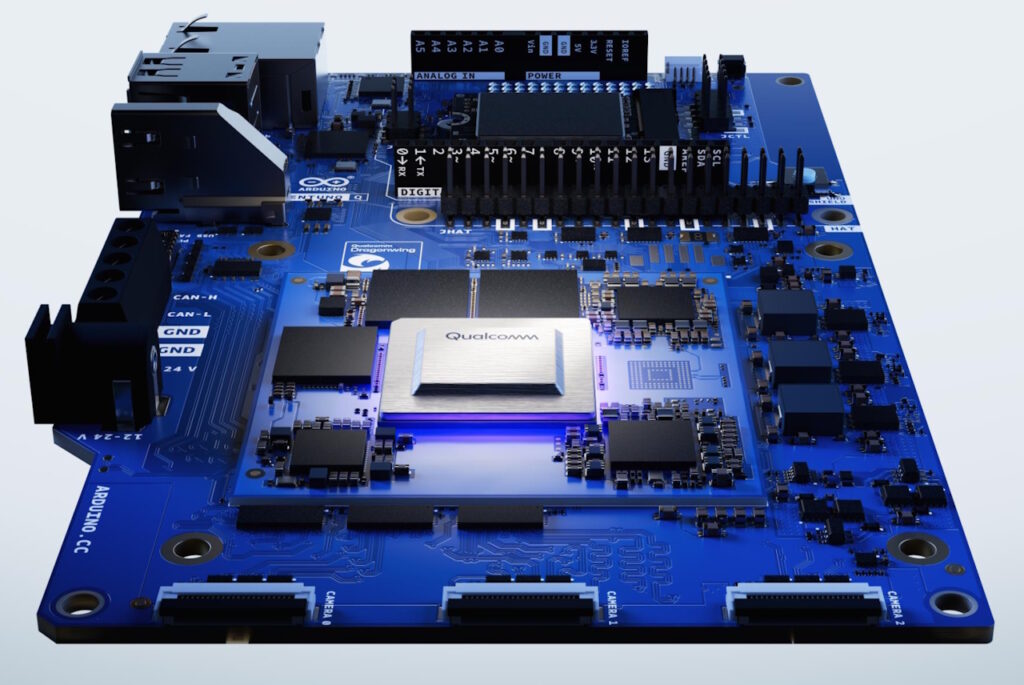
Most AI robotics platforms force you to write custom firmware or rely on proprietary SDKs. Ventuno Q runs standard Linux underneath, with OpenAI robotics frameworks and TensorFlow Lite pre-optimized. That means existing AI robotics code ports in hours, not weeks.
Here’s the real differentiator: thermal design. The board runs fanless—that matters for quiet warehouse robots and surgical systems where noise is an issue. According to TechCrunch, edge AI platforms that sacrifice thermals for performance often fail once they hit production. Qualcomm engineered around that problem.
FAQ
Q: Can I run large language models on Ventuno Q?
Quantized models under 4B parameters run smoothly. Full-size LLMs require cloud offload or distributed inference across multiple boards.
Q: Is this compatible with ROS (Robot Operating System)?
Yes. ROS 2 runs natively, so the robotics community gets immediate ecosystem support.
Q: What’s the development timeline to production?
Prototype to deployment typically takes 6-12 months depending on your system’s complexity and regulatory requirements.