UAE65/2 (16.2/50 ov)
 NED
 PAK
 ENG
 IND-W
 ZIM-W
 GMB
 LES
 MOZ
 ZMB
 Inter Milan
 Fiorentina
 Churchill
 Punjab FC
 NGA
 UGA
 Athletic
 Getafe
 MEX-W23 (9.3/20 ov, target 189)
 ARG-W188/5
 ATM1
 DEP0
 LAZ2
 PAR1
 RCL2
 PAR1
 NZ-A317
 IND-A113 & 106/2 (36 ov)
 SYL
 KHU
 MYMS299/4 (87 ov)
 CHATT
 DHA293/3 (84.1 ov)
 RAJ
 RAN320/5 (80 ov)
 BAR
 DEN
 PNG
 KENYA
 JER
 NAM321/6
 IRE290 (47.3/50 ov, target 322)
 C Palace
 Newcastle
 Hull
 Brentford
 Liverpool
 Brighton
 Man United
 Bournemouth
 Atalanta
 Frosinone
 RIY2
 TAA1
 CHE0
 TOT2
 VAL1
 VIL2
AMD’s next-generation CPU architecture is showing promising performance improvements in early benchmark results. A newly reported Geekbench 7 comparison suggests that AMD Zen 6C delivers 16.5% higher single-core performance than Zen 5 at a comparable 4.1GHz clock speed.
The result comes from AMD’s EPYC 9996 server processor, which uses the compact Zen 6C core architecture. While the processor is designed for data centres rather than consumer desktops, the benchmark offers an early look at the potential architectural improvements AMD could bring to future Ryzen processors.
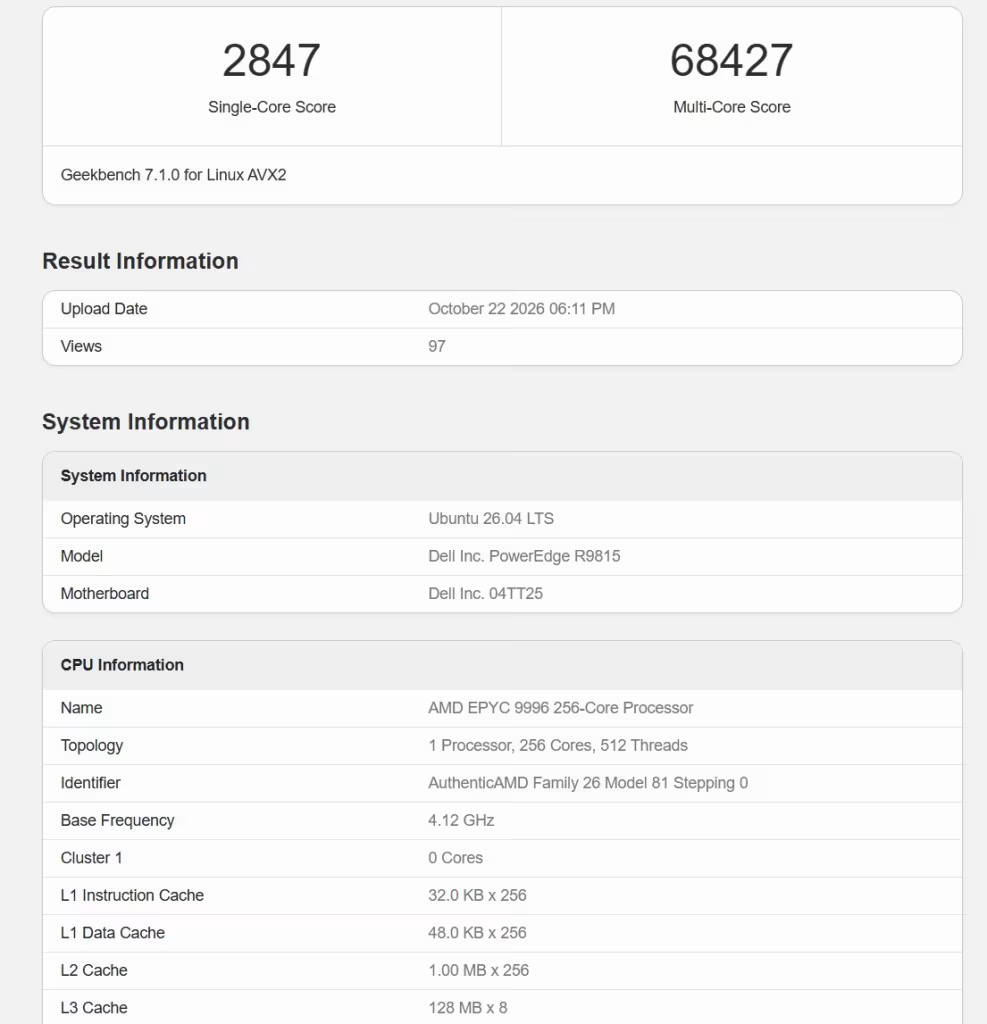
According to VideoCardz, the Zen 6C processor scored 2,847 points in Geekbench 7’s single-core test, compared with 2,444 points for a Ryzen 7 9700X running at a fixed 4.1GHz.
AMD Zen 6C vs Zen 5: Geekbench 7 Scores
The reported comparison highlights a notable difference between the two CPU architectures when operating at approximately the same frequency.
| Specification | AMD EPYC 9996 | AMD Ryzen 7 9700X |
|---|---|---|
| CPU architecture | Zen 6C | Zen 5 |
| CPU category | Server | Desktop |
| Single-core score | 2,847 | 2,444 |
| Test frequency | Up to 4.1GHz | Fixed at 4.1GHz |
| Reported improvement | 16.5% higher | Baseline |
The results indicate a 403-point advantage for Zen 6C in this Geekbench 7 comparison. However, the processors use different platforms and configurations, meaning the difference should not be interpreted as a definitive measurement of architectural improvements across every application.
EPYC 9996 Brings 256 Zen 6C Cores
The AMD EPYC 9996 is a high-core-count server processor featuring 256 cores and 512 threads. It uses AMD’s Zen 6C architecture, which focuses on packing more cores into a processor for workloads that benefit from high computing density.
The reported benchmark was conducted on a Dell PowerEdge R9815 server running Linux, using Geekbench 7.1.0 and AVX2 instructions.
Zen 6C is designed with a different balance of core density and performance characteristics compared with standard Zen cores. Consequently, the results provide an interesting indication of the architecture’s capabilities, but they do not directly establish how future desktop Ryzen processors will perform.
Some Geekbench 7 Workloads Show Even Bigger Gains
The reported comparison also shows improvements across individual single-core workloads. Zen 6C reportedly performed between 8.2% and 25.7% better than the Ryzen 7 9700X in the benchmark’s individual tests.
The largest gains appeared in HTML5 Browser, Photo Editor, Structure from Motion and Video Player workloads. File Compression and Clang recorded smaller improvements.
These differences matter because CPU performance varies depending on the instructions, software and workload involved. A processor that performs particularly well in one benchmark category may deliver a smaller advantage in gaming, productivity applications or other real-world tasks.
For more gaming performance coverage, check out our Monster Hunter Wilds performance and optimisation guide.
Could Zen 6 Improve Future Ryzen Desktop CPUs?
The results have generated interest in AMD’s next-generation desktop processors, as architectural improvements can increase performance without requiring proportional increases in clock speed.
However, Zen 6C is not the same as standard Zen 6. AMD’s future desktop Ryzen chips may use different core designs, clock speeds, cache configurations and power limits. Their final performance will depend on the specific processor and implementation.
Gaming performance also remains uncertain. Real-world results will depend on factors such as single-thread performance, cache latency, memory performance, game-engine optimisation and GPU limitations.
Readers interested in graphics performance can also explore our gaming graphics and performance coverage.
What Does This Mean for AMD Users?
The reported 16.5% single-core advantage makes the Zen 6C result an encouraging early development for AMD. It suggests that the new architecture could offer meaningful improvements over Zen 5 in certain workloads at comparable clock speeds.
Nevertheless, a single leaked benchmark is not enough to predict the performance of future Ryzen processors or determine whether upgrading will be worthwhile. Independent reviews and retail hardware tests will be needed to establish the actual gains.
Bottom line: AMD Zen 6C’s reported Geekbench 7 performance points towards a promising architectural improvement, but desktop users should wait for official specifications and real-world benchmarks before drawing conclusions about next-generation Ryzen CPUs.
Source: VideoCardz — AMD Zen 6C shows 16.5% higher single-core performance than Zen 5.
FAQs
How much faster is AMD Zen 6C than Zen 5 in the benchmark?
AMD Zen 6C scored 2,847 points in Geekbench 7’s single-core test, compared with 2,444 points for the Ryzen 7 9700X. The reported difference is 16.5% at a comparable 4.1GHz clock speed.
How many cores does the AMD EPYC 9996 have?
The AMD EPYC 9996 has 256 cores and 512 threads.
Does the Zen 6C benchmark show how fast future Ryzen desktop CPUs will be?
No. The EPYC 9996 is a server processor, and future desktop Ryzen chips may use different core designs, clock speeds, cache configurations and power limits.