The Hyundai Ioniq 5 has done something unusual for an electric crossover: it turned safety hardware into a mainstream talking point rather than a luxury-car footnote.
That matters because the features it popularised — highway driving assistance, driver attention monitoring, and rapid over-the-air refinement — are now shaping what buyers expect from every segment, including budget hatchbacks in India.
The question facing the industry is whether that influence raises the bar for everyone or simply widens the gap between EVs and conventional cars.
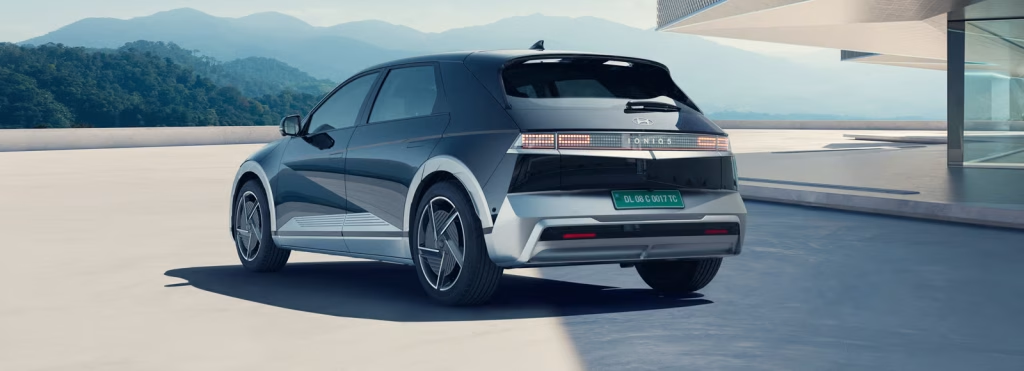
The Problem: Safety Tech Trapped in the Premium Segment
For years, advanced driver assistance systems were bundled into expensive top variants, if they appeared at all. A mid-spec compact SUV in India might offer dual airbags and little else, while a European sedan carried adaptive cruise control and lane-keeping aid.
The Ioniq 5 challenged that logic by treating its Highway Driving Assist and Smart Cruise Control as core identity features, not optional extras. Buyers noticed, and competitors had to respond.
Root Cause: Electrification Changed the Safety Conversation
Here’s the thing: electric platforms made it cheaper to integrate sensors and computing. The Ioniq 5’s E-GMP architecture routes braking, steering, and acceleration through electronic systems by default, so adding driver-assistance software costs far less than retrofitting a petrol car.
That structural advantage explains why EVs like the Ioniq 5 became the test bed for features that traditional manufacturers then adapted. It also explains the tension — brands with ageing combustion platforms face higher costs to match the same capability, which is why debates around models such as the Toyota Highlander reportedly delayed in its EV form carry safety implications, not just product-cycle ones.
Three Paths the Industry Is Taking
Manufacturers are responding in different ways, each with a clear trade-off.
| Approach | Example Direction | Main Trade-off |
|---|---|---|
| Democratise ADAS | Offering lane-keep and AEB on mid variants | Raises entry |
| Software-first updates | OTA improvements over the vehicle’s life | Depends on owner staying connected and paying |
| Sensor redundancy | More cameras and radar for reliability | Adds cost and repair complexity after crashes |
The democratisation route is the most visible. Hyundai’s decision to push its SmartSense suite widely forced rivals to advertise similar features, and that competitive pressure is now visible well beyond EVs — even recall-driven scrutiny of hardware, as seen when Toyota Recalls TRD Off-Road models over faulty dampers, shows buyers expect accountability on every component, not just electronics. The software-first route, meanwhile, carries its own risk: a car’s safety capability becomes dependent on subscriptions and connectivity, which frustrates owners. And sensor-heavy designs make even minor accidents expensive, a concern for insurance costs in dense Indian city traffic.
What Buyers Should Take From This
Worth noting: the Ioniq 5’s real legacy may be expectation-setting rather than any single feature. Once buyers in the ₹30–50 lakh bracket experienced highway assistance, they began asking why a ₹15 lakh car lacked it. That pressure benefits everyone, though Indian buyers should also weigh charging practicality — our guide on whether Are EV Charging Stations actually free in India breaks down the real running costs.
And for those wanting proven durability alongside modern tech, the Toyota Land Cruiser lineage remains a reminder that safety engineering is also about structural toughness, not just software. If you prioritise cutting-edge assistance today, an EV built on a native platform like the Ioniq 5 makes sense. If you keep cars for a decade and value mechanical simplicity, a conventionally powered car with basic ADAS remains the safer financial bet. The Ioniq 5 didn’t invent safety technology — it made the industry realise buyers would no longer accept it as an option.
Related Articles
FAQs
Does the Hyundai Ioniq 5 include advanced driver assistance as standard?
The Ioniq 5 carries Hyundai’s SmartSense suite, including forward collision avoidance and lane-keeping assistance, though exact equipment varies by market and variant, so buyers should confirm the specification sheet for their region. Are these safety features coming to cheaper cars in India?
Yes, competitive pressure means brands are progressively offering features like electronic stability control, hill-hold, and even adaptive cruise control on mid-range variants, though full highway assistance remains rare below ₹20 lakh as of 2026. Is software-based safety reliable long term? It depends on the manufacturer’s commitment to updates. Cars that receive over-the-air improvements can get safer over time, but owners should verify how long a brand promises to support a model before buying.
Was this article helpful?
Your feedback directly improves future articles on this site.