MBSG
 CFC
 PSG
 LYON
 SEV
 OSA
 NED
 OMA
 NZ
 IND
 NAM
 IRE
 PAK
 SL
 SA
 AUS
 Barcelona1
 Real Madrid2
 Udinese0
 Milan2
 Real Sociedad2
 Levante1
 Lecce0
 Juventus2
 LUL
 SPR
 NZ-A317
 IND-A113 & 488/8 (119 ov)
 SYL280/2 (84 ov)
 KHU
 MYMS465/7d
 CHATT317/3 (98 ov)
 DHA521
 RAJ103/6 (26 ov)
 RAN402
 BAR443/9d (124 ov)
 SIKM30/1 (15 ov)
 NAGA187
 JHK
 DELHI309/5 (90 ov)
 ODSA194
 SVCS13/0 (5 ov)
 BRODA222/6 (74 ov)
 J & K
 CHD298/1 (66 ov)
 HP
 CGR
 AP231 (73.2 ov)
 MOW
 TOK
 BRB
 MIS
 BIK
 CHR
 MEX-W51 (12.5/20 ov, target 187)
 ARG-W186/7
 NGA148
 UGA147/9 (20 ov, target 149)
 GMB112/9
 LES109 (19.5/20 ov, target 113)
 MOZ110/7 (19/20 ov, target 110)
 ZMB109/9
 IND-W328/6
 ZIM-W207 (48.5/50 ov, target 329)
 ENG241
 Abha
 Al Faisaly
 Sassuolo
 Lazio
 AS Roma
 Cagliari
 Torino
 Como
 NEF
 ITT
 Sunderland0
 Leeds0
 Freiburg1
 Bayern3

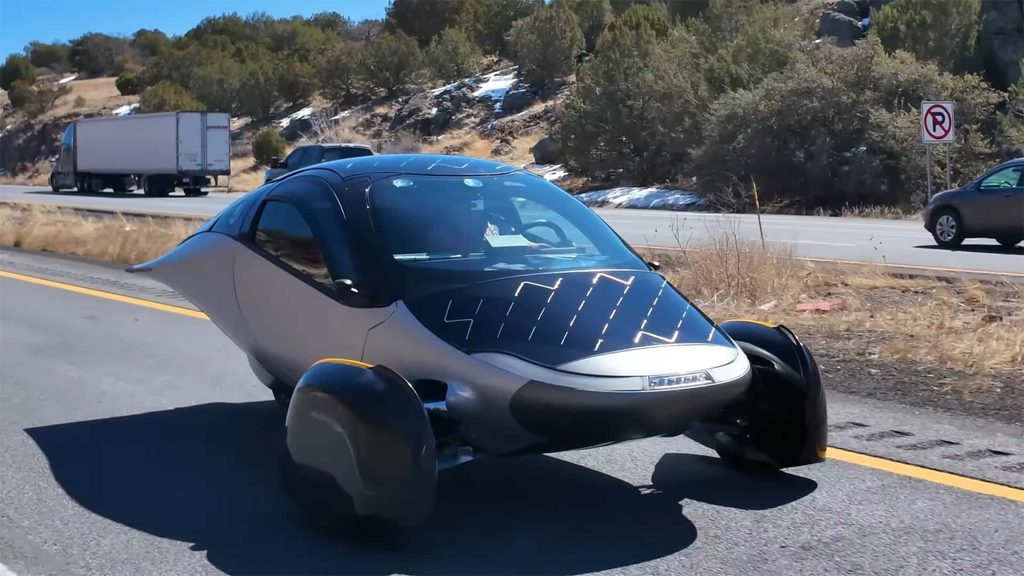
A three-wheeled electric vehicle from Aptera Motors promises up to 47 miles of daily range using only sunlight, according to company disclosures cited by InsideEVs.
The claim, framed as ideal-condition performance, is drawing fresh attention to a design that has spent more than a decade flirting with production. The figure matters because no mass-market passenger car in 2026 can claim anything close to it. Standard EVs rely on charging stations; the Aptera is built so its composite body doubles as a solar panel.
How the Solar System Works
The photovoltaic cells are molded into roughly 2.7 square metres of the vehicle’s outer shell, the equivalent of a small rooftop array travelling with the car.
Under direct summer sun, Aptera says the panels can harvest enough energy in a day to feed a 42 kWh battery enough electrons for a 47-mile commute. That is meaningful for an American driver, since the average daily trip is under 30 miles.
Theoretically, a commuter who plugs in only occasionally and drives inside the solar envelope might never visit a charger during a normal work week. The trade-off is the 1,000-mile range variant that Aptera keeps promoting.
Real-world solar yield depends on latitude, season, cloud cover, and parking habits. A winter in Chicago or a monsoon in Mumbai would slash the daily solar contribution to single digits.
A Design That Looks Like Nothing Else
The Aptera seats two, has three wheels, and wears a teardrop body that the company says delivers a drag coefficient below 0.15. For comparison, a Tesla Model S hovers around 0.20 and a modern electric SUV struggles to break 0.25.
Less drag means the same battery goes further, and the solar array spends fewer watts fighting the wind. Weight is the other lever. The composite body keeps the prototype under about 815 kg, lighter than a Tata Nano and a fraction of a typical family EV.
Lighter cars need smaller batteries, which cost less to build and charge faster from any source, including the sun. The result is a vehicle that feels closer to a road-going aircraft than a normal commuter. Whether the public treats that as exciting or eccentric will decide its commercial fate.
Why Production Has Stalled
Aptera has spent the past several years raising capital in small bursts and re-engineering the drivetrain after early prototypes fell short. The current plan targets low-volume manufacturing at a facility in Carlsbad, California, with the first customer deliveries slipping repeatedly.
Reservations are reportedly in the thousands, but conversion to actual sales has been slow. Critics point to a familiar pattern.
What Buyers Should Actually Expect
A 47-mile solar day is real on paper, but it assumes clear skies, oriented parking, and a lightweight build that has not yet passed full homologation in any major market. Treat the headline number as a ceiling, not a typical day. For the Indian and global audience watching this space, the more useful comparison is with the BMW iX3 and mainstream long-range EVs that already deliver 500 km or more per charge.
Those are real, available now, and rated under WLTP and ARAI standards. Aptera is something different: a technology demonstrator that may never move past a few thousand units a year, or that could quietly establish a new sub-category. The sun-driven 47-mile claim is the hook. The real story is whether a tiny California startup can industrialise a car shaped like a wing.
Related Articles
- Horse reveals methanol-powered range-extender for EVs
- Volkswagen ID.3 Neo UK 390 Miles Range Launch: What to Know
- Tesla’s Robotaxi Just Put Starlink Inside Its Roof 2026 Power Move
FAQs
Q: Can the Aptera really go 47 miles on sunlight alone?
A: Under ideal lab and summer conditions, Aptera says the integrated photovoltaic panels can deliver that figure in a single day. Real-world output drops sharply with weather, latitude, and parking.
What is the total driving range on a full charge?
A: The company targets up to 1,000 miles when the battery is fully charged and solar conditions are optimal, though production units have not yet been independently tested.
Is the Aptera available to buy right now?
A: No. As of August 2026, Aptera is still taking reservations and working through homologation. Customer deliveries have slipped multiple times since the project restarted.
How efficient is the Aptera compared with a normal EV?
A: With a drag coefficient below 0.15 and a kerb weight near 815 kg, it is designed to be several times more efficient than typical electric cars, which is why a small solar input translates into a usable daily range.
can go
SEO_
Was this article helpful?
Your feedback directly improves future articles on this site.