Apple has officially pulled back the curtain on the A20 Pro, the silicon that will power the iPhone 18 Pro and iPhone 18 Pro Max, and it’s not an exaggeration to call this the biggest architectural leap the iPhone has seen in years. Built on a brand-new 2-nanometre process, the A20 Pro isn’t just an incremental refresh — it’s Apple’s first smartphone chip built on this cutting-edge node, and the numbers back up the hype.
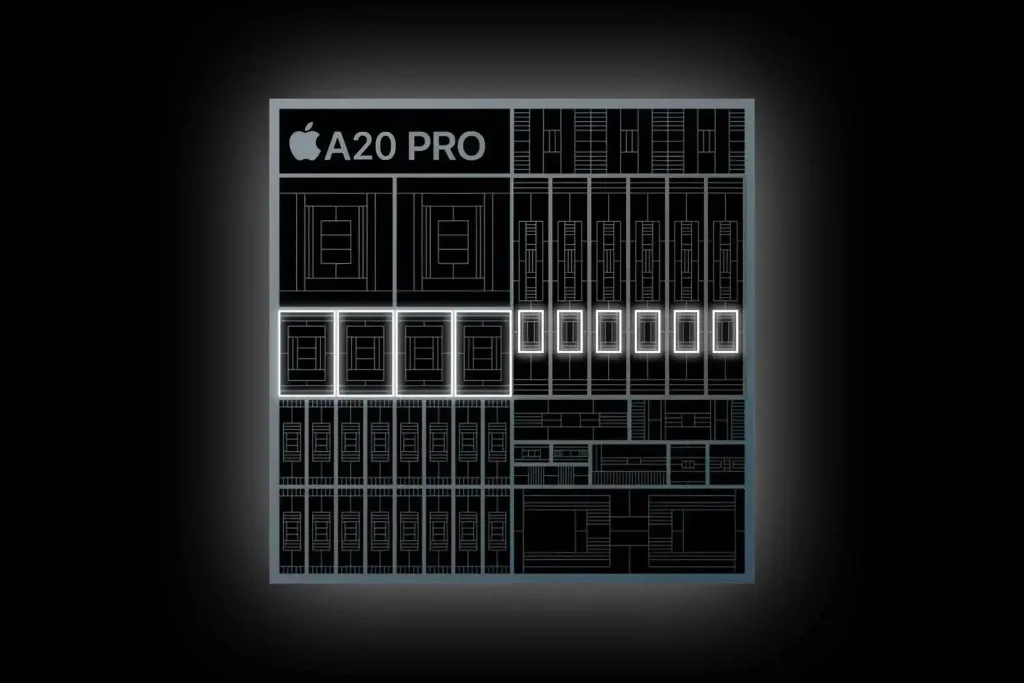
What’s New Inside
At the heart of the chip is a 6-core CPU — two “super cores” and four efficiency cores — with the performance cores reportedly clocking in near 4.90 GHz and described by Apple as “desktop class” and the fastest in any smartphone today. Pair that with a redesigned 7-core GPU delivering up to 40% faster graphics and a 32-core Neural Engine offering roughly double the on-device AI compute of its predecessor, and it’s clear Apple built this chip with generative AI workloads front and centre.
Just as significant is the memory story. Apple calls it the widest memory interface it has ever shipped in an iPhone, with a bus width nearly double that of the A19 Pro — a change that should meaningfully improve everything from camera processing to on-device AI model performance.
A20 Pro at a Glance
| Spec | A20 Pro | A19 Pro (iPhone 17 Pro) |
|---|---|---|
| Process node | 2nm | 3nm |
| CPU cores | 6 (2 performance + 4 efficiency) | 6 |
| GPU cores | 7 | 6 |
| Neural Engine | 32-core | 16-core |
| Sustained performance | +40% vs A19 Pro | Baseline |
| Memory bandwidth | Significantly wider bus | Baseline |

Why It Matters
Apple claims the A20 Pro delivers 40% more sustained performance than the A19 Pro and double the sustained performance of the A18 Pro that shipped in the iPhone 16 Pro. That kind of generational jump matters most for sustained tasks like gaming, video editing, and running larger on-device AI models without throttling — an area where Apple has clearly been listening to power users.
For TechnoSports readers tracking the flagship smartphone race, this puts real pressure on Qualcomm and MediaTek heading into 2027, and it sets up the iPhone 18 Pro as one of the most significant hardware upgrades in recent memory.
FAQs
1. What process node is the Apple A20 Pro built on?
It’s built on a 2-nanometre process, making it Apple’s first smartphone chip on this node.
2. Which iPhones will use the A20 Pro?
The A20 Pro powers the iPhone 18 Pro and iPhone 18 Pro Max.
3. How much faster is the A20 Pro than the A19 Pro?
Apple says it delivers up to 40% more sustained performance than the A19 Pro in the iPhone 17 Pro.
4. Does the A20 Pro improve AI performance?
Yes — its 32-core Neural Engine offers roughly double the compute of the previous generation, with performance reportedly exceeding 80 TOPS.
5. What GPU does the A20 Pro use?
A redesigned 7-core GPU, offering up to 40% faster graphics performance thanks to a wider memory interface.
For more on Apple’s latest chip announcements, check out Apple’s official newsroom and MacRumors’ full A20 Pro coverage.
Stay with TechnoSports for the latest on iPhone 18 Pro leaks, launch dates, and every major chip announcement as it happens.