QAD0
QAD0 ALS0
ALS0 AQAJ0
AQAJ0 PAK0
PAK0 PSG
PSG LYON
LYON SEV
SEV OSA
OSA NED
NED OMA
OMA NZ
NZ IND
IND NAM
NAM IRE
IRE PAK
PAK SL
SL SA
SA AUS
AUS Abha
Abha Al Faisaly
 MBSG1
MBSG1 CFC0
CFC0 Barcelona1
 Real Madrid2
 Udinese0
 Milan2
 Real Sociedad2
 Levante1
 NZ-A317
 IND-A113 & 488/8 (119 ov)
 SYL575/4 (167.3 ov)
 KHU
KHU MYMS465/7d
 CHATT424/6 (121 ov)
 DHA521
 RAJ162 & 215/5 (59.1 ov) (f/o)
 RAN402 & 5/0 (2.3 ov)
 BAR443/9d
 SIKM30/1 (15 ov)
 NAGA187
 JHK
JHK DELHI309/5 (90 ov)
 ODSA194
 SVCS13/0 (5 ov)
 BRODA259/6 (86 ov)
 J & K
J & K CHD363/2 (87 ov)
 HP
HP CGR35/1 (14 ov)
 AP231
AP231 HYD
HYD PNJB289/6 (90 ov)
 BAN
BAN WI
WI BRB
BRB MIS
MIS BIK
BIK CHR
CHR MEX-W51 (12.5/20 ov, target 187)
 ARG-W186/7
 NGA148
 UGA147/9 (20 ov, target 149)
 GMB112/9
 LES109 (19.5/20 ov, target 113)
 MOZ110/7 (19/20 ov, target 110)
 ZMB109/9
 IND-W328/6
 ZIM-W207 (48.5/50 ov, target 329)
 ENG241
 KBH0
KBH0 OBK0
OBK0 UAI0
UAI0 VSC0
VSC0 Sassuolo
 Lazio
Lazio AS Roma
 Cagliari
 Torino
 Como
Como GAL
GAL FEN
FEN CDSC
CDSC SLB
SLB Lecce0
 Juventus2
 Sunderland0
 Leeds0
India’s AI ethics framework is currently being shaped by the Ministry of Electronics and Information Technology (MeitY). This initiative aims to set global standards for responsible innovation. While independent sources haven’t confirmed specific provisions or the official title of the May 2026 announcement, it’s clear this represents a shift in the way the country oversees machine learning systems. AI ethics plays a crucial role in this evolving narrative.
The goal is to strike a balance between rapid tech adoption and the strict safety requirements established in the Digital Personal Data Protection Act of 2023. So, the importance of AI ethics is undeniable in this scenario.
AI Ethics: Core Governance and Strategic Foundations
The government’s recent initiatives build on the solid groundwork set by the IndiaAI Mission. This mission secured an impressive budget of ₹10,371.92 crore (around $1.24 billion USD) in March 2024. With this funding, India aims to enhance testing for algorithmic bias and improve transparency. The landscape for AI ethics is changing quickly.
Unlike past policy documents, like the 2018 NITI Aayog National Strategy for Artificial Intelligence, this new framework emphasises real-time regulatory compliance for generative models.
In essence, we’re seeing a shift from voluntary guidelines to a structured oversight mechanism. India is actively aligning its domestic policies with the UNESCO Recommendation on the Ethics of AI, a global standard that 193 member states adopted in November 2021.
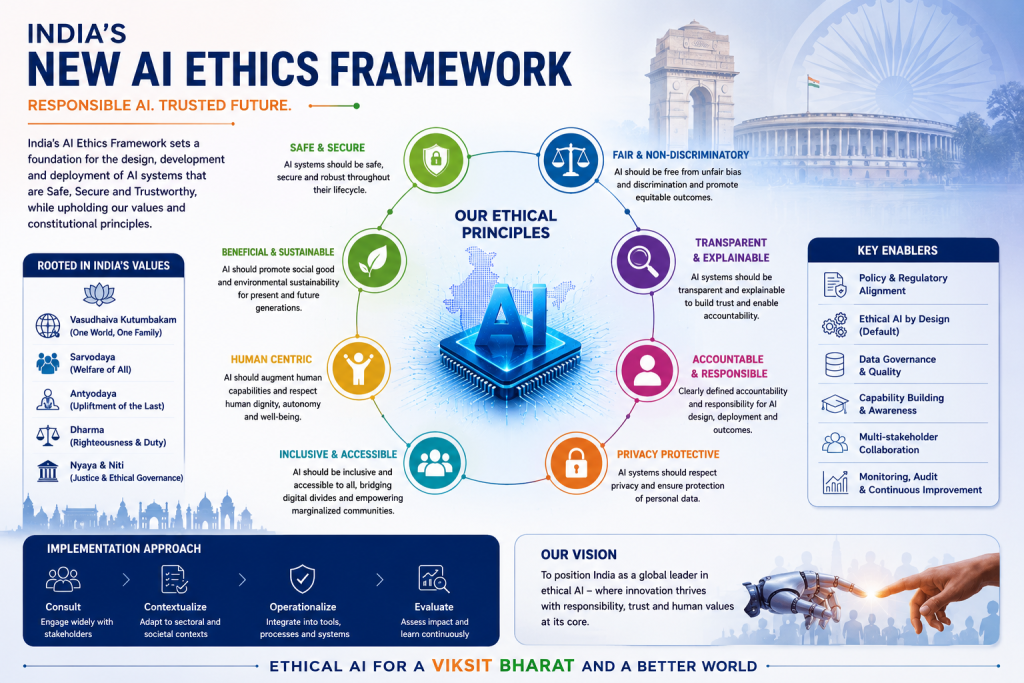
By incorporating these international principles, the government wants to ensure that Indian tech startups stay competitive while upholding universal human rights standards.
| Policy Milestone | Year | Significance |
|---|---|---|
| National Strategy for AI | 2018 | Initial vision for AI adoption |
| Digital Personal Data Protection Act | 2023 | Legal foundation for data privacy |
| IndiaAI Mission Launch | 2024 | ₹10,371.92 crore budget allocation |
| AI Ethics Framework | 2026 | Operationalizing ethical governance |
Not everyone agrees with this top-down approach. Critics worry that strict regulations might hinder local developers’ agility when compared to their international peers. (Source: TechCrunch)
On the flip side, supporters highlight the G20 New Delhi Declaration, where India managed to unite consensus on AI governance principles. This suggests a unified regulatory environment is vital for fostering public trust in automated systems.
Impact on the Indian Tech Ecosystem
Now, developers will need to navigate new operational rules. The framework is likely to require transparency reports for large-scale language models, pushing companies to reveal data sources and strategies for mitigating bias.
This aligns with the global trend towards explainable AI, making sure that software decisions are not only accurate but also transparent.
Beyond mere compliance, the framework acts as a roadmap for the next stage of the digital economy. By standardising ethical practices, the government aims to draw more foreign investment into local semiconductor and quantum computing sectors.
Still, the success of this approach hinges on how quickly MeitY can create a collaborative dialogue with industry leaders. They need to refine these standards without slowing down innovation. (Source: The Verge)
FAQs
What is the primary objective of the new framework?
The main goal is to create a regulatory environment that supports safe, transparent, and equitable AI development while safeguarding user data as per the 2023 Digital Personal Data Protection Act.
How does this framework align with international standards?
The policy specifically refers to the UNESCO Recommendation on the Ethics of AI, ensuring India’s regulations mesh well with those adopted by 193 member states.
Will this impact current AI startups in India?
Absolutely, startups will likely need to implement new transparency and bias-auditing protocols to meet the government’s ethical deployment benchmarks.
What is the primary objective of the AI Ethics framework introduced by the Ministry of Electronics and Information Technology?
The AI Ethics framework aims to set clear guidelines for machine learning development while ensuring strong protection for user data across the national tech ecosystem.
How does the new AI Ethics framework align with the IndiaAI Mission?
The AI Ethics framework acts as a foundational pillar for the IndiaAI Mission by aligning domestic tech advancements with international safety standards to promote responsible innovation.