NVIDIA AI “factory compute” model is moving from infrastructure talk to investable-asset status as data-center operators line up around its newest stack, including GB200 systems and DGX SuperPOD deployments. Here’s the thing: when compute becomes contract-backed and capacity-constrained, it starts behaving less like capex and more like a financeable service. On May 13, 2024, NVIDIA CEO Jensen Huang announced plans to release the Blackwell Ultra chip by 2025 at Computex in Taipei, putting a concrete timeline behind the next AI wave. Separately, CoreWeave said it expanded cloud data center infrastructure using NVIDIA GB200 NVL72 systems starting in late 2024.
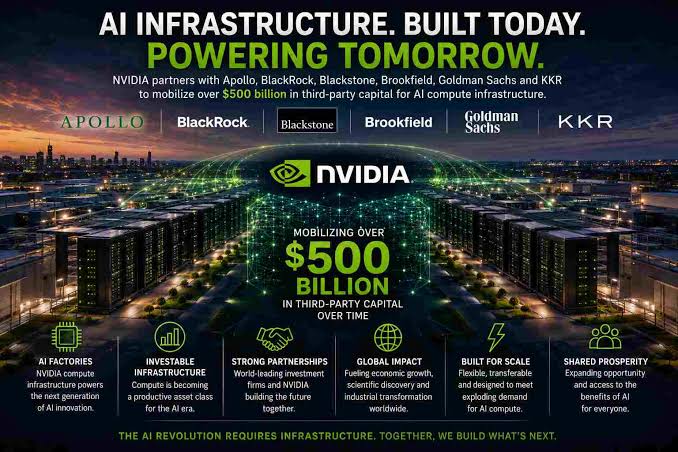
That combination—new silicon roadmap plus committed cloud build-outs—is now the blueprint investors want. Worth noting: partnerships with colocation providers and large private capital can turn “GPU shortages” into multi-year capacity contracts. Equinix partnered with NVIDIA to integrate DGX SuperPOD systems across its global data center footprint by the third quarter of 2025, while Blackstone committed over $1 billion toward specialized NVIDIA-powered AI data centers in North America during fiscal year 2025.
NVIDIA AI Factory Compute Is Becoming an Investable Asset Class Key Details: Where the investable shape is forming
The investable part isn’t just faster GPUs; it’s traceable throughput tied to specific platform components. NVIDIA’s H100 Tensor Core GPU delivers up to 9 times faster AI training performance compared to the previous-generation A100 GPU, a performance jump that matters because investors underwrite outcomes, not marketing decks. When performance scales, utilization becomes a financial variable instead of a hope.
On the deployment side, “compute as a facility” is hardening into recognizable building blocks. CoreWeave’s announcement around NVIDIA GB200 NVL72 systems starting in late 2024 frames the market around near-term capacity rather than speculative futures. Equinix’s DGX SuperPOD integration plan adds another layer: distributed placement with standardized racks and operational patterns.
Finally, private capital is treating AI data centers as specialized infrastructure rather than experimental IT. Blackstone’s stated commitment of over $1 billion for NVIDIA-powered AI data centers in North America during fiscal year 2025 signals that large funds view AI compute as a portfolio holding with defined geographic and operational constraints.
What’s the commercial mechanism?
Compute becomes investable when three things line up: predictable supply, standardized architectures, and contractual demand. The NVIDIA roadmap—anchored by Huang’s Blackwell Ultra timeline at Computex—creates a reference point for capacity planning. The cloud build-out (CoreWeave) and colocation integration (Equinix) then translate that roadmap into staged deliveries. That’s when “AI factory compute” starts to look like an asset class with durability: tenants lease capacity; operators manage utilization; financiers underwrite the cash flows.
Context: Why capacity is starting to behave like financeable infrastructure
Capacity constraints used to be a technical issue; now they’re increasingly a financing issue. When buyers can’t easily swap providers, they prefer contracts that lock in schedules, rack-level power envelopes, and platform support. That shifts the risk from “will the hardware arrive?” to “will the operator deliver usable capacity at scale?”
There’s also a performance-to-economics link. A GPU that trains up to 9x faster than its predecessor changes how long a workload needs to run, which can indirectly improve effective cost per training run—assuming utilization and power stay within plan. This is the nuance many outsiders miss: the investment case doesn’t only rest on peak benchmarks; it rests on the operational system around those GPUs.
That said, critics will argue that hardware-centric investments can overcommit if demand softens or workloads change faster than deployment cycles. Their concern is real—AI is moving quickly. Our take: compute contracts and standardized platforms reduce that specific risk by tying capital spending to scheduled capacity delivery, not to a single training run.
External context for how these infrastructure models are discussed across the AI economy is also worth tracking via VentureBeat’s AI coverage: VentureBeat AI infrastructure reporting and the policy/industry context that often follows.

What’s Next: The asset-class playbook spreads to operators and capital
Next, we expect more investors to underwrite AI data centers the same way they fund telecom towers or renewable energy projects: long-term demand expectations, contract-backed capacity, and operator expertise. That means more “capacity procurement” arrangements between cloud providers, colocation platforms, and financial sponsors—especially where NVIDIA’s ecosystem enables standardized deployment.
From a market timeline perspective, the NVIDIA Blackwell Ultra release window announced by Huang at Computex sets the near-term narrative, while GB200 NVL72 system deployments starting in late 2024 provide the bridge. Equinix’s DGX SuperPOD integration target for the third quarter of 2025 then acts as a catalyst for broader global scaling. If you’re watching where the next capital wave will land, it won’t be on generic server lots—it will be on packaged, monitored compute capacity.
For companies trying to plan model training and inference roadmaps, the practical next step is to align workload requirements with operator delivery schedules and power/rack constraints early—then lock multi-year capacity before the queue forms. As demand tightens, “AI factory compute” is likely to keep mig
Related Articles
FAQs
What does “AI factory compute” mean in practice?
It refers to treating AI compute like a factory input: standardized hardware stacks, repeatable rack deployments, and capacity contracts that deliver measurable throughput over time.
Why is NVIDIA’s ecosystem pushing compute into an investable category?
Because NVIDIA’s platform roadmap (including next-gen chips and systems) plus operator integrations help buyers plan utilization, timelines, and delivery—turning uncertain capex into more predictable cash flows.
Is this only about training performance like H100 vs A100?
No. Training speed matters, but investors care about the operational system: deployments, utilization assumptions, power delivery, and how reliably capacity can be delivered and renewed.
What signals should investors watch next?
Look for more capacity announcements tied to specific NVIDIA system names, deeper colocation integrations, and additional large private-capital commitments to specialized AI data centers.
Where can we follow credible AI infrastructure developments?
Two good starting points are VentureBeat AI coverage and MIT Technology Review’s tech policy and systems reporting.
Closing takeaway: “AI factory compute” becomes an asset class when contracts, capacity delivery, and platform standardization turn GPU scarcity into financeable throughput.
Was this article helpful?
Your feedback directly improves future articles on this site.