UAE168/3 (37.5/50 ov)
 NED
NED PAK
PAK ENG7/1 (2.2/50 ov)
 IND-W
IND-W ZIM-W
ZIM-W GMB
GMB LES
LES MOZ
MOZ ZMB
ZMB Inter Milan
 Fiorentina
 Churchill
 Punjab FC
 NGA
NGA UGA
UGA Athletic
 Getafe
 MEX-W
MEX-W ARG-W
ARG-W ATM1
ATM1 DEP0
DEP0 LAZ2
LAZ2 PAR1
PAR1 RCL2
RCL2 PAR1
PAR1 MOUNT6/0 (4.5/50 ov)
 TUSK
TUSK ROCKS
ROCKS EAGLE65/0 (8.4/50 ov)
 NZ-A317
 IND-A113 & 106/2 (36 ov)
 SYL
SYL KHU
KHU MYMS299/4 (87 ov)
 CHATT
CHATT DHA293/3 (84.1 ov)
 RAJ
RAJ RAN320/5 (80 ov)
 BAR
BAR BOL
BOL TITNS
TITNS EASTN
EASTN SA-EM
SA-EM KZNIN
KZNIN WPR
WPR NAM321/6
 IRE290 (47.3/50 ov, target 322)
 C Palace
 Newcastle
 Hull
Hull Brentford
 Liverpool
 Brighton
 Man United
 Bournemouth
 Atalanta
 Frosinone
 RIY2
RIY2 TAA1
TAA1 CHE0
CHE0 TOT2
TOT2 VAL1
VAL1 VIL2
VIL2
Canada’s next game is the biggest in men’s national team history.
Yes, every other match at this World Cup was also the biggest in Canadian history — such is the nature of playing your first games on home soil, breaking out of a group stage for the first time, then winning a knockout match for the first time. But the stakes have never been higher than they are now.
Canada’s round-of-16 meeting with Morocco is their fifth game of the tournament and presents a completely different set of challenges than anything that preceded it. Morocco are ranked sixth in the world by FIFA. They beat the seventh-ranked Netherlands on penalties in their last match. They reached the semi-finals of the 2022 World Cup — the first African nation ever to do so. And in 2025, they were crowned Africa Cup of Nations champions.
Canada are still staring upwards at Morocco. There is no honest way to describe it otherwise.
But there is no tournament in the world that produces upsets quite like the World Cup. Twenty-four hours after Canada beat South Africa, Paraguay eliminated four-time champions Germany. The sport rewards the bold, the organised and the team that plays without fear. Morocco manager Mohamed Ouahbi acknowledged as much: “If we get things wrong, we’ll go home.”
So how does Canada make them get things wrong? Here is the tactical case for a historic upset.
First, Throw Out 2022
Before going further, it is worth setting aside Canada’s 2-1 defeat to Morocco at the 2022 World Cup in Qatar. The context makes the result almost meaningless as a reference point.
Canada were already eliminated from knockout contention before that match. Only four of Morocco’s starters against the Netherlands played in that 2022 group game against Canada. A significant error from then-goalkeeper Milan Borjan gifted Morocco a goal in the fourth minute and the game was effectively gone before it had started. Morocco’s second goal could have been prevented by a back line with the pace Canada now possess. And Canada’s only goal was an own goal.
It was a dead rubber played in circumstances that have nothing to do with Saturday’s match. Discount it entirely.
The Blueprint Already Exists: Canada vs Colombia
Canada’s most instructive reference point is not a loss but a draw — a 0-0 result against Colombia, ranked 11th in the world, in October 2025.
That match demonstrated how Canada can compete with elite opposition: defend compactly in a structured block, press with authority on specific triggers, use their physicality to make the game uncomfortable, and be clinical when the rare opportunity arrives.
Canada’s Performance Profile — Against Elite Opponents
| Match | Opponent Rank | Canada’s Approach | Result |
|---|---|---|---|
| vs Colombia (Oct 2025) | 11th | Compact, pressing, physical | 0-0 draw |
| vs South Africa (WC R32) | 54th | Ground it out; two missed chances | Won in stoppage time |
| vs Switzerland (WC group) | — | Organised defensive block | Lost 2-1 |
| vs Bosnia (WC group) | — | Jittery under pressure | Got through |
The pattern is instructive. Canada are at their most dangerous when they relinquish possession willingly, execute on specific pressing triggers, and use their pace to hurt teams on the counter. They struggle when asked to break down organised low blocks with creative play.
Against Morocco, the former approach is exactly what is required — and exactly what Jesse Marsch will plan for.
Understanding Morocco’s Threats
Morocco are not simply a well-organised defensive team. They are technically sophisticated, physically capable and carry pace and creativity across multiple positions. Canada cannot afford to be naive about the individual quality they will face.
Morocco’s Key Attacking Players
| Player | Position | Threat |
|---|---|---|
| Brahim Díaz | Left wing | Trickery; quick combinations in tight spaces |
| Bilal El Khannous | Right wing | Speed; direct running |
| Azzedine Ounahi | Central midfield | Technically excellent on the ball; drives forward |
| Achraf Hakimi | Right-back | Attacking threat; dovetails with Díaz; underlaps and overlaps |
| Noussair Mazraoui | Left-back | Physicality; thunderous tackling |
| Ismael Saibari | Midfielder | Tournament’s most active runner behind the defensive line |
Saibari is a particular concern. He has made more offers to receive passes in behind than any other player at World Cup 2026, with 144 — 49 more than the second-placed Kai Havertz. He is also second at the tournament for distance covered while sprinting above 25 km/h. Canada’s centre-backs will need to track his movement with exceptional concentration across the full 90 minutes.
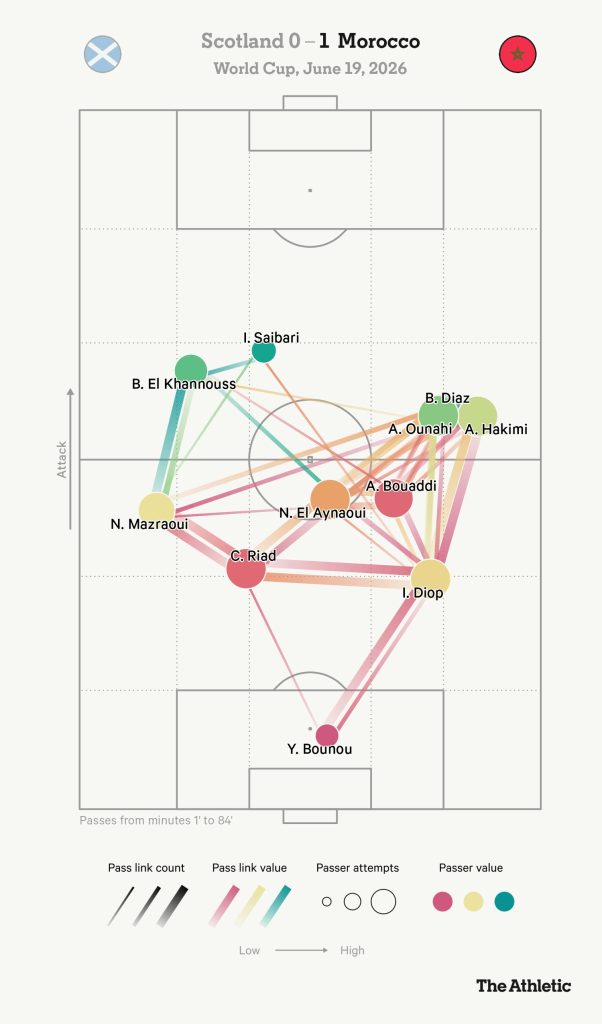
Hakimi’s relationship with Díaz on Morocco’s right side is another tactical problem. When Díaz drifts inside, Hakimi overlaps. When Díaz runs wide, Hakimi underlaps into the space between defence and midfield. The combination is fluid, experienced and very difficult to defend without collective organisation from wide midfielder and right-back simultaneously.
Morocco’s Attacking Direction — World Cup 2026
| Flank | Share of Attacking Touches |
|---|---|
| Right side | 45.3% (second highest in tournament, behind Australia) |
| Left side | Balanced — Díaz primary threat |
Canada know Morocco prefer to attack down the right flank, as evidenced in the group stage against Scotland. That information should directly influence Canada’s defensive organisation — Richie Laryea at left-back and whoever starts at left midfield will carry additional defensive responsibility in this match.
Canada’s Defensive Keys: Bombito Must Start
Moïse Bombito should start at centre-back. His pace — the most important quality a centre-back needs against Morocco’s runners — makes him essential in this specific match.
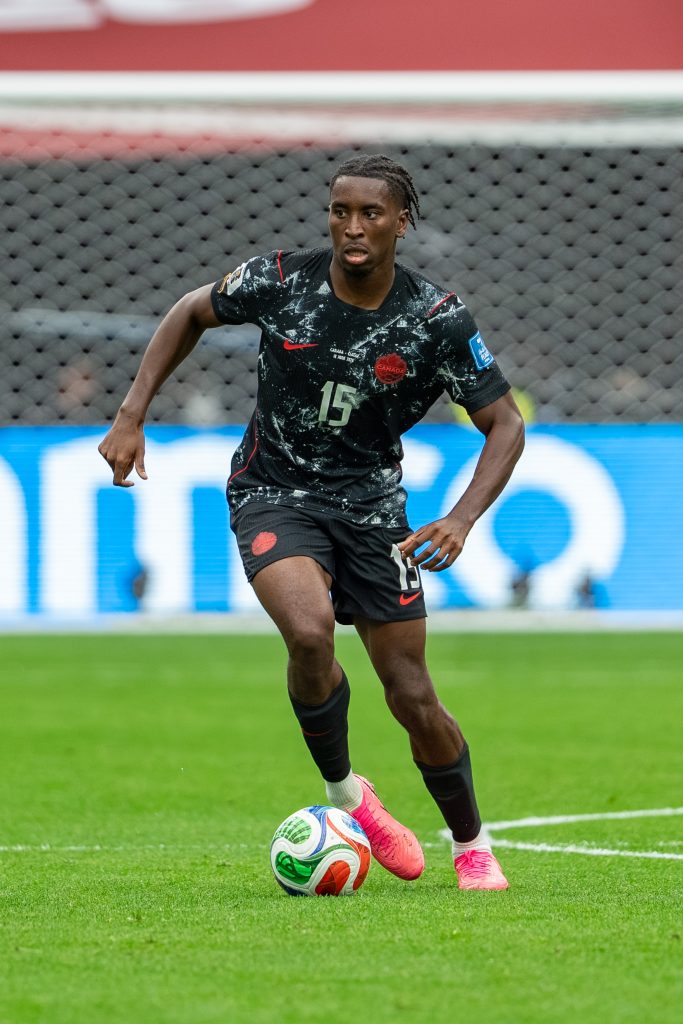
The question of who partners him remains the most significant personnel decision Marsch faces. Derek Cornelius offers reliability and is Bombito’s most used partner. Luc de Fougerolles has been Canada’s best centre-back across the tournament, but his strengths involve stepping aggressively into midfield and playing forward — a profile better suited to dominating the middle third than defending deep against Saibari’s runs in behind.
Canada’s Centre-Back Options
| Player | Key Strength | Key Concern |
|---|---|---|
| Moïse Bombito | Pace — essential against Morocco’s runners | Must start |
| Derek Cornelius | Reliability; experienced partnership with Bombito | Less dynamic |
| Luc de Fougerolles | Best tournament CB overall | Profile better in higher block |
The full-backs have been one of Canada’s genuine strengths at this tournament. Alistair Johnston in particular has had an outstanding World Cup — his defensive intelligence, physical intensity and ability to recover make him well-matched against whoever Morocco deploy down his side. Laryea’s athleticism on the left must be complemented by a left midfielder willing to defend first and attack second.
This is the critical question around Alphonso Davies.
The Davies Dilemma
There will be enormous pressure on Marsch to start Alphonso Davies — Canada’s most famous player — in the biggest match in Canadian football history. The temptation is understandable. Against South Africa, Davies showed flashes of his exceptional ability in his first appearance of the tournament.

But the evidence from that match also raised concerns. Davies did not go into heavy physical challenges with the same commitment visible in the players around him. When Canada need their left midfielder to aggressively track Hakimi’s overlapping runs, hold shape against Morocco’s combinations in tight spaces and press on specific triggers — the requirements of that role in Marsch’s system demand full physical commitment.
Davies vs. Alternative at Left Midfield
| Option | Attacking Contribution | Defensive Intensity | Morocco-Specific Concern |
|---|---|---|---|
| Alphonso Davies (start) | Very high potential | Uncertain after South Africa performance | Hakimi + Díaz combination requires defensive discipline |
| Jacob Shaffelburg | Good | High | Less quality gap — more reliable defensively |
| Davies (substitute) | High-impact option | Fresh legs — less of an issue | Dropping into stalemate could destabilise Morocco |
Shaffelburg impressed in the second half against South Africa and offers the pressing intensity Marsch’s system requires. Davies may deliver more as a second-half weapon — introduced into a tight, physically draining match when Morocco’s full-backs are tired and the space in behind begins to open.
Canada’s Attacking Plan: Pace, Counter and Clinical Finishing
Canada cannot afford to miss the chances they missed in the first half against South Africa. Jonathan David was unmarked from a corner and hit his shot wide. Derek Cornelius had a free header and did not generate enough power to test the goalkeeper.
Against Morocco’s defensive quality, such opportunities will be rarer and the margins will be finer.
Canada’s Attacking Keys
| Priority | Detail |
|---|---|
| Clinical finishing | Cannot waste chances that required patience to create |
| Counter-attack speed | Morocco had 61% possession vs Netherlands — Canada must use the space in behind |
| Jonathan David movement | Needs space to roam — Oluwaseyi’s pressing creates that |
| Set-piece organisation | Morocco are physically strong but Canada’s aerial threat is real |
| Press on triggers | Execute on specific moments — not a general high press |
David is the focal point. He scores when Canada give him space to roam and when the players around him are doing the unglamorous work that creates his freedom. Tani Oluwaseyi’s willingness to press, run in behind and sacrifice his own attacking contribution for the collective benefit is exactly the kind of running that opens space for David.
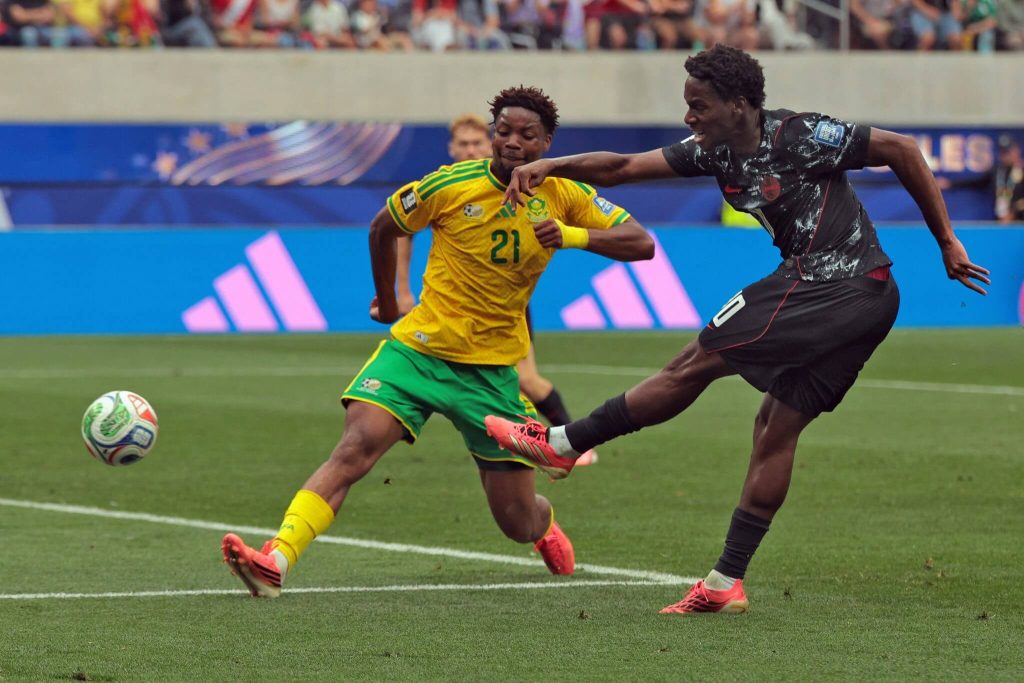
As Oluwaseyi himself said before the tournament: “I think Jonathan plays best when he’s allowed to roam a bit. And once he gets going like that, it makes life so much easier for the rest of us. So for me, it’s a matter of recognising the spots that he does like getting the ball. And it also means doing the dirty work.“
That dynamic — Oluwaseyi working, David roaming — is Canada’s most reliable route to a goal that could change the match.
The Psychological Dimension
Canada have shown throughout this tournament that their performance level is closely tied to their psychological state. When they play under pressure they feel the weight of expectation — against Bosnia, Switzerland and in the first half against South Africa — the hesitation is visible. When they feel free, as in their best performances of 2025 against stronger opposition, they attack with pace and conviction.
Morocco’s internal expectation is to reach the semi-finals. Canada’s external expectation is to lose respectably and go home. That asymmetry of pressure is a genuine tactical variable.
Marsch has embraced the underdog framing explicitly. He told his players before preparing the match plan that Morocco have zero weaknesses — not to intimidate them, but to liberate them from the burden of being favourites. Canada play best when they have nothing to lose.
Canada’s Form by Psychological Context
| Match | Canada’s Status | Performance | Result |
|---|---|---|---|
| vs Bosnia | Expected to compete | Jittery | Got through |
| vs Switzerland | Needed result | Heavy | Lost |
| vs South Africa | Needed result | Uncertain | Won late |
| vs Colombia (2025) | Underdogs | Excellent | Drew |
| vs Morocco | Clear underdogs | Calm build-up | TBD |
The free-hit framing — which Marsch himself used — is not spin. It is an accurate description of Canada’s position, and it might be the most powerful asset they bring into Saturday’s match.
Can Canada Actually Do It?
The honest assessment: Morocco are the better team and the probability is that they advance. Their quality in possession, the individual brilliance of Díaz and Ounahi, Saibari’s relentless running, and the experience of a squad that has been in this position before all tilt the balance clearly in their favour.
But the condition for a Canada upset exists. If Bombito and his partner can manage Saibari’s runs, if Johnston and Laryea can contain Hakimi, if David gets the space Oluwaseyi’s movement creates, if Canada execute on their pressing triggers and — most importantly — if Canada convert when they get their moments, then a result is possible.
It would require Morocco to have an off day at the same moment Canada have a very good one. That is not a likely combination, but it is not an impossible one.
Paraguay showed that four-time world champions can lose to the right team on the right night. Canada have the speed, the organisation, the collective belief and, crucially, the pressure of nothing to lose.
That is enough to make Saturday genuinely interesting.
Read More: How Jesse Marsch Must Solve Morocco’s Puzzle if Canada Are to Beat the Favourites
Also Read: The Real Value of Canada’s World Cup Run Goes Far Beyond $18.5 Million