NZ
NZ IND
IND NAM
NAM IRE
IRE MOZ
MOZ UGA
UGA Aston Villa
 Man City
 Rayo
Rayo Elche
Elche GMB
GMB ZMB
ZMB NGA
NGA LES
LES Cagliari
 Bologna
 IPS1
IPS1 NFO1
NFO1 ALA1
ALA1 MCF1
MCF1 TOR3
TOR3 MON2
MON2 BRE1
BRE1 NICE2
NICE2 TAS129/7 (23.3/35 ov, target 276)
 VIC304/7 (50 ov)
 WA
WA NSW38/1 (9/50 ov)
 NZ-A135/3 (41 ov)
 IND-A113
 DHA
DHA RAJ
RAJ MYMS
MYMS CHATT
CHATT RAN
RAN BAR
BAR SYL
SYL KHU
KHU MEX-W
MEX-W ARG-W
ARG-W UAE
UAE NED
NED AFG170/3 (34.3/50 ov, target 170)
 ZIM169
 IND-W200/1 (27.1/50 ov, target 198)
 ZIM-W197
 DOLPH56/0 (3.5/8 ov, target 56)
 SWD51/4 (8/8 ov)
 WSW1
WSW1 BRI1
BRI1 Como
Como Sassuolo
 Augsburg
 Union Berlin
 Cologne
 Schalke
 Mainz
Mainz Bremen
 RB Leipzig
 Elversberg
 VFB2
VFB2 BMG3
BMG3 AHL4
AHL4 KHA1
KHA1
At first, Kevin Blue leapt out of his seat.
Canada Soccer’s general secretary and CEO was sitting beside FIFA officials and leadership from the South African Football Association when Stephen Eustaquio scored a dramatic stoppage-time goal to give Canada their first-ever World Cup knockout round victory. Instead of returning to his seat, Blue rushed to three nearby Canada Soccer colleagues — chief of soccer operations Mathieu Chamberland, sporting director Kenneth Heiner-Møller, and COO and CFO Erin Crowe — in a wave of red-faced emotion.
“A jumping, four-way hug,” Blue said.
After the elation eventually subsided, the ever-pragmatic Blue would have recognised what was coming to Canada Soccer beyond another knockout round match: an additional $4 million USD ($5.7 million CAD) in FIFA prize money for reaching the round of 16.
Prize money is a lesser-known aspect of the World Cup. Canada had never previously made it out of the group stage — and had qualified for the tournament only twice before 2026. Most years, Canada Soccer had missed out entirely on the financial rewards that deep tournament runs generate. That was not the only reason Canada Soccer struggled financially, but it was one of them.
Canada’s run to the round of 16 has changed things. And how the organisation responds to that change — financially, structurally and culturally — could determine whether this moment is a one-off or the beginning of something sustainable.
How Much Has Canada Made?
The prize money structure at the 2026 World Cup rewards progression at each stage. Canada have moved through each level for the first time.
Canada’s World Cup Prize Money — 2026
| Stage | Prize Money (USD) | Prize Money (CAD approx.) |
|---|---|---|
| Qualifying for the tournament | $12.5 million | $17.8 million |
| Advancing from group stage to Round of 32 | $2 million | $2.8 million |
| Reaching Round of 16 | $4 million | $5.7 million |
| Total | $18.5 million | $26.3 million |
That $18.5 million represents a significant number in absolute terms. In the context of Canada Soccer’s recent financial history, it represents something even more significant: a genuine departure from the organisation’s baseline.
Canada Soccer ran a $1.01 million ($1.44 million CAD) deficit in 2025 and projected a $4.61 million ($6.55 million CAD) surplus in 2026 before the tournament began. The prize money does not land in the organisation’s account intact — a substantial portion is distributed to players, coaches and the women’s programme — but the net effect is still meaningfully positive.
Where Does the Money Go?
The distribution of prize money is governed by Canada Soccer’s recently signed collective bargaining agreement with both the men’s and women’s national team players’ associations. The terms are specific and layered.
Prize Money Distribution Structure
| Recipient | Amount / Terms |
|---|---|
| Men’s national team players (group stage) | $25,000 USD per player per group-stage game |
| Men’s and women’s players’ associations (knockout rounds) | 50% of knockout prize money, split equally between both associations |
| Women’s players’ association | Also entitled to equal share of men’s team knockout round prize money at 2027 Women’s World Cup |
| Coaching staff | Various bonuses required |
| Canada Soccer (retained) | Remainder after all distributions |
The layered nature of the distribution means the prize money is diluted considerably before it reaches the organisation’s balance sheet. Blue acknowledged this directly.
“It’s nonetheless still positive,” he said. “Having said that, our financial health is predicated on underlying strength of our business model now.”
The CBA itself is notable. The agreement between Canada Soccer and both national team player associations was hard-won after a period of significant acrimony between the organisation and its players. The fact that both men’s and women’s national team players share in each other’s knockout success is a structural commitment to collective investment in both programmes.
The Real Financial Story: Philanthropy, Not Prize Money
Blue was clear that while the FIFA prize money is welcome, it is not the primary driver of Canada Soccer’s improving financial picture. The bigger opportunity lies in what the World Cup run makes possible off the pitch.
In September 2025, Canada Soccer launched the Canada Rising campaign — a philanthropic initiative aimed at raising $17.6 million USD ($25 million CAD) before the end of 2027, with the stated purpose of fuelling the growth of Canadian soccer from the ground up.
The challenge was real. Hockey dominates the psyche of Canadian sports fans in a way that is almost culturally total. Canada Soccer had also spent several years mired in controversy and associated in the public mind with underperformance — particularly on the men’s side. Asking philanthropic donors to support an organisation in that position, in a sport competing for attention against hockey, basketball and baseball, was an uphill task in the most charitable description.
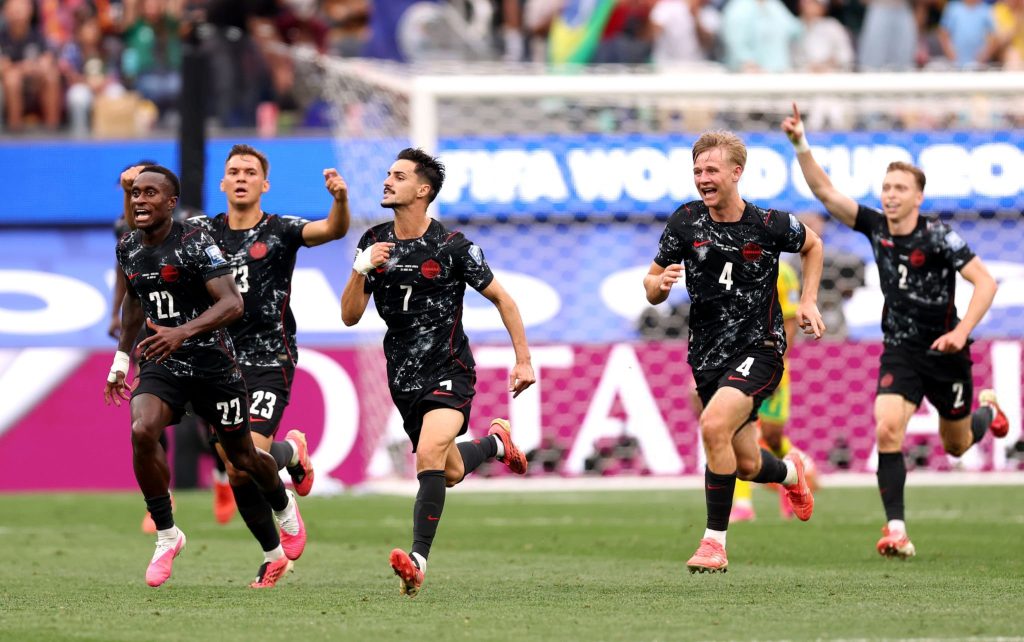
A run to the round of 16 changes the calculation.
“People want to support institutions and things that show promise,” Blue said. “The goal that Eustaquio scores has immense sporting value and competitive value. It has some direct value in terms of the prize money that you referenced, but this is far dwarfed by the immensity of the attention, the celebratory nature of it nationwide, and soccer’s continually escalating place in the consciousness of corporate Canada and philanthropic Canada, who want to see Canada succeed on sports’ biggest stage.“
Canada Rising Campaign — Key Details
| Metric | Figure |
|---|---|
| Fundraising target | $17.6m USD ($25m CAD) |
| Target completion date | End of 2027 |
| Purpose | Youth development, coaching infrastructure, programme investment |
| Impact of World Cup run | Increased donor interest; national profile raised |
Canada Soccer’s expectation is that philanthropic donations will ultimately deliver more financial benefit than the FIFA prize money itself — but that the prize money alone could not have created the conditions for those donations. The World Cup run is the proof of concept that makes the fundraising credible.
What Jesse Marsch Wants to Build
Jesse Marsch, who re-signed with Canada Soccer until 2030 before the tournament began, has been specific about where investment needs to go. His vision is not vague aspiration — it is a list of concrete infrastructure requirements.
“The biggest thing we’re dying for in this country is infrastructure for the youth national teams,” Marsch said. “We need a training centre, we need full-time youth coaches, we need full-time youth teams, and we need residencies to push the themes of what is necessary for the highest level of international football based on the identity of our players in our country.”
Marsch was candid about his motivation for re-signing before the tournament — a decision that attracted some scepticism at the time.

“I don’t need more money, I don’t need job security, I don’t need anything that the new contract offers me,” he said. “The reason I did it was because I think that we can continue to have a massive impact on the sport in the country.”
That belief looks considerably more credible following Canada’s round-of-16 appearance. And with it comes a clearer sense of urgency around the infrastructure gaps that have constrained the programme.
Canada Soccer’s Identified Infrastructure Needs
| Need | Current Status | Marsch’s Vision |
|---|---|---|
| National training centre | Does not exist | Central base for all national programmes |
| Full-time youth coaches | Limited | Full-time appointments across age groups |
| Full-time youth teams | Not in place | Residency programmes with top-down identity |
| Training methodology | Fragmented | Unified, coach-developed playing system |
For comparison, the US Soccer Federation officially opened the Arthur M. Blank National Training Center in Atlanta in May 2025 — a state-of-the-art facility designed to centralise all national team programmes and embed consistent playing identity from youth level upward. Canada does not yet have an equivalent.
The gap matters. Without a permanent base, national team programmes operate in a fragmented way — training camps assembled and disassembled, with no physical home that reinforces culture, methodology and continuity. The youth pipeline that produces the next generation of Canadian internationals is developing without the infrastructure that comparable footballing nations take for granted.
The National Training Centre: The Most Lasting Legacy
In June, Canada Soccer launched a formal request for proposals process for a future national training centre. The process is expected to conclude in the autumn, with the centre envisioned as a long-overdue permanent base for all national team programmes.
Blue described it as a significant priority — but also as one part of a broader professionalisation of the organisation that the World Cup run has accelerated.
“It’s a significant priority, but it’s part of the continued professionalization of the federation,” Blue said. “We are using the World Cup as a jumping-off point for further elevation of the business model, the sporting priorities.”
Marsch, for his part, is ready for the implementation phase.
“We already have ideas for residencies and billet programmes and we already have ideas of who can be our coaches and then how to implement the game at different levels from the men’s and women’s perspective,” Marsch said. “We already, I think, have a lot of the expertise, and now that we can have the financial backing as well, I think we can actually build something.”
The training centre would provide what Canada Soccer currently lacks: a physical and cultural anchor for every national team programme, from the youngest age groups to the senior men’s and women’s teams. Players developing through the youth system would absorb the same coaching philosophy, the same tactical identity and the same standards that the senior teams embody.
Whether it is built in Toronto, Vancouver, Ottawa or elsewhere remains to be determined through the proposals process. What is not in question is that it is the single most important infrastructure investment Canada Soccer can make.
Blue’s Turnaround: What the Organisation Looked Like Before
Blue was hired as Canada Soccer’s CEO in February 2024 — into an organisation that was struggling on almost every front simultaneously.
There were ongoing controversies about governance, treatment of the women’s national team, and the organisation’s relationship with its players. The financial picture was bleak. There was no permanent men’s national team head coach. The sport’s profile in Canada, despite the country’s enormous and genuinely diverse soccer-playing population, remained inconsistent.
The transformation since then has not been complete — building lasting institutional credibility takes longer than eighteen months — but the direction of travel has changed materially. The CBA with both players’ associations was signed. Marsch was hired and retained. The Canada Rising campaign was launched. The training centre process was initiated.
Blue deflects the personal credit.
“What I’m most satisfied by in terms of how this tournament has gone specifically,” Blue said, “is that it’s super rewarding for people that have been around this team and this sport for many, many, many years and have put their blood, sweat and tears into it.“
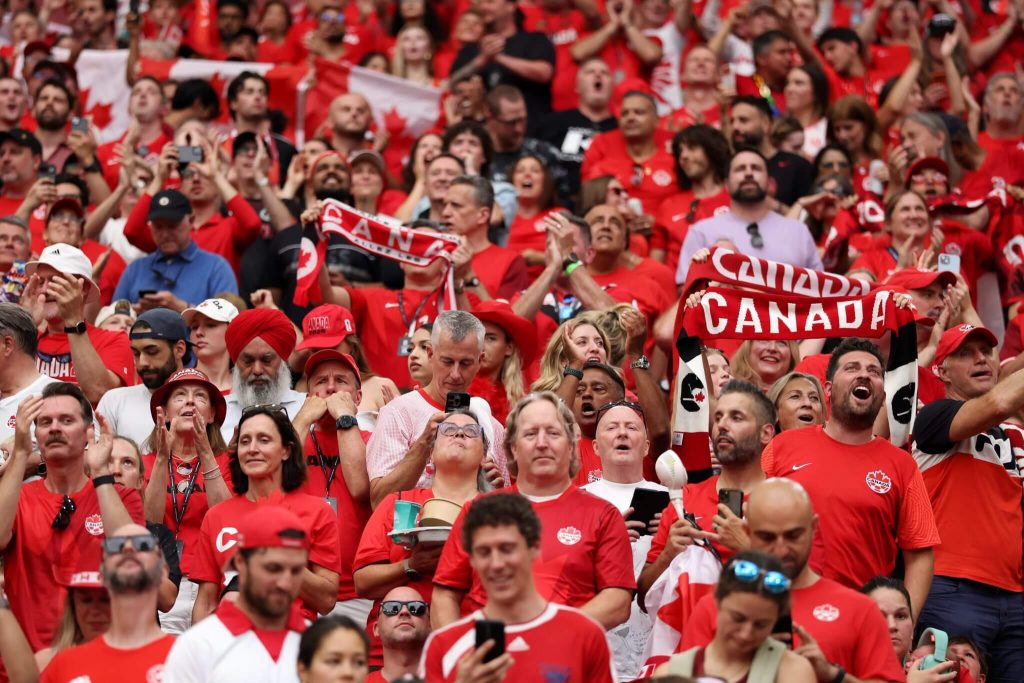
That is diplomatically said. The structural changes that made Canada Soccer ready to capitalise on a World Cup run required decisions and leadership at the top of the organisation. The prize money and the philanthropic opportunity it creates are available partly because the organisation rebuilt enough credibility to be worth investing in.
What This Run Has Already Changed
Canadian players have spoken throughout the tournament about their desire to change the sport in Canada through their performances. What they may not fully appreciate — and no player could be faulted for not wanting to leaf through the books — is that their performances are measurably doing exactly that.
Canada Soccer: Before and After the World Cup Run
| Metric | Pre-Tournament | After Round of 16 |
|---|---|---|
| World Cup prize money (prior runs) | Minimal — group-stage exits | $18.5m USD — first R16 appearance |
| Projected 2026 financial position | $4.61m CAD surplus | Further improved by prize money |
| Philanthropic campaign status | Ambitious target; uphill donor environment | World Cup visibility transforms credibility |
| National training centre | Proposal stage | Formal process launched; autumn conclusion expected |
| Men’s national team profile | Limited mainstream visibility | Eustaquio’s winner — nationwide celebration |
“We feel like there’s increased momentum and increased reach of how great our players are to support, how great the programs are, how important the youth national team programs are to support, and how important this sport is for the sporting culture in Canada,” Blue said.
The four-way hug after Eustaquio’s winner was not just a moment of sporting joy. It was the moment a small group of people realised that the work they had put into rebuilding an organisation was about to compound in ways they had hoped for but could not guarantee.
Whether Canada beat Morocco and advance further, whether the philanthropic campaign reaches its target, whether the training centre is built on schedule, whether the youth programmes produce the next generation of players capable of making deep World Cup runs routine — none of that is certain yet.
What is certain is that the run to the round of 16 has made all of it more possible than it was before Eustaquio scored in stoppage time.
Read More: How Jesse Marsch Must Solve Morocco’s Puzzle if Canada Are to Beat the Favourites