LIVEIndia tour of New Zealand 2026/27NZ180/5IND56/2 (8.3/20 ov, target 181)India require another 125 runs with 8 wickets and 11.3 overs remainingFixtures
LIVEIreland tour of Namibia 2026/27NAM156/2 (32/50 ov)IREIreland won the toss and elected to fieldFixtures
RESULTICC Men's T20 World Cup Sub Regional Africa Qualifier Group CMOZ19UGA23/0 (0.5/20 ov, target 20)Uganda won by 10 wickets (with 115 balls remaining)Fixtures
RESULTEnglish Premier LeagueIpswich1Nottm Forest1FTTableFixtures
LIVEIndia tour of New Zealand 2026/27NZ180/5IND56/2 (8.3/20 ov, target 181)India require another 125 runs with 8 wickets and 11.3 overs remainingFixtures
LIVEIreland tour of Namibia 2026/27NAM156/2 (32/50 ov)IREIreland won the toss and elected to fieldFixtures
LIVEAustralian Domestic One-Day CompetitionWANSW371/8 (50 ov)New South Wales won the toss and elected to batFixtures
LIVECWC Challenge League Group ADENKUWStarts at 09:45 local timeFixtures
LIVECWC Challenge League Group AKENYAQATStarts at 09:45 local timeFixtures
LIVECSA Women Pro50 Series 2026/27SWD-WEPR-WStarts at 10:00 local timeFixtures
LIVECSA Women Pro50 Series 2026/27TTN-WWPR-WStarts at 10:00 local timeFixtures
LIVEIndia A tour of New Zealand 2026/27NZ-A135/3 (41 ov)IND-A113New Zealand A lead by 22 runs with 7 wickets remaining in the 1st inningsFixtures
LIVENational Cricket LeagueDHARAJStarts at 09:30 local timeFixtures
LIVENational Cricket LeagueMYMSCHATTStarts at 09:30 local timeFixtures
LIVENational Cricket LeagueRANBARStarts at 09:30 local timeFixtures
LIVENational Cricket LeagueSYLKHUStarts at 09:30 local timeFixtures
UPCOMINGICC Men's T20 World Cup Sub Regional Africa Qualifier Group CGMBZMBFixtures
UPCOMINGICC Men's T20 World Cup Sub Regional Africa Qualifier Group CNGALESFixtures
UPCOMINGArgentina Women tour of Mexico 2026/27MEX-WARG-WFixtures
UPCOMINGArgentina Women tour of Mexico 2026/27MEX-WARG-WFixtures
UPCOMINGICC Men's Cricket World Cup League 2UAENEDFixtures
UPCOMINGZimbabwe Women tour of India 2026/27IND-WZIM-WFixtures
UPCOMINGICC Men's T20 World Cup Sub Regional Africa Qualifier Group CGMBLESFixtures
RESULTICC Men's T20 World Cup Sub Regional Africa Qualifier Group CMOZ19UGA23/0 (0.5/20 ov, target 20)Uganda won by 10 wickets (with 115 balls remaining)Fixtures
RESULTICC Men's T20 World Cup Sub Regional Africa Qualifier Group CGMB27UGA28/0 (1.4/20 ov, target 28)Uganda won by 10 wickets (with 110 balls remaining)Fixtures
RESULTUnited Arab Emirates Tri-Nation SeriesAFG170/3 (34.3/50 ov, target 170)ZIM169Afghanistan won by 7 wickets (with 93 balls remaining)Fixtures
RESULTICC Men's T20 World Cup Sub Regional Africa Qualifier Group CNGA94/3 (8.3/20 ov, target 94)MOZ93Nigeria won by 7 wickets (with 69 balls remaining)Fixtures
RESULTICC Men's T20 World Cup Sub Regional Africa Qualifier Group CLES58ZMB61/3 (7.4/20 ov, target 59)Zambia won by 7 wickets (with 74 balls remaining)Fixtures
RESULTZimbabwe Women tour of India 2026/27IND-W200/1 (27.1/50 ov, target 198)ZIM-W197IND Women won by 9 wickets (with 137 balls remaining)Fixtures
Why Spain Are the Hardest Team to Attack at the World Cup
One major byproduct of FIFA's expansion to a 48-team World Cup is that even the best sides can slip a little under the radar. Spain haven't been spoken about too…
One major byproduct of FIFA’s expansion to a 48-team World Cup is that even the best sides can slip a little under the radar.
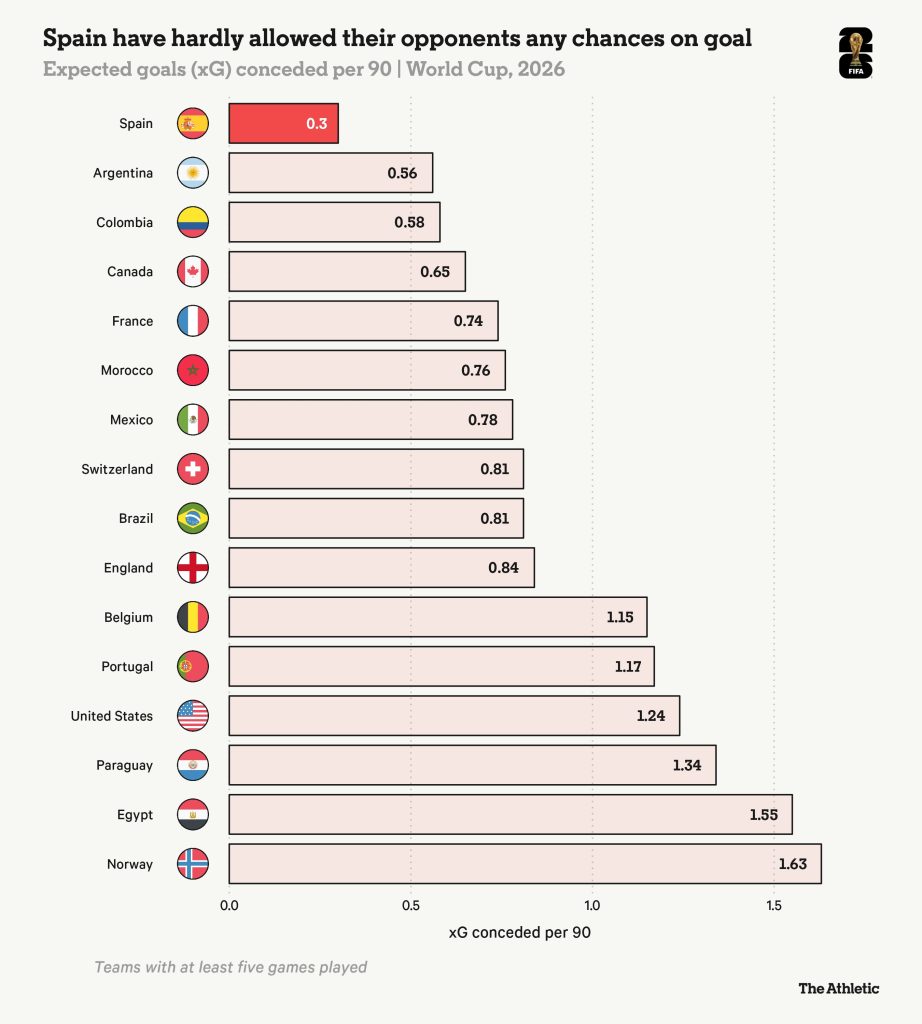
Spain haven’t been spoken about too much since their shock goalless draw against Cape Verde in their opening game. But suddenly, they find themselves in the last eight and look to be in ominous form — the only nation yet to concede a single goal at World Cup 2026. In fact, Spain hold the record for the longest time without conceding a World Cup goal: 609 minutes have now passed since they conceded to Japan in Qatar in 2022.
Their route to a quarter-final clash with Belgium hasn’t had the thrills and spills of some other contenders, but the clinical efficiency of Luis de la Fuente’s side has only become more evident as the competition has progressed.
The Numbers Behind the Defensive Dominance
Spain’s status as the best defensive team in the tournament is no fluke.
Defensive Metric
Spain’s Standing
xG conceded per game
Lowest of any team to reach the last 16
Touches allowed in penalty area
Fewest of any remaining team
Possession sequences against (average duration)
19.3 seconds — by far the shortest in the tournament
Final third ball regains
Most of any team in the tournament
Time spent in high block (out of possession)
10.4% — highest share of any nation
No country who made it through to the last 16 conceded fewer expected goals per game than Spain, while they also allowed the fewest touches in their own penalty area. They keep the ball away from their goal more effectively than any of the tournament’s remaining sides.
Possession as Protection
With teams who dominate the ball — like Spain — it can be easy to gloss over the discipline and focus required to keep the defensive structure so secure. Pablo Zabaleta, now part of FIFA’s Technical Study Group for the summer, knows exactly what it feels like to defend for a possession-heavy side, having spent nine years at Manchester City.
“Of course, dominating possession means that you can control the flow of the game and deny the opposition the chance to attack too often themselves. Especially in the final stages where you have to manage the intensity of games, they are so good at controlling things with the ball — it is part of their DNA.”
“But it is also part of their principle that by having so many players with short distances between each other when they pass the ball, it allows them to counter-press very quickly when they lose it. That is something that they work on from an early age in Spain, to make sure that players are switched on and in the right place to win the ball back the second they lose it.”
The Rest Defence: Structure During Attack
Against Saudi Arabia, the benefits of Spain’s secure rest defence — the structure they maintain during attacks — were clearly visible. They build down the left with a triangle of Pedri, Alex Baena and full-back Marc Cucurella. The two midfielders are positioned to apply instant pressure the moment a pass is cut out.
That rushed Musab Al-Juwayr into a quick pass forward. Spain immediately congregated and picked up the loose ball in the central channel, with four teammates surrounding Dani Olmo as he retrieved possession. It allowed Spain to sustain their territorial dominance — exhausting opponents who must repel wave after wave of attacks without a moment of respite.
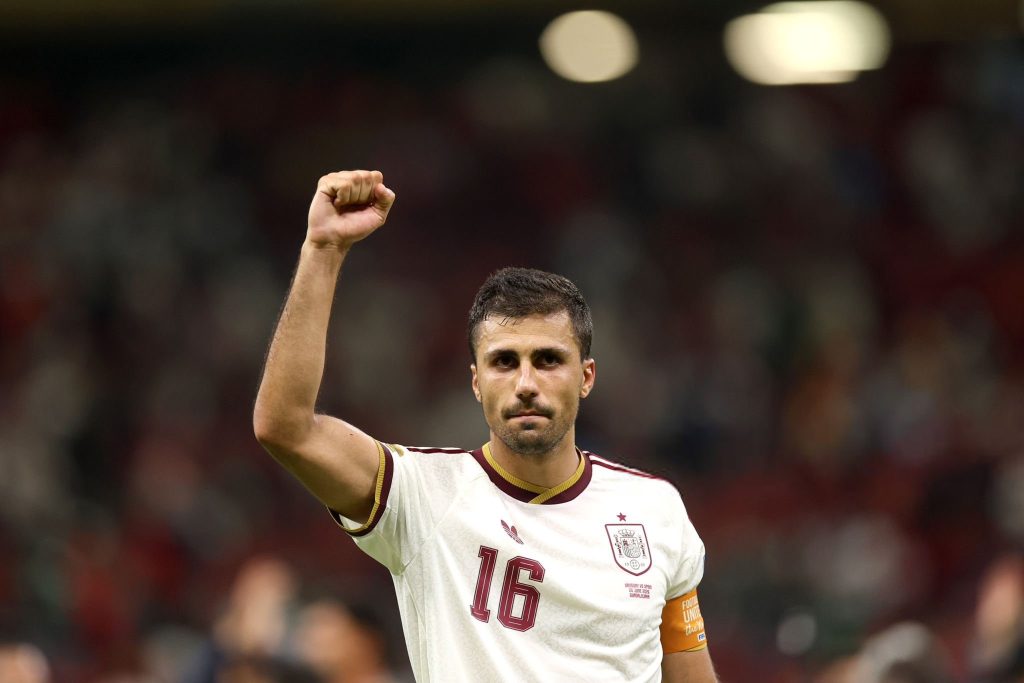
Against Austria in the knockout stage, as Lamine Yamal was tackled inside the box, Ralf Rangnick’s team attempted to spring a quick counter-attack. Rodri was immediately touch-tight to Marcel Sabitzer, regaining the ball within seconds. Again, Rodri had four players congregated around him as he looked up — counter-pressing collectively, hunting in packs, with distances always short. It allowed Spain to nick possession and attack again quickly, maintaining relentless pressure on the opposition back line.
Zabaleta reserves particular praise for Rodri’s role within the system:
“He can read the game really well — he always knows when to press. His positioning is always excellent to counter-press and win the ball back immediately. I’ve played in Spain and I’ve lived in Spain, and in every region of the country, they do exactly the same thing. They all know that those two or three seconds after losing the ball are crucial. That’s a huge advantage, because when they meet for the national team, everyone has grown up with those principles.”
Rodri
In a final example of this awareness, as a low cross was intercepted during their match with Portugal, Rodri appeared from nowhere to shoulder Bruno Fernandes off the ball as Portugal attempted to break — surrounded by teammates who effectively boxed the ball in.
Such commitment and organisation in their front-footed defending is reflected clearly in the numbers: no team have regained possession more often in the final third, while the average duration of opposition possession sequences — at just 19.3 seconds — is by far the shortest of any team at World Cup 2026.
The Role of the Centre-Backs
It is not only the forward players who need to be switched on for the counter-press. Centre-backs and full-backs must be prepared to step up — pushing teammates on and squeezing the space to give opponents as little time on the ball as possible.
Zabaleta is direct on this point:
“They are ready for that. Cubarsi does it almost every game for Barcelona with that high line they play. It is a risk. As a coach, you need to convince the players to do this, but Cubarsi has the personality to accept it. Laporte has a little more experience, but they are always very tight on the strikers and want to win those duels.”
Cubarsi and Laporte — Duel Statistics (Middle Third)
Detail
Duels won
24 of 31
Success rate
77.4%
Data source
FIFA Football Performance Insights enhanced dataset
Anticipation plays a huge part. Against Cape Verde, the two centre-backs were quick to drop and follow a run in behind — but Laporte quickly recovered, spotted the forward pass into midfield, and his interception kept Spain on the front foot.
Full-Backs Defending From the Inside
Though not as common with this Spain team, full-backs are also expected to drift inside and defend when required — something Zabaleta experienced directly under Pep Guardiola at Manchester City.
“I had one season with Pep at City where I was drifting into the half-spaces to push one of the No.8s a little higher. Obviously one reason was to create an extra body in midfield, but he would also say to me: ‘Pablo, I want the wingers to stay wide and the technical midfielders to play in those tight spaces. I need you in those central positions to avoid the counter-attacks, because you are a defender. I prefer full-backs to be inside there to counter-press quickly.'”
De la Fuente shares that philosophy. Left-back Cucurella frequently takes an aggressive position, jumping forward to track his opposite number into advanced areas. The dangers are clear.
“As a defender, this can be really hard — one ball in behind, and you have to run 40 yards back,” says Zabaleta. “But that’s a risk that the coach wants to take, and sometimes you get there, but on other occasions the opposition forward is really quick and will win that race.”
Out of Possession: Man-Marking and the High Block
On the rare occasions Spain allow their opponents the ball, their out-of-possession shape is predictably strong.
They will often force the ball onto a specific side of the pitch before man-marking each player and restricting passing options. Either they retrieve the ball high up the field to transition forward quickly, or force the opponent into a riskier long pass — before hoovering up possession and beginning a new wave of attack.
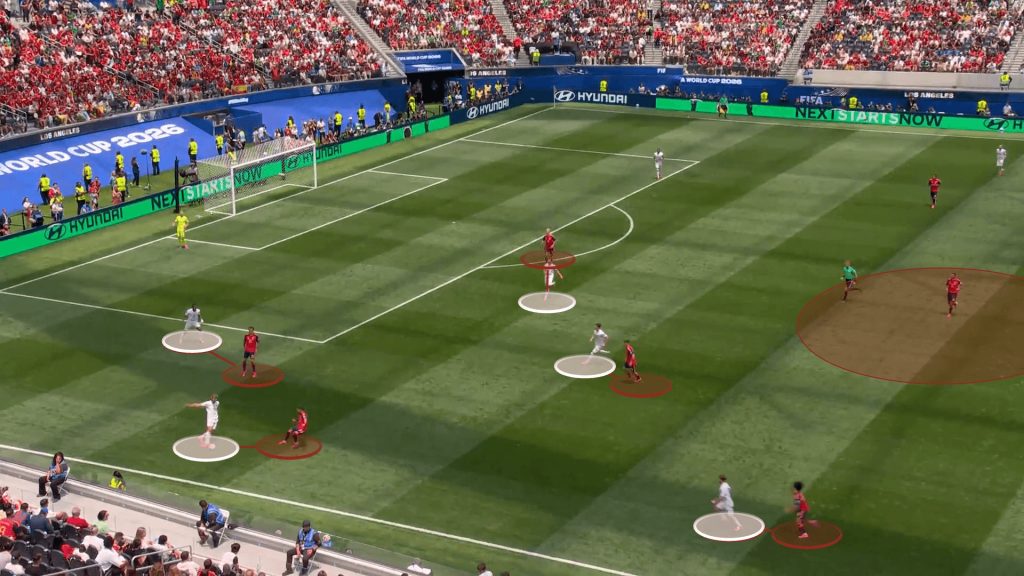
Against Austria, all ball-side Spain players were within two yards of their opposite number. Cucurella took an aggressively advanced position, tracking his man into forward areas. Rodri patrolled the central space, poised to jump in and support teammates or pick up second balls.
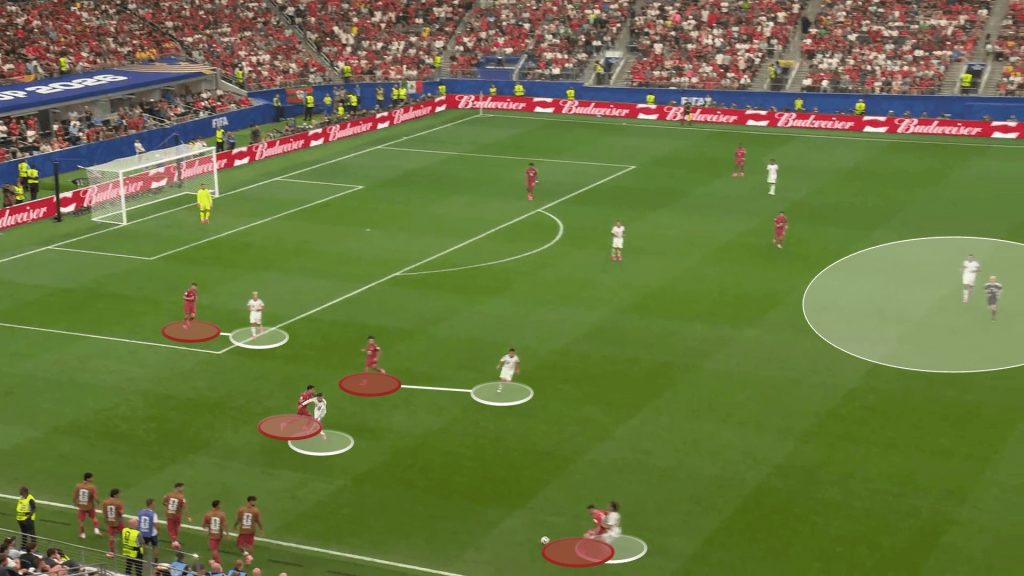
The near-identical pattern repeated itself in the last-16 clash with Portugal. Each ball-side player was closely marked, the opponent’s options were severely limited, and Rodri patrolled central space as extra cover.
Spain Out-of-Possession Metrics
Detail
High block usage
10.4% of out-of-possession time — highest in tournament
Design intent
Regaining ball in advanced areas is deliberate, not accidental
Rodri’s role
Central space cover — the shield behind the counter-press
Per FIFA’s dataset, 10.4% of Spain’s time out of possession has been spent in a high block — no nation has a larger share by that metric. Regaining the ball in advanced areas of the pitch is not down to fortune. It is by design.
The Risk Ahead: Mbappé and Belgium
Of course, the risks are real. Someone like Kylian Mbappé — who Spain could yet face — can exploit space in behind more effectively than most of the forwards they have faced to this point in the competition. The high defensive line that enables so much of Spain’s counter-pressing dynamism also leaves space that elite forwards can punish.
But Spain are a well-oiled machine. While it is easy to focus on their patient passing patterns and their technical ability with the ball, their intensity and coordination without it is unmatched at World Cup 2026.
609 minutes and counting. The record grows with every match — and right now, there is no sign of it stopping.
How long have Spain gone without conceding at World Cup 2026?
Spain have not conceded for 609 minutes of World Cup football — a record for the longest run without conceding in World Cup history, dating back to a goal conceded to Japan in Qatar in 2022.
What are Spain’s key defensive statistics at World Cup 2026?
Spain have conceded the fewest xG per game of any team to reach the last 16, allowed the fewest touches in their penalty area, lead the tournament in final third ball regains, and have the shortest average opposition possession sequence at just 19.3 seconds.
How do Spain’s centre-backs contribute to their defensive structure?
Cubarsi and Laporte have won 24 of 31 duels in the middle third — a 77.4% success rate — stepping in aggressively to intercept play and maintain Spain’s high defensive line and counter-pressing structure.
What role does Rodri play in Spain’s defensive system?
Rodri is the engine of Spain’s counter-press — always positioned to immediately pressure opponents after turnovers, shield the central space, and win the ball back within seconds of Spain losing possession.
What is Spain’s high block percentage and why does it matter?
Spain spend 10.4% of their out-of-possession time in a high block — the highest share of any nation at World Cup 2026. It reflects their deliberate strategy of winning the ball back in advanced areas rather than retreating and defending deep.
Follow us on Google NewsGet real-time updates & exclusive tech coverage

 NZ180/5
 IND56/2 (8.3/20 ov, target 181)
 NAM156/2 (32/50 ov)
 IRE
IRE AVL
AVL MNC
MNC RAY
RAY ELC
ELC GMB
GMB ZMB
ZMB NGA
NGA LES
LES CAG
CAG BOL
BOL COMO
COMO SAS
SAS FCA
FCA FCU
FCU KOE
KOE S04
S04 MOZ19
MOZ19 UGA23/0 (0.5/20 ov, target 20)
 Ipswich1
 Nottm Forest1
 Alavés1
 Málaga1
 Torino3
 Monza2
 WA
WA NSW371/8 (50 ov)
 DEN
DEN KUW
KUW KENYA
KENYA QAT
QAT SWD-W
SWD-W EPR-W
EPR-W TTN-W
TTN-W WPR-W
WPR-W NZ-A135/3 (41 ov)
 IND-A113
 DHA
DHA RAJ
RAJ MYMS
MYMS CHATT
CHATT RAN
RAN BAR
BAR SYL
SYL KHU
KHU MEX-W
MEX-W ARG-W
ARG-W UAE
UAE NED
NED PAK
PAK ENG
ENG IND-W
IND-W ZIM-W
ZIM-W AFG170/3 (34.3/50 ov, target 170)
 ZIM169
 CHE0
CHE0 DYI0
DYI0 CHO1
CHO1 QIN0
QIN0 HEN1
HEN1 BEI0
BEI0 LIA1
LIA1 ZHE0
ZHE0 QWC1
QWC1 YUN0
YUN0 SHX0
SHX0 Shanghai Shenh0
 TIG0
TIG0 SHP0
SHP0 WTT1
WTT1 SHT3
SHT3 M05
M05 SVW
SVW RBL
RBL ELV
ELV Brest1
 Nice2
Nice2 Stuttgart2
 Gladbach3
 Al Ahli4
 Al Khaleej1