Mohun Bagan
 Chennaiyin
 PSG
PSG Lyon
Lyon Sevilla
 Osasuna
 NED
NED OMA
OMA NZ
NZ IND
IND NAM
NAM IRE
IRE PAK
PAK SL
SL SA
SA AUS
AUS BAR1
BAR1 RMA2
RMA2 UDI0
UDI0 MIL2
MIL2 RSO2
RSO2 LEV1
LEV1 LEC0
LEC0 JUV2
JUV2 BRB61/3 (8/15 ov)
 MOW
MOW NZ-A317
 IND-A113 & 245/4 (68.5 ov)
 SYL280/2 (84 ov)
 KHU
KHU MYMS465/7d
 CHATT134/2 (40 ov)
 DHA521
 RAJ103/6 (26 ov)
 RAN402
 BAR179/3 (56.1 ov)
 LUL
LUL SPR
SPR TOK
TOK MIS
MIS MEX-W51 (12.5/20 ov, target 187)
 ARG-W186/7
 NGA148
 UGA147/9 (20 ov, target 149)
 GMB112/9
 LES109 (19.5/20 ov, target 113)
 MOZ110/7 (19/20 ov, target 110)
 ZMB109/9
 IND-W328/6
 ZIM-W207 (48.5/50 ov, target 329)
 ENG241
 Abha
Abha Al Faisaly
 LAFC
LAFC LA
LA Neftchi Fergana
 Al Ittihad
 Besiktas
 Istanbul BB
 Caykur Rizespor
 Trabzonspor
 SUN0
SUN0 LEE0
LEE0 SCF1
SCF1 MUN3
MUN3
Virat Kohli wasn’t ready to celebrate. RCB needed just ten more runs to win the IPL 2026 title. More than 90,000 people at the Narendra Modi Stadium were already convinced. The big screen was flashing images from last year’s title-winning journey. The crowd had merged into a deafening chorus of “Aar-cee-bee, Aar-cee-bee.” And then — as they always do — they shifted to “Kohli, Kohli.”
He didn’t flinch. He kept pumping himself. There was still work to do.
Two balls later came the anxiety: a lofted length ball toward a diving Shubman Gill at mid-off. Nobody could tell if it had carried — not Gill, and certainly not umpire Nitin Menon. The third umpire was summoned. What followed was an eternity of silence before the verdict: not out. The roar that erupted was louder than anything that had come before.
Kohli punched the air. Glanced briefly at the sky. Then immediately turned to Jitesh Sharma for a quiet word. Nine runs still to get. The game face stayed on.
“It’s stuff that you dream of,” Kohli said on the broadcast afterwards. “I’ve thought of this moment many times… that once when we win the IPL, I should be standing there hitting the winning runs. Tonight, it was possible.”
He signed off with a six. In his 19th IPL season.
The Weight of 19 Seasons
Not many players on the field on Sunday night could have understood the fragility of IPL finals the way Kohli does.
He had been there in 2009 and 2011 as a youngster — experiencing the heartbreak of watching the trophy go elsewhere with the rawness of someone not yet central enough to carry the blame or the burden. By 2016, everything was different. He was RCB’s defining figure, the axis around which the entire team revolved. He produced arguably the greatest individual batting season in IPL history. It was not enough. The trophy went to Sunrisers Hyderabad.
Last year’s title had finally ended the wait. But Kohli knew that moments like Sunday night — the chance to finish a final on his own terms, bat to the end, hit the winning runs — were never guaranteed. Finals can be lost in a single over. Partnerships can dissolve unexpectedly. The game can turn.
This is why, when he said “it’s stuff that you dream of,” the words carried the particular weight of someone who has been close enough to the dream to almost touch it, and learned exactly how quickly it can slip away.
Before the Chase: The Huddle
The game face was on long before RCB took the field.
When the team gathered for their pre-match huddle, Kohli dropped to one knee at the centre and delivered an animated message. Nobody outside that circle knows what was said. The intensity of his actions left little room for ambiguity about its nature. This was a man who had been carrying this moment in his mind for a long time, and who wanted every single player around him to feel the same weight and urgency.
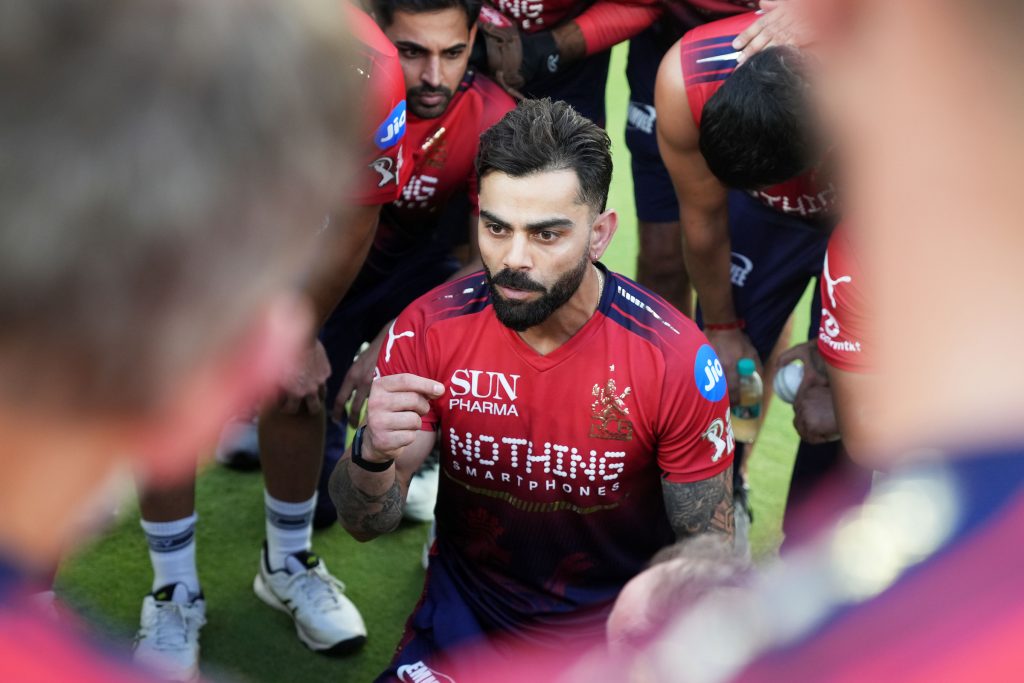
Throughout GT’s innings, he was everywhere. When wickets fell, he celebrated with his characteristic fist-pumping energy — never more vociferous than when Gill was dismissed early. He urged the fast bowlers constantly to hit the deck hard — a tactical instruction that Dinesh Karthik later revealed had been central to RCB’s game plan following their assessment of the surface. Field placements, encouragement, celebrations, conversations — Kohli was in the centre of every camera frame.
At the best of times, he can be this intense. With 90,000 voices singing to his tune, the question of which was really the home team seemed genuinely open. His presence at the Narendra Modi Stadium had always felt larger than circumstance.
The Chase: Kohli 2.0 in Full Flow
When RCB came out to bat, needing 156, the approach was immediately clear. This was not a chase to manage carefully or take deep. This was a chase to attack from the first ball.
Kohli was off the blocks instantly. A gorgeous whip off Kagiso Rabada in the fourth over — the ball soaring over midwicket for six — was the high point of an over where almost every shot seemed equally good. He had clearly identified that the pitch was not a featherbed. Deliveries were holding in the surface, making timing more difficult and aggressive intent more necessary.
He communicated that assessment immediately to his opening partner, Venkatesh Iyer.
“I just told him one thing: we need to kill the game in the powerplay,” Kohli said. “And he said, ‘yeah, let’s go’. There was total clarity.”
| Kohli’s IPL Final Innings | Figure |
|---|---|
| Season | IPL 2026 (his 19th IPL season) |
| Fifty | His fastest IPL fifty |
| Winning shot | Six over long-on |
| Key partnership | With Venkatesh Iyer (powerplay) |
| Final act | Hit the winning runs |
There may have been a time — perhaps even two or three years ago — when Kohli would have approached a middling chase of 156 differently. But over the past two seasons, he has spoken repeatedly and openly about the need to evolve alongside the younger generation of IPL batters.
“You see these super young players pushing you all the time and really asking you to change your game and up the ante,” he said. “It’s an exciting situation because it gives you something to improve on, something to work towards.”
The adjustments, he has acknowledged, were as much mental as technical. “It was just the demands of today’s modern game where you need to get those 20-30 extra runs. I had to kind of change my mindset, not my game so much, but more often take the bowlers on, probably the best bowlers in the opposition. That was always my target.”
This reinvention — from a player who accumulated carefully and accelerated late, to one who attacks from the powerplay on surfaces that demand it — has been one of the defining stories of Kohli’s most recent IPL seasons. Sunday’s innings was the fullest expression of it.
The Fastest Fifty and the Refusal to Let Go
Reading situations, understanding pressure, and maintaining control of a contest have always been among Kohli’s greatest strengths. On a two-paced surface where allowing the contest to drift could have boomeranged badly, he stayed ahead of the game from the first over to the last.
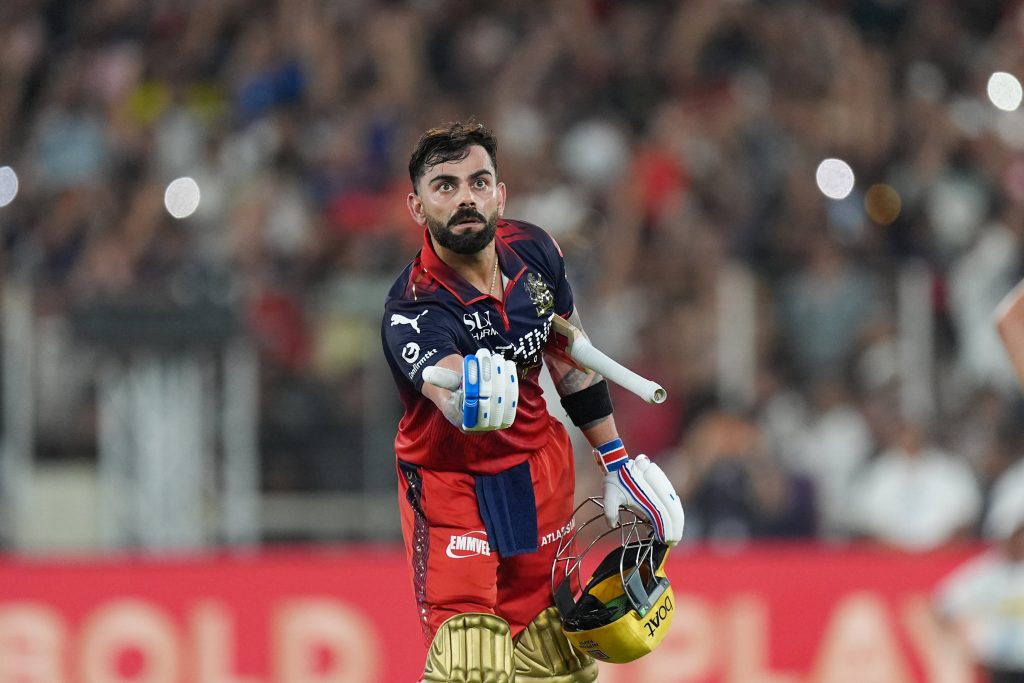
His fastest IPL fifty — achieved in his 19th season — was the product of this clarity of purpose. The innings never lost its urgency. Even when RCB were comfortably placed, the intent did not diminish. He had no interest in taking the game deep, no interest in watching someone else finish it.
It wasn’t until a flat-batted pull reduced the equation to just one run needed that the result began to feel inevitable to him. And it was only after the ball disappeared into the stands for the winning runs — a six over long-on, as he had imagined — that the tension finally left him. The intensity that had defined the entire evening dimmed. The smile widened. His teammates streamed onto the field.
The Champion Team That Freed Him to Play
Collecting the Player-of-the-Match award, Kohli reflected on what this RCB side has come to mean to him — and what it has changed about how he plays.
“Even tonight, I was very confident that even if I got out early, we have a champion team that’s going to finish the job.”
This was a striking statement from a player who spent much of his IPL career as the solitary pillar of RCB’s batting, carrying the burden alongside AB de Villiers and Chris Gayle while the rest of the lineup was noticeably thinner. The franchise’s identity for years was built almost entirely on the power of its star trio. When they succeeded, RCB competed. When they didn’t, RCB collapsed.
This version of the team — assembled by Andy Flower, Mo Bobat, and Dinesh Karthik — has given Kohli something he never had in his earlier RCB years: collective confidence. The assurance that the team extends beyond any one individual, however brilliant.
“When you have that kind of confidence, you can go out there and really take the bowlers on,” he said. “That’s credit to the management, the way they stacked up the squad, the talent of the players, the belief that the players have shown. That’s why we stand here as champions back-to-back.”
The Six, the Dream, and What Tendulkar Felt That Night
Fifteen years ago, after India won the Cricket World Cup at the Wankhede Stadium in Mumbai, Kohli delivered one of the most iconic lines in Indian cricket: that the team had carried Sachin Tendulkar on their shoulders that night, and that it was the least they could do after he had carried the country for 21 years.
After 19 seasons of carrying RCB through its highest highs and most painful lows — after the 2016 final, after the three consecutive years without a title, after watching others lift the trophy year after year — Kohli may now have some real understanding of what Tendulkar felt that night in Mumbai.
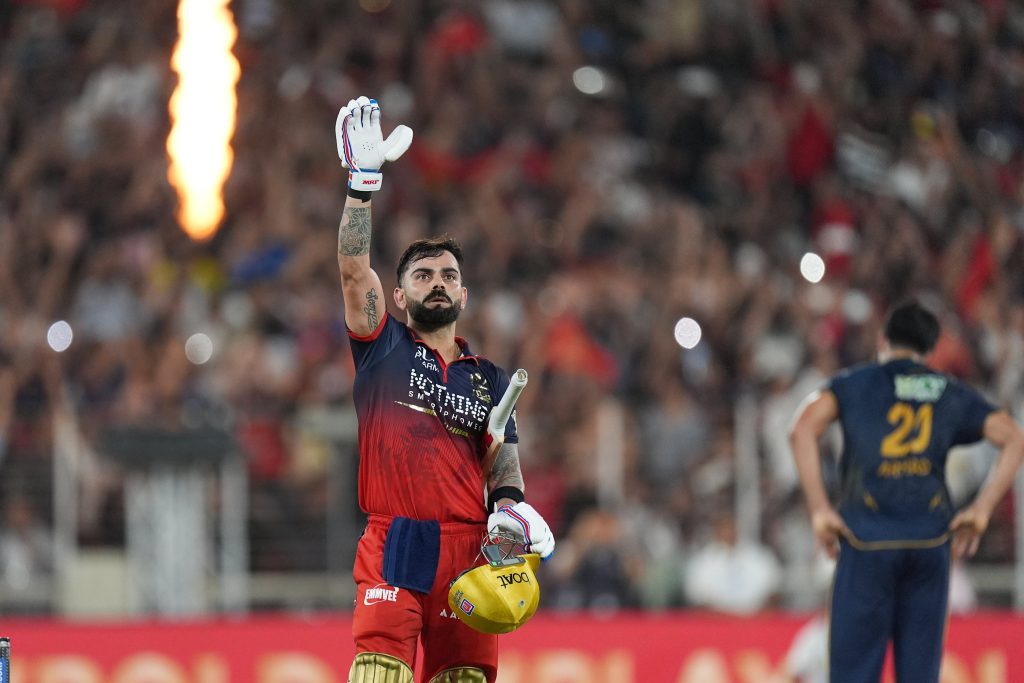
He got the ending he had imagined for years. A six over long-on. The winning runs. Standing in the middle, bat raised, while RCB celebrated around him.
For much of the evening, he had refused to give time to the dream. He had to stay focused. The work had to be done first. And only when it was done — when the six cleared the boundary and the title was secure — could he finally let himself feel it.
Read More: How RCB Turned GT’s Biggest Strength Into Their Greatest Weakness in IPL 2026 Final