LAZ2
 PAR1
 RCL2
 PAR1
 MEX-W
 ARG-W
 ATM1
 DEP0
 ADO2
 HEE3
 CLB2
 TOR0
 GVFC0
 FCP0
 Internacional2
 Botafogo0
 UAE
 NED
 PAK
 ENG
 IND-W
 ZIM-W
 GMB
 LES
 MOZ
 ZMB
 Inter Milan
 Fiorentina
 Churchill
 Punjab FC
 NGA
 UGA
 RIY2
 TAA1
 CHE0
 TOT2
 VAL1
 VIL2
 DOR1
 SGE0
 NZ-A135/3 (41 ov)
 IND-A113
 SYL
 KHU
 MYMS299/4 (87 ov)
 CHATT
 DHA293/3 (84.1 ov)
 RAJ
 RAN320/5 (80 ov)
 BAR
 DEN
 PNG
 NAM321/6
 IRE290 (47.3/50 ov, target 322)
 NZ180/5
 IND181/6 (19.5/20 ov, target 181)
 Mirassol1
 São Paulo1
 Vitória1
 Athletico-PR1
 Athletic
 Getafe
 C Palace
 Newcastle
 Hull
 Brentford
 Liverpool
 Brighton
 Man United
 Bournemouth
 Atalanta
 Frosinone
 NAP3
 ROMA3
 KHO0
 ETT3
The claim that “tinyfish makes search free” reportedly puts TinyFish’s web-reading agent in focus on Monday, October 19, 2026. TinyFish builds web-infrastructure tools for AI agents. Neither the announcement date nor the claim that web reading costs nothing has been confirmed.
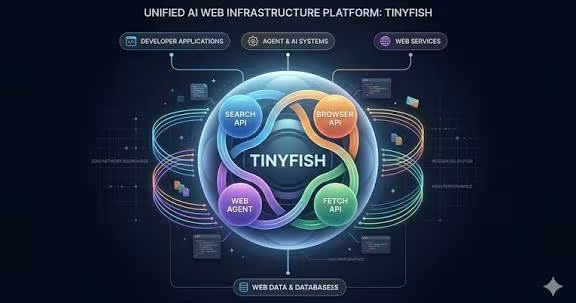
The October 19 claim: TinyFish makes search free
The promise covers the cost of retrieving web pages, not every expense involved in using an AI agent. That distinction matters: agents may incur charges both when they fetch information and when a model processes it.
Marktechpost’s report on TinyFish describes a service with no retrieval charge within stated rate limits. But that doesn’t make every task free. The service still sends retrieved content to a model, where processing pages, reasoning and generating answers can incur costs.
TinyFish Search scored 71 in a September 28 snapshot
TinyFish’s reported web-native model is built for search, retrieval and interaction with live websites. The company runs it on its own infrastructure, while a cloud browser fleet renders pages and handles interactions. Users can access the service through REST (Representational State Transfer), Python and TypeScript software development kits (SDKs), a command-line interface or the Model Context Protocol (MCP). They don’t need local GPU hardware.
A September 28, 2026 snapshot from the Artificial Analysis Search API leaderboard gave TinyFish Search (web) a score of 71. The snapshot listed a cost of $9.30 per 1,000 benchmark tasks and an average task time of 59 seconds, including model and search time. These figures reflect the benchmark’s measured cost and speed; they don’t guarantee the same result for every customer task. The free retrieval allowance also comes with limits. Search allows 30 requests per minute and 500 per hour, while Fetch allows 150 URLs per minute and 1,000 per day. Teams that exceed those limits can’t assume the zero-charge retrieval claim still applies.
Why free retrieval does not mean free AI
An agent’s web-reading bill has two distinct layers. One is the fee for search or fetch requests; the other is the model’s token use when it reads retrieved material and produces an answer. Reducing the first can help, but long pages and multi-step tasks can still drive up model-processing costs.
This is the cost distinction buyers should track when comparing agent platforms. A free request doesn’t always mean a cheap answer, especially if a workflow pulls in lots of text or repeats model processing. TinyFish’s approach focuses more on infrastructure and retrieval economics, while teams still need to measure their own model workloads.
The product also shifts some operational complexity away from customers. TinyFish manages the model infrastructure and browser fleet, so teams don’t need to provide a local GPU for this service. That may ease setup, but it doesn’t establish the total cost of an agent workflow.
Free retrieval shifts attention to total task costs
The next practical test is whether the free allowance suits real workloads and how token use affects the total bill. Teams should weigh retrieval limits, task duration and model-processing charges together—not treat a zero-dollar search request as a zero-cost agent. That distinction may shape how businesses assess expenses: The search request may cost nothing; the agent’s work still has a meter.
FAQs
Does TinyFish make all AI agent usage free?
No. The reported offer removes retrieval charges within stated limits, but model processing and generated responses can still use tokens.
What are TinyFish Search’s reported rate limits?
Search allows 30 requests per minute and 500 per hour. Fetch allows 150 URLs per minute and 1,000 per day.
Does TinyFish require a local GPU?
No local GPU is required for the described service. It runs on TinyFish-managed infrastructure and uses a cloud browser fleet.
What does the $9.30 figure measure?
The figure is the listed cost per 1,000 benchmark tasks in the September 28, 2026 Artificial Analysis snapshot. It isn’t a universal rate. Closing takeaway: Free retrieval could reduce one part of agent costs, but businesses still need to measure the model work behind each answer. Source: Marktechpost
Was this article helpful?
Your feedback directly improves future articles on this site.