Netflix released over 125 movies in 2025, and while the streaming giant delivered several gems, not every swing connected. From the $300 million Russo Brothers misfire to rom-coms that forgot to be funny, these five films represent the year’s most regrettable viewing experiences. Whether you’re curious about what to avoid or fascinated by cinematic train wrecks, here’s your definitive guide to 2025’s biggest Netflix disappointments.
The Bottom Five: What Went Wrong
| Rank | Title | Genre | Budget | Key Issue | Runtime |
|---|---|---|---|---|---|
| 5 | The Electric State | Action/Sci-Fi | ~$300M | Shallow storytelling, contradictory themes | 220 min |
| 4 | The Life List | Rom-Com/Drama | Unknown | Bloated runtime, cringey humor | 123 min |
| 3 | Demon City | Action/Crime | Unknown | Poor pacing, forgettable characters | 106 min |
| 2 | Brick | Sci-Fi/Thriller | Unknown | Weak execution, forced metaphors | 100 min |
| 1 | Kinda Pregnant | Comedy/Drama | Unknown | Lack of chemistry, tone problems | 97 min |
Source: What’s On Netflix
5. The Electric State: When $300 Million Can’t Buy Coherence
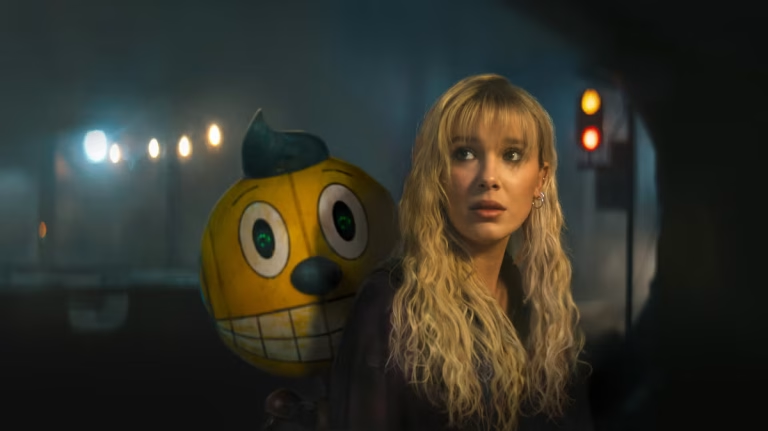
The Russo Brothers’ post-Avengers return to filmmaking became one of 2025’s most expensive disappointments. Starring Chris Pratt and Millie Bobby Brown in an alternate 1990s where robots lost a civil rights war, The Electric State promised Amblin-style adventure with cutting-edge visual effects. What audiences received instead was tech word salad wrapped in nostalgic packaging.

Set in a world where humans use Neurocasters—neural links connecting consciousness to robotic drones—to work and play simultaneously, the film follows orphaned teen Michelle (Brown) as she teams with smuggler Keats (Pratt) to find her supposedly deceased brother whose consciousness inhabits a cartoon robot.
Why It Failed: The film’s fundamental problem lies in its identity crisis. Adapted from Simon Stålenhag’s bleak graphic novel, the Russos opted for crowd-pleasing spectacle over substantive commentary. Every moment that could explore AI ethics, technological dependence, or robot rights pulls back into shallow nostalgia. The runtime of 220 minutes compounds these issues—nearly four hours of contradictory messaging that can’t decide if technology liberates or enslaves humanity.
Critics noted the irony: a film warning against distraction became an exercise in empty spectacle. The New York Times called it “obvious, garish and just plain dumb,” while audiences questioned how a $300 million budget couldn’t secure a coherent script.
Explore more movie reviews and streaming recommendations on our entertainment hub.
4. The Life List: Sofia Carson’s Bloated Rom-Com Misfire
Sofia Carson’s return to leading roles after seven years stumbled with this inheritance-driven romantic comedy about a woman forced to complete her teenage bucket list. The premise—complete 13-year-old Alex’s life goals to receive her late mother’s inheritance—promised heartfelt exploration of grief and self-discovery. Instead, viewers endured 123 minutes of meaningless tasks and forced romance.
The Setup: After her mother’s cancer returns and she refuses treatment, Alex (Carson) discovers she can’t inherit her mother’s cosmetics empire unless she completes the “Life List” she created at 13. Tasks include learning piano, doing stand-up comedy (despite having zero comedic ability), getting a tattoo, and finding true love—all within one year.
Critical Flaws: The film struggles to justify its protagonist’s journey. Alex abandoned teaching for her mother’s company, but the movie provides zero backstory explaining this career pivot or why teaching mattered. Her 30-year friendship with Kate (Jillian Bell) feels underdeveloped despite being supposedly central to her identity. The romance with Will Forte’s character lacks chemistry entirely—their interactions remain awkward even after months together.
Most damagingly, the Life List itself makes no sense for Alex’s character. Why would a future teacher prioritize stand-up comedy or reading Moby Dick? These feel like screenplay obligations rather than meaningful self-discovery milestones. The film’s message about finding yourself gets lost in contrived plot mechanics and a protagonist who gains relationships through deception without facing consequences.
For more Netflix original analysis and film critiques, visit our streaming section.

3. Demon City: Style Over Substance in This Manga Adaptation
Based on Masamichi Kawabe’s manga “Oni Goroshi,” Demon City promised gun-fu action and stylish revenge thrills. Hitman Shuhei Sakata (Toma Ikuta) completes one final job eliminating the Kono-gumi Yakuza gang, only to have the mysterious demon-masked Kimen-gumi organization murder his family and leave him for dead.
After years in a coma followed by a vegetative state, Sakata miraculously recovers when attacked again—his body responding to adrenaline by snapping back to full assassin capabilities. Now free and focused solely on revenge against the Kimen-gumi, Sakata embarks on a blood-soaked quest for justice.
What Went Wrong: Despite featuring Tomoyasu Hotei’s rock guitar soundtrack (Kill Bill Vol. 1, Samurai Fiction) and demon-masked villains perfect for viral clips, Demon City collapses between action sequences. The pacing drags painfully whenever gunfights end, sapping momentum completely. The central villain barely appears and offers bland motivations for his criminal empire.
Most problematically, we learn almost nothing about Sakata beyond “hired gun who had family.” His miraculous recovery from vegetative state receives no explanation, his relationship with his murdered family gets minimal development, and his motivations never deepen beyond simple revenge. The film works as a collection of Internet-ready fight clips but fails as cohesive cinema.
2. Brick: Psychological Sci-Fi That Crumbles Under Its Own Weight
German thriller Brick reunited Army of Thieves stars Matthias Schweighöfer and Ruby O. Fee as Tim and Olivia, a couple whose struggling relationship becomes the least of their problems when their apartment seals itself with mysterious brick-like structures. All doors, windows, and exterior walls become impenetrable, trapping them with no communication or explanation.
As they break through walls to neighboring apartments, gathering help while searching for escape routes, the film attempts to blend science fiction mystery with psychological drama about emotional barriers. The metaphor becomes painfully obvious: Tim built emotional walls, now he must break through literal walls to escape.
Critical Issues: The poorly executed genre blend satisfies nobody. The science fiction mystery gets solved by a dead man’s video message rather than clever deduction. The psychological drama consists of forced trauma bonding between shallow characters who don’t deserve extended backstories. The thriller elements arrive too late and get constantly derailed by heavy-handed philosophical musings.
The film’s message remains muddled throughout. Should we trust technology or surveillance? Believe experts or conspiracy theorists? The movie can’t commit to answers, leaving audiences confused about its purpose beyond labored metaphor.
Check out more sci-fi reviews and genre film analysis on our entertainment page.

1. Kinda Pregnant: Amy Schumer’s Chemistry-Free Disaster
Taking the top spot as 2025’s worst Netflix movie, Kinda Pregnant represents a perfect storm of tonal inconsistency, forced humor, and complete lack of romantic chemistry. Amy Schumer’s first leading role in seven years follows Lainy, a 40-year-old woman desperate for motherhood who fakes pregnancy with a sympathy bump to receive the positive attention pregnant women attract.
The Premise Falls Apart: After her four-year relationship ends and best friend Kate (Jillian Bell) announces her pregnancy, Lainy straps on a fake baby bump and ventures into the world as a “pregnant” woman. She befriends actual pregnant women, starts dating Dan (Will Forte), and watches her lie snowball beyond control.
Frequently Asked Questions
Why did The Electric State fail despite its massive $300 million budget and A-list talent?
The Electric State’s failure demonstrates that money and star power cannot compensate for fundamental storytelling problems. Despite the Russo Brothers’ MCU success, Chris Pratt and Millie Bobby Brown’s marquee appeal, and adaptation of a critically acclaimed graphic novel, the film suffers from severe identity crisis. The source material’s dark, philosophical dystopia got transformed into shallow Amblin-style adventure with nostalgia bait—Mr. Peanut robots and 1990s pop culture references—replacing meaningful commentary about AI, technology dependence, and robot rights. Every time the narrative approaches substantive themes, it retreats into sentimentality and spectacle.
The 220-minute runtime compounds these issues, stretching thin material across nearly four hours without deepening characters or themes. Audiences in 2025 exist in a world grappling with actual AI concerns, Metaverse debates, and tech billionaire influence—making the film’s refusal to engage seriously with these topics particularly frustrating. The contradiction extends even to the soundtrack, with “Yoshimi Battles The Pink Robots” ironically celebrating killing robots after the film attempts pro-robot messaging.