LAZ2
 PAR1
 RCL2
 PAR1
 MEX-W
 ARG-W
 ATM1
 DEP0
 ADO2
 HEE3
 CLB2
 TOR0
 GVFC0
 FCP0
 Internacional2
 Botafogo0
 UAE
 NED
 PAK
 ENG
 IND-W
 ZIM-W
 GMB
 LES
 MOZ
 ZMB
 Inter Milan
 Fiorentina
 Churchill
 Punjab FC
 NGA
 UGA
 RIY2
 TAA1
 CHE0
 TOT2
 VAL1
 VIL2
 DOR1
 SGE0
 NZ-A135/3 (41 ov)
 IND-A113
 SYL
 KHU
 MYMS299/4 (87 ov)
 CHATT
 DHA293/3 (84.1 ov)
 RAJ
 RAN320/5 (80 ov)
 BAR
 DEN
 PNG
 NAM321/6
 IRE290 (47.3/50 ov, target 322)
 NZ180/5
 IND181/6 (19.5/20 ov, target 181)
 Mirassol1
 São Paulo1
 Vitória1
 Athletico-PR1
 Athletic
 Getafe
 C Palace
 Newcastle
 Hull
 Brentford
 Liverpool
 Brighton
 Man United
 Bournemouth
 Atalanta
 Frosinone
 NAP3
 ROMA3
 KHO0
 ETT3
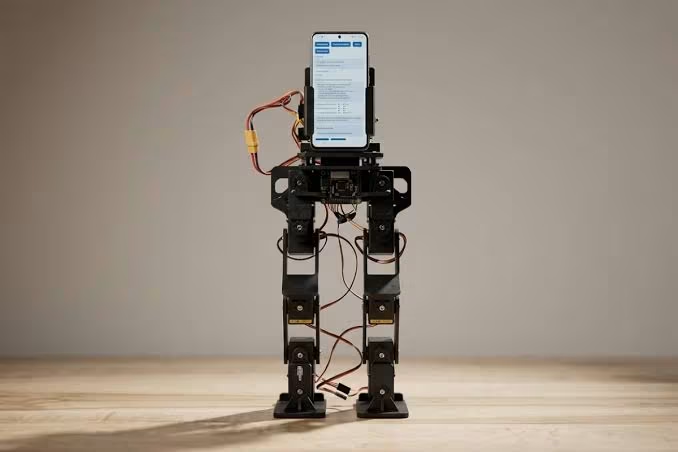
The PhoneBot humanoid robot shows that complex robotics doesn’t require a billion-dollar research lab. It’s reportedly a compact machine that turns discarded mobile devices into autonomous walking platforms. ucla researchers reportedly announced the open-source project on Monday, October 19, 2026, demonstrating how accessible technology can replace expensive custom electronics. Exact manufacturing costs remain unconfirmed, but the core idea relies on readily available technology.
Why Expensive Custom Hardware Held Back Bipedal Robots
For years, building a working bipedal machine meant hiring specialized engineers and making a major capital investment. Hobbyists and independent developers ran into steep barriers when they tried to build walking robots from scratch. Dedicated onboard computers, high-end depth sensors, and custom motion-tracking systems quickly pushed budgets beyond reasonable limits.
Most accessible kits stopped at wheeled chassis or static robotic arms because dynamic balance required more processing power than consumer-grade budgets could support. As our earlier coverage of the Humanoid Robot: Brain highlighted, stability calculations alone usually push costs into enterprise pricing tiers. Manufacturers assumed that anyone building a walking bot needed industrial-grade components. That belief held back grassroots innovation across the maker community.
The PhoneBot Humanoid Robot’s Smartphone-Based Design
Here’s the thing: the ucla team reportedly saw that modern mobile devices already contain components useful for locomotion. The reported platform mounts a standard Android smartphone on the upper chassis, where it serves as the central processing unit. Its integrated camera array handles visual mapping and object tracking, with no need for external lenses.
The built-in inertial measurement unit (IMU) sends gyroscopic data to the control algorithms, helping the machine adjust its center of gravity in real time. Rather than buy separate microcontrollers for motor management, the researchers routed wireless commands from the mobile operating system. The smartphone costs $50, making the computing node potentially free for anyone recycling their own device; the platform is designed for makers exploring gait mechanics without proprietary software ecosystems.
PhoneBot’s Reported $400 Open-Source Build
Breaking Down the Mechanical Architecture
The physical build favors lightweight durability over raw strength. It measures 483 millimeters tall and weighs 1.8 kilograms. Thirteen precision servo motors drive the legs and rotating torso during movement sequences.
With the mobile processor handling the heavy mathematical work, an auxiliary computer focuses on sending low-latency signals to the joints. This division of labor is meant to support smooth transitions between standing and walking.
| Component | Traditional Robot Build | PhoneBot Architecture |
|---|---|---|
| Processing Core | Dedicated Industrial PC | Recycled Android Smartphone |
| Vision System | External Depth Cameras | Integrated Mobile Camera Array |
| Motion Tracking | Custom IMU Modules | Built-in Gyroscope and Accelerometer |
| Total Hardware Cost | over $2,000 | approximately $400 |
PhoneBot’s Open-Source Approach Could Lower Barriers
That said, PhoneBot could signal a shift toward making physical artificial intelligence more accessible. Independent creators may be able to prototype bipedal machines without venture capital. The project’s open-source design could encourage global collaboration, with researchers sharing gait-optimization scripts.
If you want to experiment with computer vision for locomotion, this recycled setup could offer an affordable starting point. Academic teams studying energy-efficient robotics could also use its existing mobile silicon to gather data on sustainable hardware lifecycles. Similar platforms may emerge as major chipmakers see the potential of refurbished electronics in educational robotics. PhoneBot turns discarded mobile tech into a walking lab, giving everyday creators tools to explore dynamic balance. Source: Techradar
FAQs
What is the PhoneBot humanoid robot?
PhoneBot is an open-source bipedal machine developed by ucla researchers. It uses an Android smartphone for processing and vision.
How much does the PhoneBot hardware cost?
The structural and motorized components cost about $400, while the targeted
Can I program the PhoneBot myself?
The platform is designed as an open-source project for makers and developers. They could adapt its code to experiment with movement and vision.
Why use a smartphone instead of a dedicated computer?
The reported design uses a smartphone as its processing brain and camera system, potentially putting recycled mobile components to use.
Was this article helpful?
Your feedback directly improves future articles on this site.