India clinched a memorable 2-1 series victory over South Africa with a dominant nine-wicket triumph in the third ODI at Visakhapatnam on December 6, 2025. Yashasvi Jaiswal’s maiden ODI century, complemented by Rohit Sharma’s attacking 75 and Virat Kohli’s unbeaten 65, guided India to a comfortable chase of 271 after Kuldeep Yadav and Prasidh Krishna shared eight wickets to restrict the Proteas to 270.
The comprehensive victory showcased India’s ability to dominate when winning the toss, a luxury they experienced for the first time in 21 ODIs. KL Rahul’s decision to bowl first, made with his left hand for good luck, proved inspired as India’s bowlers delivered clinical performances before the batsmen sealed the series with more than 10 overs to spare.
India Finally Win the Toss
The story of the India vs South Africa series had been defined by toss misfortune, with India losing both previous coin flips and struggling to compete while batting first in dewy conditions. KL Rahul, standing in as captain with Shubman Gill recovering from a neck injury, resorted to spinning the coin with his left hand and finally ended India’s rotten luck with the toss that had spanned 21 consecutive ODI losses.
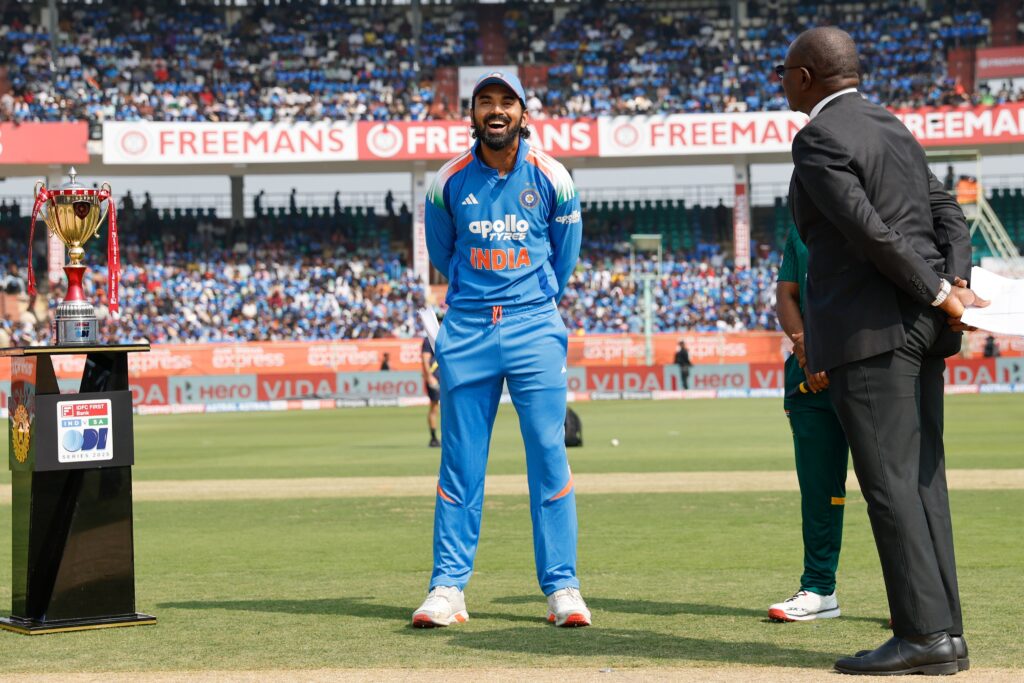
The significance of winning the toss became immediately apparent as India could field first and exploit the early moisture in the pitch while avoiding the challenging conditions their bowlers had faced in the first two matches when dew made gripping the ball nearly impossible during South Africa’s chases.
The victory vindicated the widespread belief that toss advantage had been decisive in the series, though India demonstrated that their performance was far from simplistic “win the toss, win the match” formula. The match ebbed and flowed with varying conditions presenting themselves throughout, requiring India to execute well across all phases.
Arshdeep and Rana Exploit Early Conditions
Arshdeep Singh and Harshit Rana used the early moisture beautifully to tie South Africa down from the opening over. Ryan Rickleton was opening in place of Tony de Zorzi, with Aiden Markram pushed down to number five to accommodate the batting order change. Arshdeep took Rickleton’s edge in the first over, immediately putting South Africa on the back foot.
Rana followed up with a maiden over, establishing the disciplined bowling that characterized India’s approach. India bowled three maidens in the first eight overs, creating immense pressure on the South African batsmen. Only two edged boundaries from Quinton de Kock’s bat took South Africa to 25 for 1 after the initial powerplay restrictions.
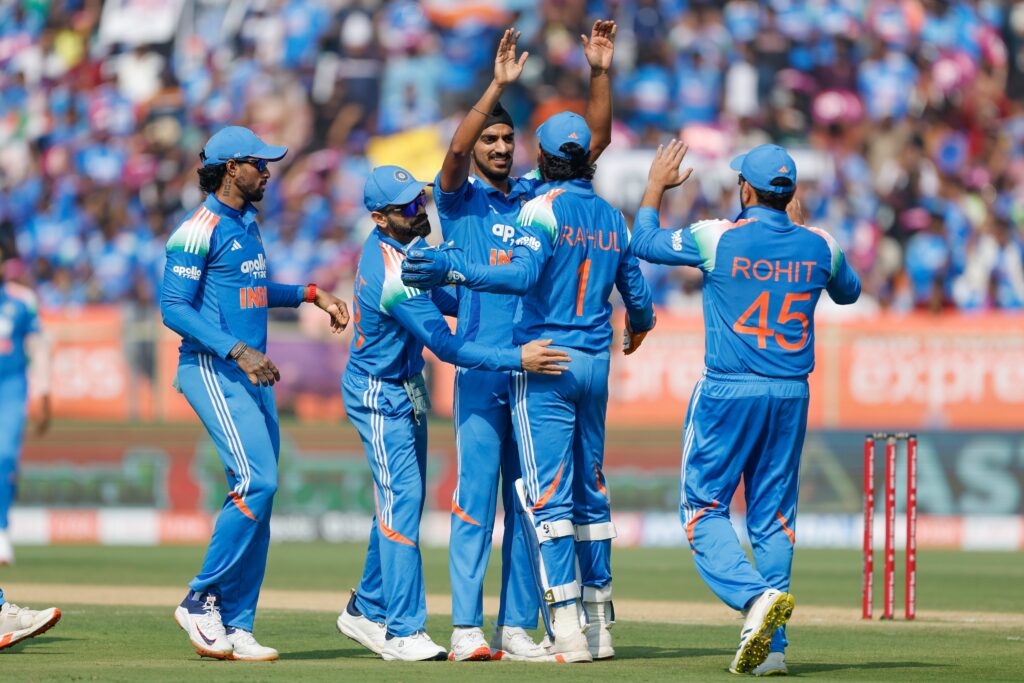
The controlled bowling reflected India’s determination to capitalize on favorable conditions after being denied such opportunities in the previous matches. The extra moisture, perhaps deliberately added to prevent the pitch from drying out completely in the first innings, provided India’s pace attack the assistance they needed to establish early dominance.
De Kock’s Magnificent Century
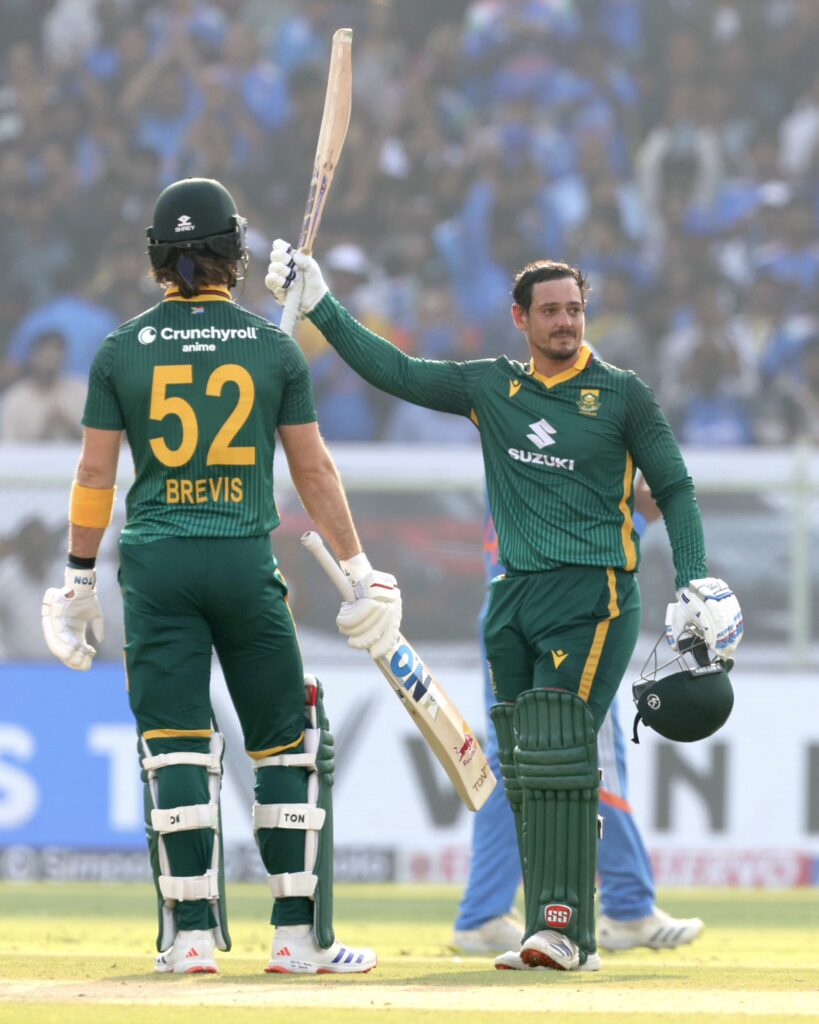
The introduction of Prasidh Krishna, already under fire for expensive spells earlier in the series, provided South Africa an opportunity to break free from the shackles. Quinton de Kock took special liking to Prasidh, pulling him for two sixes in his first two overs and playing the two shots of the day: an aerial extra-cover drive on the up for six and one along the ground for four.
Prasidh conceded 27 runs in his first two overs as de Kock launched a counter-attack that threatened to seize momentum. Runs started flowing in a 113-run partnership between de Kock and captain Temba Bavuma, though the latter scored only 48 of those runs off 67 balls, indicative of the conditions and quality of India’s bowling. De Kock, in contrast, raced to 63 off just 55 deliveries.
The pitch had settled by this stage, and Matthew Breetzke capitalized by taking down part-time spinner Tilak Varma, playing in place of Washington Sundar. By the end of the 26th over, the fifth-bowler combination of Prasidh and Tilak had leaked 56 runs from their five overs, raising concerns about India’s bowling depth.
De Kock was well on his way to a seventh ODI century against India in just 23 innings, an extraordinary record that no other batsman has matched. No visiting batter has scored more centuries against India than de Kock’s seven on Indian soil, cementing his status as one of India’s most persistent tormentors in limited-overs cricket.
Prasidh Krishna’s Redemption
At 158 for 2 and with de Kock cruising, Prasidh Krishna began his second spell, immediately tightening India’s grip on proceedings. His first over of the new spell went for just two runs, reestablishing control after his expensive opening burst. Harshit Rana complemented him from the other end as India desperately sought wickets to stem South Africa’s momentum.
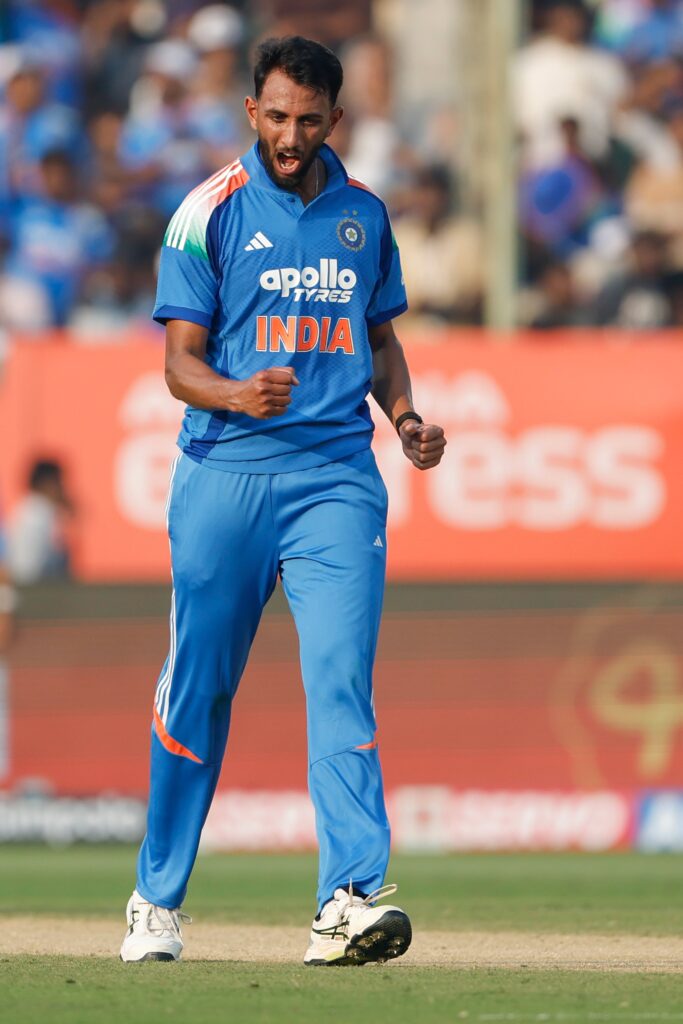
De Kock hit a boundary to take South Africa past a run-a-ball for the first time in the innings, but Prasidh’s persistence paid dividends in his next over. Matthew Breetzke, attempting to continue dominating the pacer, misjudged the length and played back and across the line to a delivery hitting top of off stump. He was dismissed lbw, breaking the threatening partnership.
In the same over, Markram chipped one to Virat Kohli fielding at short cover, reducing South Africa to significant trouble. The double-wicket over transformed the match dynamics, vindicating the faith shown in Prasidh despite his earlier struggles in the series.
The critical moment arrived at 199 for 5 in the 33rd over when de Kock, having compiled a magnificent 106 off 89 balls, played all around a full delivery from Prasidh. The dismissal derailed South Africa’s innings at a crucial juncture, depriving them of their set batsman with 17 overs remaining and the platform for a potentially match-winning total evaporating.
Kuldeep Yadav’s Masterclass With Dry Ball
Dewald Brevis and Marco Jansen attempted to maintain South Africa’s attacking momentum, but Kuldeep Yadav’s return to the attack brought new challenges. India needed to bowl five overs of spin in the final 14 overs, which could have been problematic given the dew conditions anticipated later.
However, Kuldeep relished bowling with the dry ball for the first time in the series and with the older ball for the first time in his ODI career, taking advantage of the new rule allowing the bowling side to use only one of the two balls after the 34th over. The drier conditions and older ball provided the grip and turn that had eluded him in previous matches.
Brevis and Jansen refused to play defensively against Kuldeep, the leading wicket-taker in the series despite predominantly bowling with a wet ball. When Kuldeep began the second over of his new spell, there had been 19 deliveries without a boundary as pressure mounted. Aware that big shots were imminent with the extra fielder about to move out, Kuldeep kept tossing the ball wide and extracting turn.
Both batsmen holed out in the same over attempting expansive strokes, unable to resist Kuldeep’s probing. The wrist-spinner’s wizardry accounted for two more wickets as he finished with figures of 4 for 41, his 15th haul of four or more wickets in ODI cricket. Only Australia’s Adam Zampa has taken more such hauls since Kuldeep’s debut, underlining the Indian spinner’s consistency at the highest level.
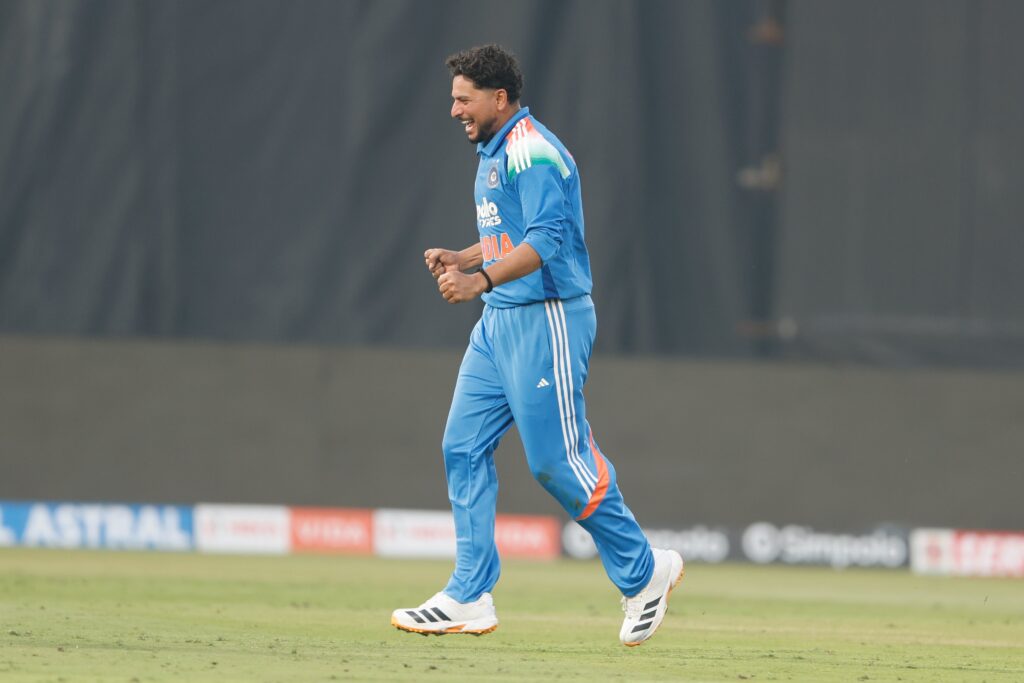
Prasidh cleaned up the tail to finish with 4 for 66, completing a remarkable redemption arc after his expensive first spell threatened to undermine India’s bowling effort.
Jaiswal’s Maiden ODI Century
Chasing 271 for victory, India needed early wickets from South Africa’s perspective. The ball moved around for Marco Jansen and Lungi Ngidi initially, but seven wides in the first two overs and occasional calculated strikes from Rohit Sharma kept India in touch with the required rate despite the movement.
Even as Yashasvi Jaiswal struggled to find his rhythm, Rohit took the initiative, charging down the track and pulling Ngidi for six before chipping Keshav Maharaj for four against the turn. His trademark imperious pull shot made appearances as he dominated the early exchanges, allowing Jaiswal time to settle into the innings.
While Jaiswal’s strike rate hovered around 50 during the early overs, Rohit reached his 94th score of 50 or more at a run-a-ball, providing the perfect platform for India’s chase. The partnership dynamic allowed Jaiswal to build his innings methodically rather than forcing the pace prematurely.
The scenario represented an unfamiliar challenge for Jaiswal, filling in for injured captain Shubman Gill. He had been obligated to attack from the outset in the first two ODIs as India chased above-par totals after losing the toss, but the lower target and favorable batting conditions provided him opportunity to construct a substantial innings.
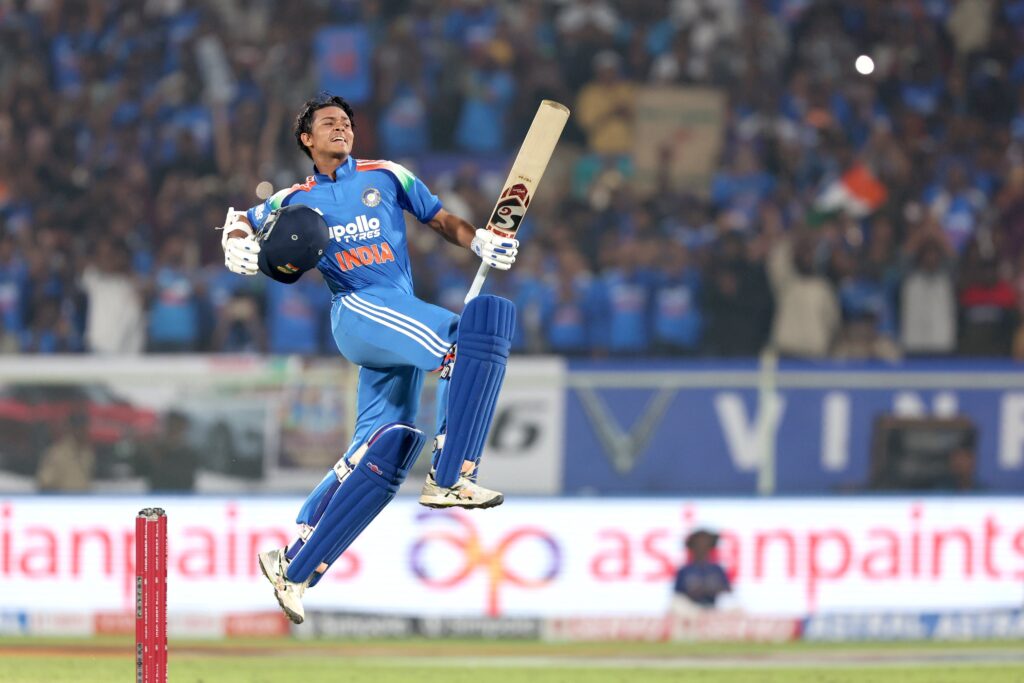
Jaiswal’s innings flowed smoothly after reaching 50 off 75 balls. He accelerated dramatically thereafter, reaching his maiden ODI century in just 36 additional deliveries to become the sixth Indian batsman to score centuries in all three international formats. He batted alongside both Rohit and Virat Kohli during different phases of the chase, showcasing maturity beyond his limited ODI experience.
Rohit-Jaiswal Partnership Sets Foundation
The opening partnership between Rohit Sharma and Yashasvi Jaiswal yielded 155 runs, effectively sealing the match outcome before Rohit’s dismissal. The experienced captain’s aggressive approach at the top complemented Jaiswal’s more measured accumulation, creating an ideal balance that South Africa’s bowlers could not disrupt.
Rohit fell 25 runs short of what would have been his 34th ODI century, caught while attempting another expansive stroke after a fluent 75 off 73 balls. His innings featured the full repertoire of strokes that have made him one of the format’s most destructive openers, including powerful pulls, elegant drives, and calculated aggression that kept South Africa’s bowlers constantly under pressure.
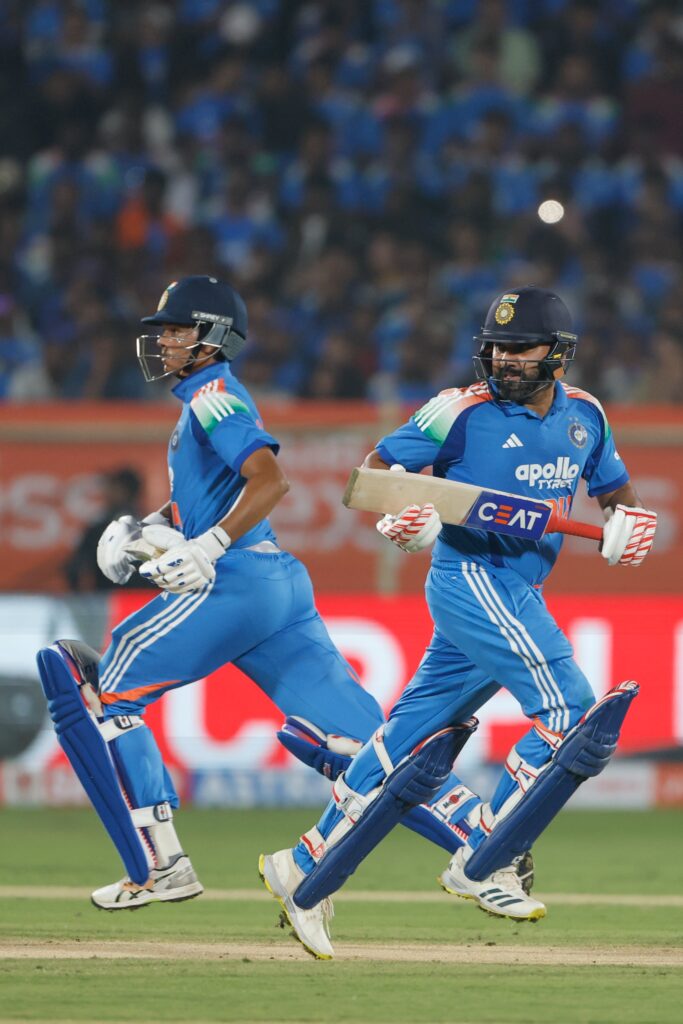
The partnership’s significance extended beyond mere run accumulation. By establishing such a commanding platform, Rohit and Jaiswal eliminated any possibility of late-innings pressure that might have complicated India’s chase. The foundation allowed Virat Kohli to express himself freely in the final overs rather than managing a tense finish.
Kohli’s Six-Hitting Display
Virat Kohli announced his arrival with characteristic authority, immediately imposing himself on South Africa’s bowlers. His unbeaten 65 off 45 balls featured yet another upgrade to his already formidable limited-overs game: an exceptional six-hitting display that saw him clear the boundary 12 times across the series.
The 12 sixes represented Kohli’s highest total in any bilateral ODI series, surpassing his previous best and demonstrating his evolution as a power-hitter in the latter stages of his career. The ability to clear boundaries with such regularity adds another dimension to Kohli’s batting, complementing his traditional strengths of accumulation and boundary hitting along the ground.
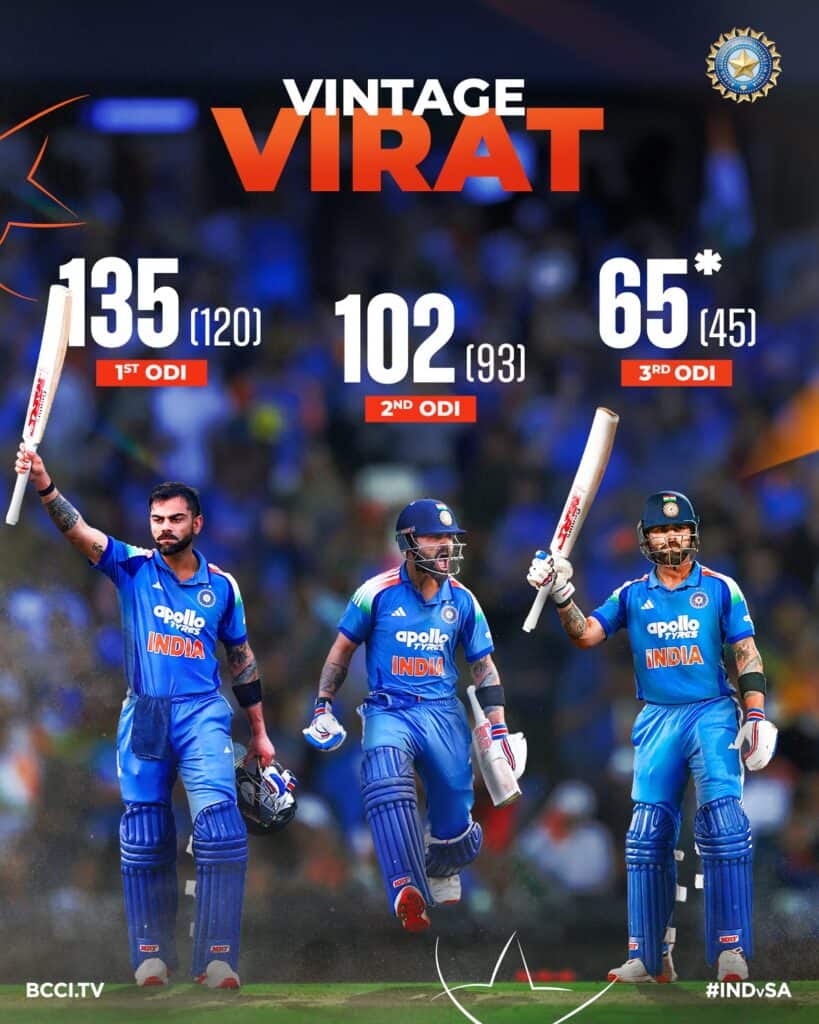
Kohli’s finishing prowess ensured India completed the chase with 10.1 overs remaining, emphasizing the comprehensive nature of their victory. The unbeaten 116-run partnership between Jaiswal and Kohli featured contrasting styles: Jaiswal’s elegant stroke-play and Kohli’s calculated aggression combining to devastating effect.
Series Overview and Player of the Series
Virat Kohli was named Player of the Series for his outstanding contribution of 302 runs across the three matches, demonstrating remarkable consistency against quality bowling. His performances in the IND vs SA series included crucial innings in both victories and a fighting effort in the loss, showcasing his enduring class in ODI cricket.
The series victory represented India’s ability to bounce back from adversity, having lost the opening match comprehensively after being inserted. The toss disadvantage in those games made competing exceptionally difficult given the dew conditions that plagued India’s bowlers during opposition chases.
Kuldeep Yadav finished as India’s leading wicket-taker despite bowling predominantly with a wet ball in the first two matches, a testament to his skill and adaptability. Prasidh Krishna’s redemption in the final match, taking 4 for 66 after expensive performances earlier, highlighted the character within India’s bowling unit.

For South Africa, Quinton de Kock’s continued dominance against India with his seventh ODI century proved insufficient to secure series victory. The tourists will rue their inability to post a competitive total after de Kock’s brilliant platform, with the middle-order collapse proving decisive.
India’s 9-wicket victory in the India vs South Africa 3rd ODI completed a hard-fought series triumph that required overcoming toss disadvantages in the first two matches. Yashasvi Jaiswal’s maiden ODI century, achieved alongside Rohit Sharma and Virat Kohli, provided a glimpse of India’s batting depth and the youngster’s adaptability across formats.
The IND vs SA series showcased compelling cricket across all three matches, with toss proving influential but not determinative of outcomes. India’s ability to execute with both bat and ball when conditions favored them in the decider demonstrated the quality within the squad and their capacity to win crucial matches under pressure.

As both teams prepare for the upcoming T20I series, India can draw confidence from their series victory while South Africa will seek to regroup and compete more effectively in the shorter format. The comprehensive nature of this final victory, with more than 10 overs to spare, sends a strong message about India’s capabilities when all departments fire in unison.
Read More: WBBL Match Descends Into Chaos as Unprecedented Pitch Blunder Forces Abandonment in Bizarre Scenes