There is a moment early in Gears of War: E-Day where you stop and just look at the street. Rain-slick asphalt, a red van idling beside a neon PUB sign, a taxi with its door hanging open, and a mountain looming over a city that does not yet know what is about to climb out of the ground. Then the Locust arrive, and the calm turns into the loud, heavy, glorious chaos that this series is famous for. After spending time with the PC version on an NVIDIA RTX 50 series GPU, our verdict is simple: this is a really good time, and one of the best-looking games you can run on a PC right now.
Gears of War: E-Day Review at a Glance

| Detail | Information |
|---|---|
| Game | Gears of War: E-Day (prequel) |
| Release date | October 6, 2026 |
| Platforms | PC, Xbox Series X |
| Engine | Unreal Engine 5 with Nanite, Lumen and MegaLights |
| NVIDIA tech | DLSS 4.5, Dynamic Multi Frame Generation, DLAA, Reflex, RTX Mega Geometry, ray tracing |
| Played on | NVIDIA RTX 50 series GPU, curved ultrawide monitor |
| Our verdict | Highly recommended |
The Story: Back to Emergence Day
E-Day takes us to the day the Locust Horde first erupts from beneath the city of Kalona. It is a prequel, and it follows a young Marcus Fenix and Dominic Santiago alongside new recruits, with the squad forced into a fight nobody trained them for. As Gaming Trend put it in its own review, each character has to find the grit to pull themselves together as their world falls apart. That framing works well. Seeing familiar faces before they became legends gives the story a human, slightly vulnerable edge, and the quiet beats, like Dom hauling a shaken soldier up with a blunt “On your feet”, carry real weight.
Combat and Pacing
Combat is still weighty and close, built around cover, chunky weapons and the satisfying crunch of a well-timed finisher. Reviews note that The Coalition has smoothed out movement, and added weapon attachments, tactical gear with perks and armour mods. In our time with the game, the street fights and tight corridors felt tense, while the open areas gave us room to breathe. The game mixes linear set pieces with more open sections that reward exploration, and checkpoints arrive often enough to keep frustration low.
One small gripe, echoed by other reviewers: secondary characters can look stiffer and less detailed than the leads, which stands out in a game that looks this good elsewhere.

Why It Is a Showcase for NVIDIA RTX 50
Where this PC version truly shines is its technology. NVIDIA confirmed day-one support for a broad feature set, and on an RTX 50 series card, it shows.
| Technology | What it does | What we noticed |
|---|---|---|
| DLSS 4.5 Super Resolution | AI upscaling for higher frame rates and sharper images | Crisp image quality in dark, detail-heavy streets |
| Dynamic Multi Frame Generation | Generates extra frames and adapts to hit a target | Smooth motion on an ultrawide screen |
| DLAA | Anti-aliasing at native resolution | Clean edges on railings, wires and signs |
| NVIDIA Reflex | Lowers system latency | Responsive aiming and cover swaps |
| RTX Mega Geometry | Rebuilds ray-tracing geometry to match Nanite detail | Fewer shadow errors on small objects |
| Ray-traced lighting | Shadows from many lights, reflections and global illumination | Neon, fire and street lamps feel truly in the world |

RTX Mega Geometry is the quiet hero. Unreal Engine 5 builds worlds from enormously detailed Nanite geometry, but ray tracing normally has to use simplified versions of that detail, which causes missing shadows and odd artifacts. According to PC Games Hardware, Mega Geometry reconstructs ray-tracing geometry to match Nanite scenes and is exclusive to RTX cards on PC. NVIDIA also says MegaLights enables ray-traced shadows from up to 100 light sources, while Lumen handles global illumination and ambient occlusion.
The result is a city that feels lit, not painted. A burning wreck throws amber light across a ruined train car, red emergency glow bleeds into wet roads, and storefront neon reflects in puddles. Our on-screen overlay showed the GPU working hard, at roughly 91 to 98 percent load, with the CPU mostly in the high teens to mid-20s, so this is a game that really uses a graphics card.

Setting It Up: Shaders and Settings
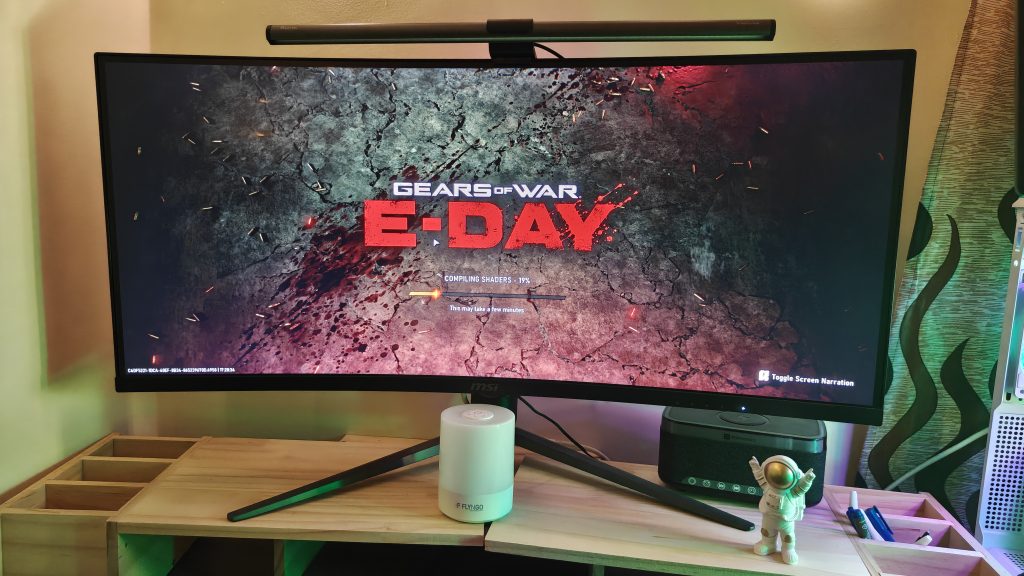
On first launch the game compiles shaders, and the loading screen warns it may take a few minutes. It is worth the wait, because it reduces hitching afterwards. Our advice is to turn on DLSS Super Resolution with Dynamic Multi Frame Generation and NVIDIA Reflex first, then raise ray-tracing quality until your target smoothness starts to slip. If you have a high-resolution ultrawide display, DLAA is a great choice if your GPU has headroom.

The Verdict
Gears of War: E-Day is a confident, cinematic and brutally fun return that makes a strong case for PC as the best place to play it. The story is engaging, the combat feels weighty, and the visuals, powered by RTX Mega Geometry, DLSS 4.5 and ray tracing, are among the most impressive we have seen on an RTX 50 card. Multiplayer modes were not part of our time with the game, so we are judging the campaign experience here. If you have an RTX GPU and enjoy action games, this one belongs on your list. You can read more about the franchise on Wikipedia, see NVIDIA’s official feature announcement, and find more game coverage under our Gears of War tag.
Quick Answers
When is Gears of War: E-Day out? October 6, 2026.
Do I need an RTX 50 card? All GeForce RTX cards are supported, though the newest cards get the most from DLSS 4.5 and Dynamic Multi Frame Generation.
Is RTX Mega Geometry AMD compatible? Reports say it is exclusive to NVIDIA RTX cards for now.
Source: NVIDIA GeForce, Gaming Trend, PC Games Hardware