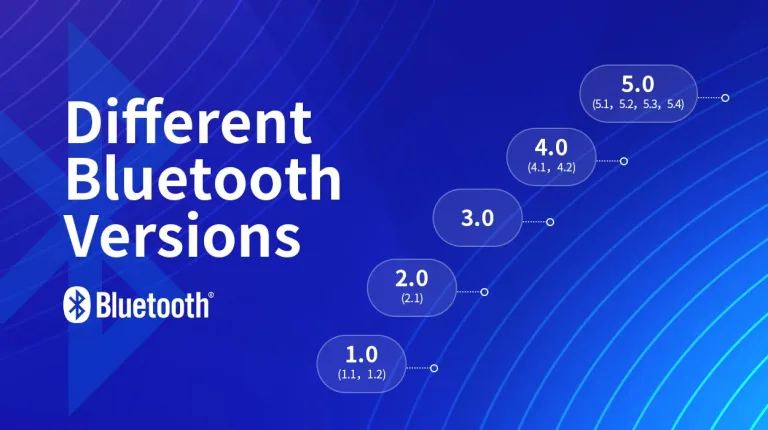
Bluetooth evolution has moved from basic cable replacement to low-latency, multi-device audio through four major stages defined by the Bluetooth SIG, with the latest transition centred on Bluetooth LE Audio. This article is published on Saturday, September 19, 2026, and separates official Bluetooth standards from the broader way consumers experienced each generation.
The Four-Stage Audio Timeline
The first stage was Bluetooth Classic, introduced for short-range device connections and early wireless headsets. Bluetooth SIG documentation places the first Bluetooth specification in 1999, when audio focused on replacing wired phone accessories rather than delivering premium music playback. The second stage arrived with Bluetooth 2.0 and Enhanced Data Rate, commonly called EDR.
Bluetooth SIG introduced EDR in 2004, increasing the theoretical link speed from the earlier Bluetooth 1.2 level and making wireless stereo headsets more practical for phones, laptops and portable music players. Bluetooth 4.0 created the third stage in 2010 by adding Bluetooth Low Energy, or BLE. BLE was designed for lower power consumption than Bluetooth Classic, although early BLE did not replace the Classic audio profile used by most wireless headphones. That distinction matters because Bluetooth version numbers alone never tell the full audio story. Bluetooth 5.0 arrived in 2016, while Bluetooth 5.2 introduced the core features behind LE Audio in 2020, according to the Bluetooth SIG. LE Audio uses the LC3 codec, supports broadcast audio through Auracast and is designed to make multi-stream audio more efficient.
| Stage | Bluetooth milestone | Audio significance | Source |
|---|---|---|---|
| One | Bluetooth specification, 1999 | Wireless headset connections | Bluetooth SIG |
| Two | Bluetooth 2.0 EDR, 2004 | More practical stereo audio | Bluetooth SIG |
| Three | Bluetooth 4.0 BLE, 2010 | Lower-power device ecosystem | Bluetooth SIG |
| Four | Bluetooth 5.2 LE Audio, 2020 | LC3, multi-stream and Auracast | Bluetooth SIG |
What Changed for Sound, Battery and Connectivity?
The biggest change in Bluetooth evolution was not simply higher speed. Bluetooth Classic audio generally relies on profiles such as A2DP, while LE Audio adds a modern architecture built around the LC3 codec and Isochronous Channels. The LC3 codec is designed to maintain useful audio quality at lower bitrates than the older SBC codec. Bluetooth SIG states that LC3 can provide improved audio quality at a lower bitrate, but the final result still depends on the phone, earbuds, firmware and manufacturer tuning. For more detail, see Gizmodo.
Battery gains also require careful interpretation. LE Audio can reduce the amount of data transmitted for some workloads, yet a headset’s battery life still depends on active noise cancellation, microphones, amplifier power, radio design and call usage. A Bluetooth 5.2 label does not guarantee longer playback than a well-designed Bluetooth 5.0 product. Consumers comparing premium wired and wireless options can also read our USB-C High-End Audio coverage, since the connector and the wireless standard solve different parts of the listening chain.
Why Bluetooth Version Numbers Mislead Buyers
A higher Bluetooth number does not automatically mean better sound. Bluetooth 5.0 can improve range and data handling in compatible conditions, but audio quality is also shaped by codecs such as SBC, AAC, aptX variants and LC3. Codec support must exist on both ends of the connection.
An Android phone and wireless earbuds may advertise different codec combinations, causing the devices to fall back to a shared option. Apple products also manage codec selection differently from many Android phones, so specifications should be checked as a complete system rather than judged by the Bluetooth logo. The same rule applies to charging. A headset may use USB-C while still relying on an older Bluetooth audio profile. Our USB-C Standards Four guide explains why a common connector does not guarantee identical charging, transfer or audio capabilities.
What’s Next for Wireless Audio?
Auracast is the most visible consumer-facing feature in the fourth stage of Bluetooth evolution. Bluetooth SIG describes it as a broadcast audio capability that can send one audio stream to many compatible receivers, creating possible uses in airports, cinemas, classrooms and public venues. The challenge is adoption. Phones, earbuds, hearing devices and venue transmitters must support compatible LE Audio features before consumers receive the full benefit.
Existing Bluetooth Classic headphones will not automatically gain Auracast simply through a software update. Buyers should therefore prioritise codec support, multipoint behaviour, latency, microphone quality and software updates over a Bluetooth number alone. Fitness users comparing connected audio accessories can also consult our Garmin Forerunner: Four buying guide for a wider view of device compatibility. Bluetooth evolution is moving from one-to-one headphone links towards lower-power, multi-stream audio, but the best purchase still depends on the complete phone-and-headset combination.
FAQs
What are the four stages of Bluetooth audio?
The four editorial stages are Bluetooth Classic, Bluetooth 2.0 with EDR, Bluetooth 4.0 and the Bluetooth 5.2-era LE Audio architecture.
Is Bluetooth 5.2 automatically better for music?
No. Bluetooth 5.2 can support LE Audio features, but sound quality depends on codec compatibility, device tuning, firmware and the connected phone.
What is LC3 in Bluetooth audio?
LC3 is the codec used by LE Audio. The Bluetooth SIG designed it to deliver audio efficiently at lower bitrates than older codec approaches.
What is Auracast?
Auracast is Bluetooth LE Audio’s broadcast feature, allowing one compatible audio source to transmit to multiple compatible receivers.
Was this article helpful?
Your feedback directly improves future articles on this site.