SA329 & 140/4 (47 ov)
 AUS429
 BAN272
 WI134/4 (48 ov)
 NZ
 IND
 NAM
 IRE
 Abha
 Al Ittihad
 NorthEast
 Bengaluru
 Al Diriyah
 Neom SC
 Le Havre AC
 PSG
 Nice
 Rennes
 Al Shabab
 Al Ahli
 FIO2
 ATA2
 NSR5
 KHO3
 RIY0
 QAD6
 FRO5
 LEC1
 SBP172 & 165/7 (59.4 ov, target 237)
 MITS112 & 296
 SOA154
 WA406/5d & 79/6 (29 ov)
 UAE
 NED
 PAK
 SL
 BH-W
 SS-W
 AS-W
 MS-W
 PS-W
 MR-W
 MIS
 TOK
 AFG221/7
 ZIM202/5 (20 ov, target 222)
 ENG386/5
 OMA196
 HH-W174/8 (20 ov, target 193)
 ST-W140/4 (17/20 ov, target 139)
 MOW185/3
 VAG90/9 (20 ov, target 186)
 SCR2
 ALM2
 FDU0
 CCSU0
 Elversberg
 Mainz
 Villarreal
 Espanyol
 KHA4
 HAZ2
 Genoa2
 Juventus0

Barcelona’s second major examination of the campaign ended in another failure. Days after losing in Paris, Hansi Flick’s team went down again, this time to their oldest rival. In this El Clasico, a sterile Barcelona attack never solved Real Madrid’s organised defence, while the home side’s well-known problems at the back decided the contest in José Mourinho’s favour.
The setting felt familiar. In 2010, Real Madrid appointed Mourinho to bring silverware back to the Bernabeu while a dominant Barcelona dazzled the continent with their football. He helped lay the groundwork, left in his third year, and the club went on to collect six Champions League trophies, three of them consecutively, a feat nobody had managed before. Thirteen years after leaving, he is back to solve a remarkably similar puzzle.
A Different Mourinho, a Different Test
Almost everything else has changed. His standing is weaker than it once was, damaged by the setbacks he suffered at other clubs before coming home. His methods are also under scrutiny, since the game has moved on considerably since his first departure. This return is therefore a chance to show he still deserves a place among the elite.
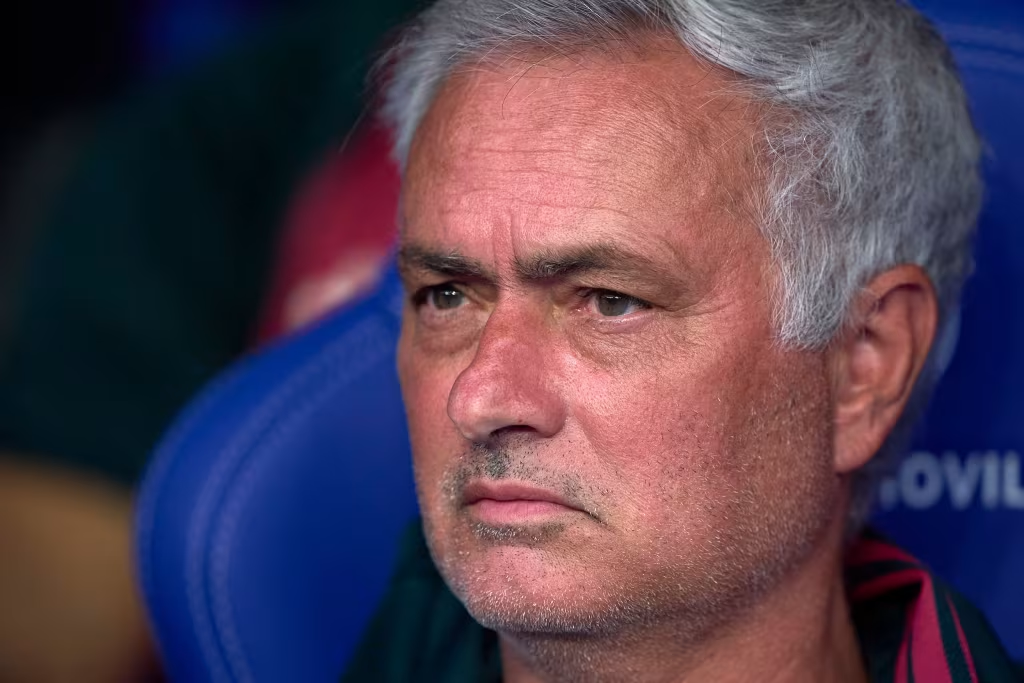
Madrid’s 2026/27 campaign has produced wins in nearly every match, with the exceptions being the games against Real Betis and Atlético Madrid. That left them six points behind Barcelona in La Liga. Their displays have swung between sharp and flat, and against sides of comparable quality they often looked uncertain. Those games prompted doubts about Mourinho’s plan and about whether the squad could sustain a title push.
Barcelona’s trajectory has been the opposite. Since Flick replaced Xavi Hernandez in 2024, the Catalans have controlled Spanish football and grown into a serious European force. Two straight league titles followed. Entering his third year, Flick’s team won nine from nine, with a goal difference of plus 30, before this fixture. Critics countered that those wins came against weaker opposition, and the loss to Paris Saint-Germain gave that argument weight, casting doubt on Barcelona’s readiness for the Champions League, the competition they prize most this season.
The Starting Elevens in the El Clasico
Flick kept the back line that faced PSG: Xavi Espart, Pau Cubarsi, Gerard Martin and João Cancelo, with Rodri and Pedri ahead of them. Fermín López played in the number ten role, and Anthony Gordon and Lamine Yamal supported Raphinha.
Mourinho largely retained the group that crushed Leipzig 4-1. Flu ruled out Thibaut Courtois, so Andriy Lunin took the gloves. Ibrahima Konaté returned alongside Dean Huijsen in central defence, Federico Valverde again filled in at right-back, and Marc Cucurella took the left. Bernardo Silva and Aurélien Tchouaméni formed the midfield pair. Jude Bellingham played just behind Kylian Mbappé, with Arda Güler and Yan Diomandé on the flanks.
Madrid’s Defensive Plan Worked With and Without the Ball
The intentions of both coaches were obvious from the first whistle. Madrid dropped into a 4-4-1-1 mid-block, with Mbappé slightly ahead of Bellingham, who tracked Rodri. Silva and Tchouaméni picked up Pedri and López. The wingers, Güler and Diomandé, leapt out toward the far-side full-backs when needed. Cucurella was given the job of containing Yamal, while Huijsen and Konaté shared the duty of dealing with Raphinha, one holding zone and the other watching his runs. Valverde squared up to Gordon, who liked to cut from outside to inside as play gathered on the other flank.
When Barcelona built, their ball-side full-back advanced. On the left, Gordon tucked inside to open the channel for Cancelo. Madrid’s midfielders were glued so tightly to their opposite numbers that the hosts were funnelled toward the touchline. As Cancelo took possession, Güler would step diagonally from the half-space to cut the pass to Gordon, while the nearby midfielders sealed off inside and backward options, aiming to win the ball on the edge of the pitch.
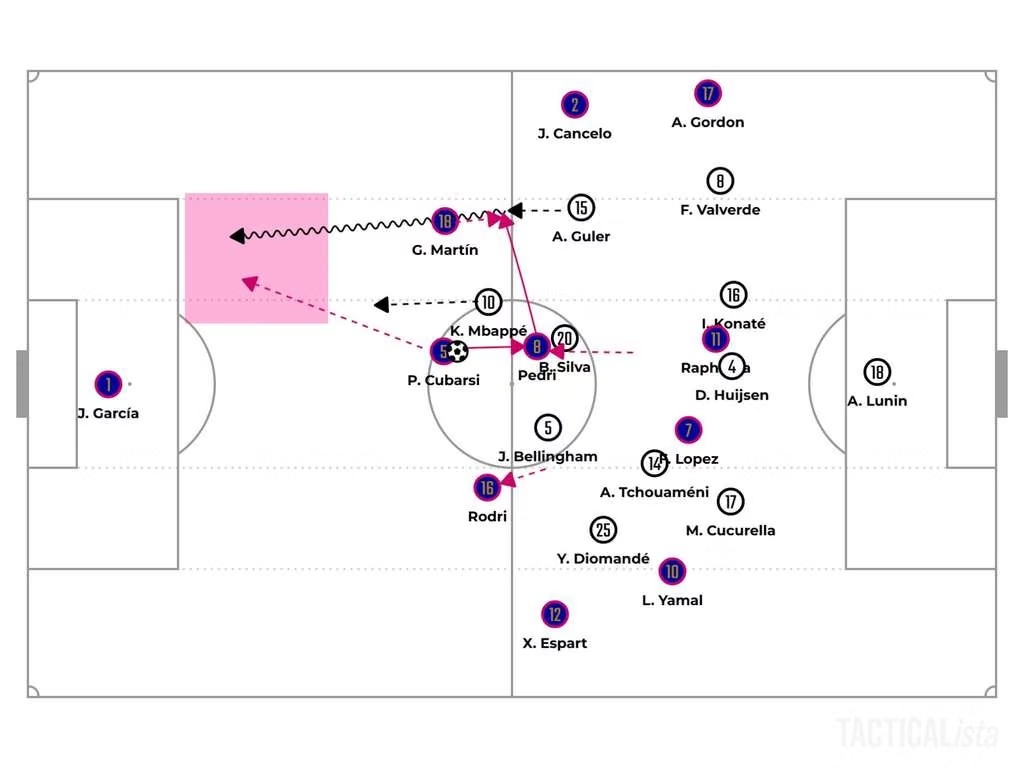
In the fourth minute, Rodri dropped between Cubarsi and Martin, and Mbappé blocked the lane between the two centre-backs. Pedri came short to bounce a pass off Martin but misplaced it, which let Güler pick up the loose ball and run into the space behind the left-back. When he reached the area, Cubarsi shut the route to Mbappé, and Güler lifted his shot over.
From goal kicks, Madrid pushed up and went man-for-man, forcing Barcelona to play long and wide toward Gordon, who nevertheless controlled it comfortably. Madrid’s other players then slipped back into their zonal duties, with Silva moving wide to help Valverde and Güler closing the backward option. That left Pedri free to find an inside pass. Even so, the visitors recovered quickly. Their midfielders stayed tight to their opponents, which helped them win the ball back and attack the large gaps in Barcelona’s structure.
Those gaps were partly self-inflicted. Barcelona built in a direct, vertical way, so when they lost the ball their players were far apart before the press could begin. Madrid exploited the space between the deep-lying Valverde and Cancelo, giving the Uruguayan time to find Güler behind the left-back. Güler dropped to pull Martin out, which opened the wide lane for Bellingham to sprint into. The quality of Güler’s final pass, though, stopped the move short.
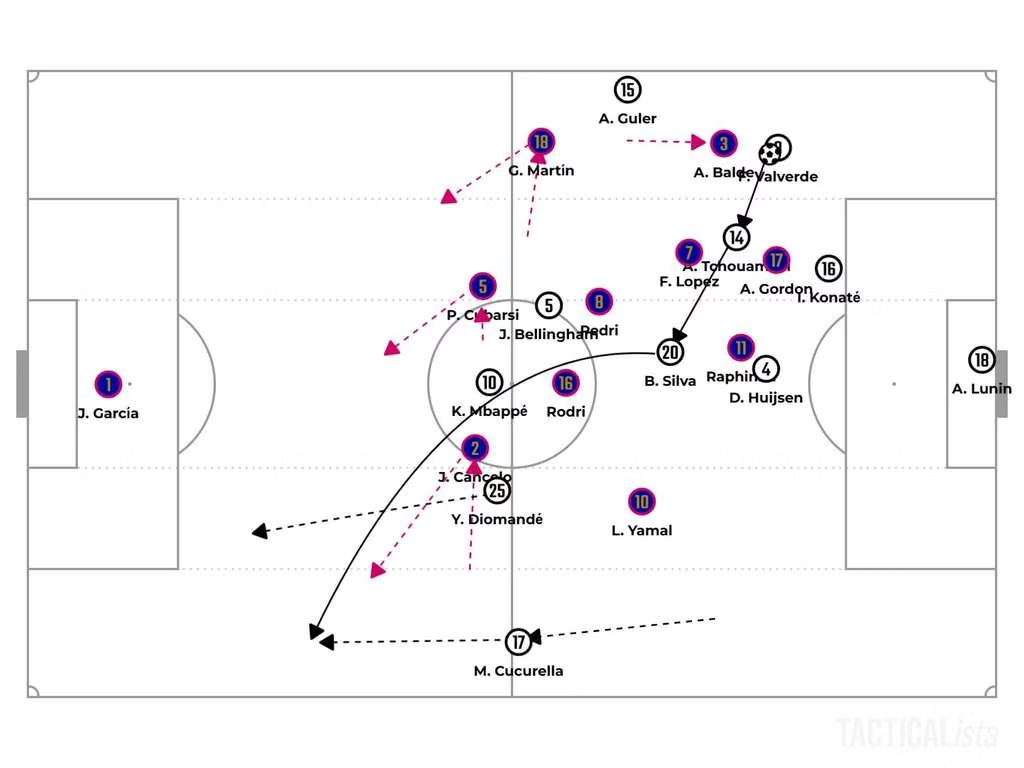
In the thirteenth minute, Valverde’s aggressive jump at Gordon let him win an aerial ball. Güler and Silva retreated quickly to pounce on the second ball, and Madrid regained possession in midfield before moving it to Diomandé for a one-on-one with Espart. Yamal had failed to track Güler, who attacked the gap between Espart and Cubarsi. His pass into the area, helped by Mbappé’s run dragging Cubarsi toward goal, was good, but Bellingham arrived a beat late and Martin cleared.
Barcelona Live and Die by the High Press
Early on, Barcelona did win the ball high up the pitch, helped by late movement from Madrid’s midfielders or sloppy touches near the touchline. In the third minute, Tchouaméni was slow to swing across behind López. Yamal, standing close, pounced on the loose ball after Huijsen’s pass, drove inside and was met by Silva. His attempt to find Raphinha between the centre-backs was overhit.
Madrid also had moments of progress down their left. Cucurella took advantage of Yamal’s starting position before shifting to find Diomandé dropping short, then ran underneath him to combine and escape the touchline. Pedri had two jobs, marking Silva and defending zonally when play was funnelled wide, so Silva could be a free option in the middle. Gordon’s quick return toward the Portuguese forced Madrid wide, while Barcelona’s players squeezed the space around the ball. Under that pressure Madrid lost possession through loose touches.
By the fifteenth minute, the positioning of Valverde, deep and far from Cancelo, gave Madrid’s right-back the time to switch play. The visitors had numbers because Yamal narrowed toward Huijsen. Cucurella fed Diomandé, who went straight for the gap between right-back and centre-back, but his prod landed behind Cucurella, and Pedri gathered it.
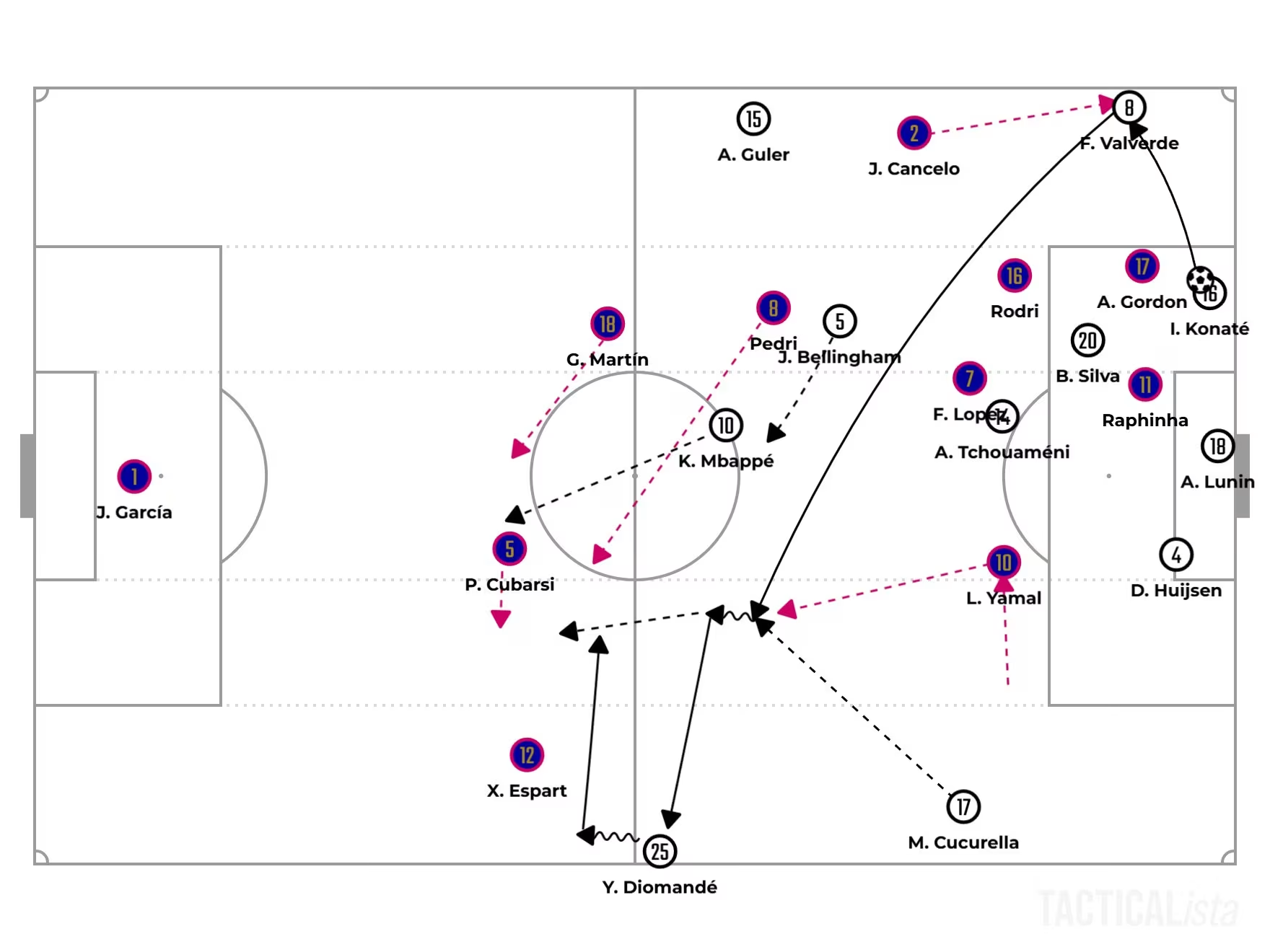
On Barcelona’s right, Espart and Yamal alternated between hugging the line and drifting inside. Yamal’s habit of dropping lured Tchouaméni forward, opening a diagonal channel between defence and midfield. Madrid were fortunate that Silva moved in sync with the Frenchman to pressure the ball, and Tchouaméni collapsed quickly to restrict space.
Lunin’s long diagonal passes were a useful release from the press. He timed them toward Güler as Cancelo jumped to Valverde. Güler received on the Portuguese defender’s blind side and laid the ball to Valverde for a switch. Mbappé pinned Espart this time, allowing Diomandé to control the switch in space and send Mbappé in behind. Near the six-yard box, Cubarsi and Espart closed the angle, so Mbappé turned it back, and Tchouaméni found Güler at the edge of the area. Güler’s shot was saved by Juan Garcia.
Two Teams Playing Directly
When Madrid sat in their block, their midfielders marked in pairs. To create openings, Pedri, Rodri and López clustered on the right and pulled their markers across. That stretched the gap between Madrid’s far winger and midfielder, which Raphinha dropped into. As the visitors shifted, Raphinha drifted in front of their block until he saw López slipping behind Tchouaméni in the right half-space. López received on the half-turn, but Huijsen blocked the shot.
Both sides were direct. Madrid relied on quick restarts to locate Valverde in space near the touchline before Cancelo arrived. Barcelona, meanwhile, split into two separate units when pressing high, with the front line, two midfielders and Cancelo advancing while the rest were held in place by Madrid’s forwards. Mbappé ran into the space between those lines, opening an out-to-in passing lane to Valverde. He then squared to Güler, who dragged Martin away so Mbappé could attack the vacated channel. The striker sprinted the length of the pitch, beat his marker and entered the area, but his cutback was underhit.
Against Barcelona’s mid-block, Madrid lacked central options. The Catalans compressed the space between the lines and pushed the visitors into backward passes. The weakness appeared when Barcelona shifted from block to press. Silva and Valverde sometimes swapped positions, Madrid’s wingers fixed the opposite full-backs, and Gordon stepped up to Konaté. Barcelona’s pivots had to slide across to cover the wide areas. On the right half-space, Rodri stood between Bellingham and Silva while Pedri moved to track the Portuguese. Valverde peeled wide, though, creating a two-versus-one, and the pair fed Güler while Valverde made a late run through the gap between Martin and Cancelo, looking for a reverse pass to teammates arriving from deeper.
The jumping front line and the pinned defence left space around Pedri and Rodri. As Madrid built on their left, Pedri tracked Silva and Rodri followed Bellingham’s diagonal runs from the middle toward the touchline. This let Diomandé drop into the half-space and open a lane to the defence. Madrid’s loose touches stopped them taking advantage, as Barcelona’s midfielders closed the ball carrier down centrally. Barcelona’s high wingers then helped turn the ball over, stretching the space between Valverde and Konaté for Gordon to attack, but Valverde’s recovery run intercepted the pass from midfield.
The Opening Goal
In the fortieth minute, Madrid scored. Barcelona pushed the visitors backward, but Gordon’s and Raphinha’s presses were not supported by the players behind them. This gave Tchouaméni and Silva room to move the ball across the pitch behind Barcelona’s first line. Diomandé tucked in, pulling Cancelo with him and opening the touchline for Cucurella. Silva’s diagonal ball found Cucurella, and Diomandé ran the channel between Cancelo and Cubarsi, reaching the box alone. He prodded the ball across to Bellingham. Martin’s clearance struck Mbappé from behind and deflected in, putting Madrid ahead.
To close the middle and deny access between the lines, Bellingham often dropped alongside the midfield, screening the defence. Barcelona committed numbers to one side to draw Madrid’s pivots across and stretch the distance to the far-side winger. Four minutes after the goal, Silva and Tchouaméni shuttled over to block López and Gordon, who drifted infield. On the opposite flank, Balde occupied Güler in the right half-space, so Pedri saw Rodri free between Güler and Silva. Rodri advanced as Raphinha, López and Gordon dragged the defence toward goal, reaching the edge of the box and shooting, but Lunin gathered easily.
The Second Half and Madrid’s Counters
After the interval, Madrid kept the same plan with a deeper block. Barcelona sent more players forward, particularly on the left, to pull the visitors across and then quickly find Yamal in isolation against Cucurella. They found no way through against Lunin, and the extra bodies forward exposed them to counter-attacks.
Five minutes after the restart, López drove from left to centre and fed Pedri, who supplied Yamal near the box. Cancelo overlapped high, pulling Cucurella out and widening the gap to Huijsen, which López attacked, dragging Silva with him. His movement opened a diagonal lane between Yamal and Raphinha. Huijsen anticipated the pass and Tchouaméni collected the loose ball, releasing Bellingham and Mbappé against Cubarsi and Martin. Bellingham beat Cubarsi and ran the length of the field, but Martin recovered, cut out the pass to Mbappé and forced the Englishman toward the byline.
Wide rotations were another way Madrid escaped the press. On the left, Diomandé dropped and drifted inside, pulling Cancelo with him and leaving the channel for Bellingham. Yamal did not fully commit to closing Cucurella, who therefore had time on the ball. Diomandé’s movement also cleared the lane between Cucurella and Bellingham, who dribbled past Cubarsi near the touchline and got behind the defence. Mbappé delayed his run between Martin and Balde to stay onside, yet Bellingham’s through ball was overhit, giving Balde time to recover and Garcia the chance to sweep up.
Late Runs Decide It
After about half an hour of the second period, Barcelona equalised from a quick short corner that caught Madrid unprepared. The visitors then dropped into a deep block. Gordon hugged the left touchline, dragging Dumfries and Güler across, which stretched the space between Konaté and Dumfries for Balde to attack. Gordon slipped the ball between his markers to Raphinha near the six-yard box, whose shot was blocked by Konaté.
Cancelo’s overlapping and underlapping runs cut both ways. Cucurella dealt with Yamal’s passes to the fullback, and Tchouaméni or Silva dropped to cover between Huijsen and Cucurella. But with Cancelo so high, Diomandé was free near the touchline for Madrid’s counters. Rodri and Pedri had to move wide to track the Ivorian. Support runs from players like Bellingham pulled Pedri backward, and Diomandé’s dribbling let Madrid escape the flank and reach the far side, where Barcelona’s full-back faced Güler and Dumfries. The pair moved the ball into advanced areas to cross for runners from behind.
Dumfries, unlike Valverde, became a pressing trigger that Barcelona targeted. From open play, the distance between Gordon and Dumfries let Gordon jump quickly and cut off the diagonal pass inside. Dumfries had to give it to Güler, closely marked by Balde, and Barcelona won possession high and wide. Camavinga’s forward runs also vacated the area in front of the defence, letting Yamal move inside at the edge of the box and look for a shot.
Then, with three minutes left before stoppage time, Camavinga’s late run produced the winner. Moments earlier, Camavinga, Konaté, Güler and Bellingham swarmed Jesus, shrinking the central space. Bellingham claimed the loose ball and, in a manner reminiscent of Zidane, glided past Pedri, Jesus and Balde to feed Camavinga before the halfway line. Camavinga found Güler near the touchline, then made a late run behind Barcelona, poked the ball past Cubarsi inside the box and cut it back for Mbappé to finish.
Key Takeaways
Madrid arrived as underdogs, with a real risk of suffering a heavy defeat to their closest rivals. The mood around both clubs fed that story. Yet Los Blancos and Mourinho prepared for the fight as well as they could.
Madrid shut down Barcelona’s main players and used a firm mid-block to leave the Catalans looking flat in possession. With the ball, they exposed the lingering flaws of Flick’s side through quick switches to the far flank, where Barcelona lacked bodies, and through late runs that beat the high line and offside trap. They also punished the numbers Barcelona sent forward by using the huge spaces on counter-attacks.
In La Liga, Barcelona’s winning run is over. The defeat trimmed their lead to two points over Atlético Madrid and three over Real Madrid. Worse, teams of similar quality now seem better able to find answers to Barcelona’s defensive troubles.
Read More: Jose Mourinho Thrives When Football Turns Messy, and Real Madrid Are Reaping the Rewards
Also Read: Barcelona Fined €602 Over Approach for Julián Álvarez
FAQs
Who won this El Clasico?
Real Madrid beat Barcelona 2-1, with Mbappé scoring both, the winner coming from Camavinga’s late cutback.
What formation did Mourinho use?
Madrid defended in a 4-4-1-1 mid-block, with Bellingham marking Rodri and the midfielders tracking opponents closely.
How did Madrid beat Barcelona's high press?
They used long diagonals from Lunin, quick switches to the far side and late runs behind the defensive line.
What does the result mean for La Liga?
Barcelona’s lead shrank to two points over Atlético Madrid and three over Real Madrid.
Why was Barcelona vs Real Madrid so important for Mourinho?
It was a statement win for his return, showing his methods still work against elite opposition.