NED
NED OMA
OMA NZ
NZ IND
IND NAM
NAM IRE
IRE PAK
PAK SL
SL SA
SA AUS
AUS Abha
Abha Al Faisaly
 AFG
AFG ZIM
ZIM Sassuolo
 Lazio
Lazio AS Roma
 Cagliari
 SEV2
SEV2 OSA0
OSA0 PSG2
PSG2 LYON0
LYON0 MBSG1
MBSG1 CFC0
CFC0 Barcelona1
 Real Madrid2
 BIK
BIK CHR16/0 (2.4/20 ov)
 JER
JER KUW
KUW PNG
PNG QAT
QAT SYL575/4 (167.3 ov)
 KHU
KHU MYMS465/7d
 CHATT424/6 (121 ov)
 RAN402 & 5/0 (2.3 ov)
 BAR443/9d
 SIKM133/4 (44.1 ov)
 NAGA187
 JHK
JHK DELHI453/5 (122 ov)
 ODSA194
 SVCS13/0 (5 ov)
 BRODA384/6 (119 ov)
 J & K
J & K CHD528/2 (118 ov)
 HP
HP BAN
BAN WI
WI IND-W
IND-W ZIM-W
ZIM-W JAB
JAB KAY
KAY BRB149/5 (16.2/20 ov, target 148)
 MIS147
 MOW107/9
 TOK111/5 (18.4/20 ov, target 108)
 LUL88/3 (9.5/20 ov, target 88)
 SPR87
SPR87 Torino
 Como
Como GOA
GOA SC Delhi
 Milan
Milan Bologna
 Parma
Parma Udinese
 Venezia
 Inter Milan
 FLA3
FLA3 CAM2
CAM2
AO3, the beloved fan fiction archive that’s quietly powered millions of creative communities, just made it official: after 17 years in beta, Archive of Our Own has launched as a fully released platform. That’s not a typo. Seventeen years.
The site hosts over 13 million works — everything from Harry Potter to K-pop fandoms — and spent nearly two decades in a technical state most developers finish in a few months. If you’re curious about how platforms handle long-term transitions, our coverage of apple marks years of product milestones offers an interesting parallel.
17 Years in Beta: The Full Story Behind AO3’s Official Launch
Archive of Our Own — known universally as AO3 — launched its beta in 2008, built by the Organization for Transformative Works (OTW), a nonprofit founded by fans, for fans. The platform was always free, always ad-free, and always volunteer-run. That last part explains a lot about the timeline.
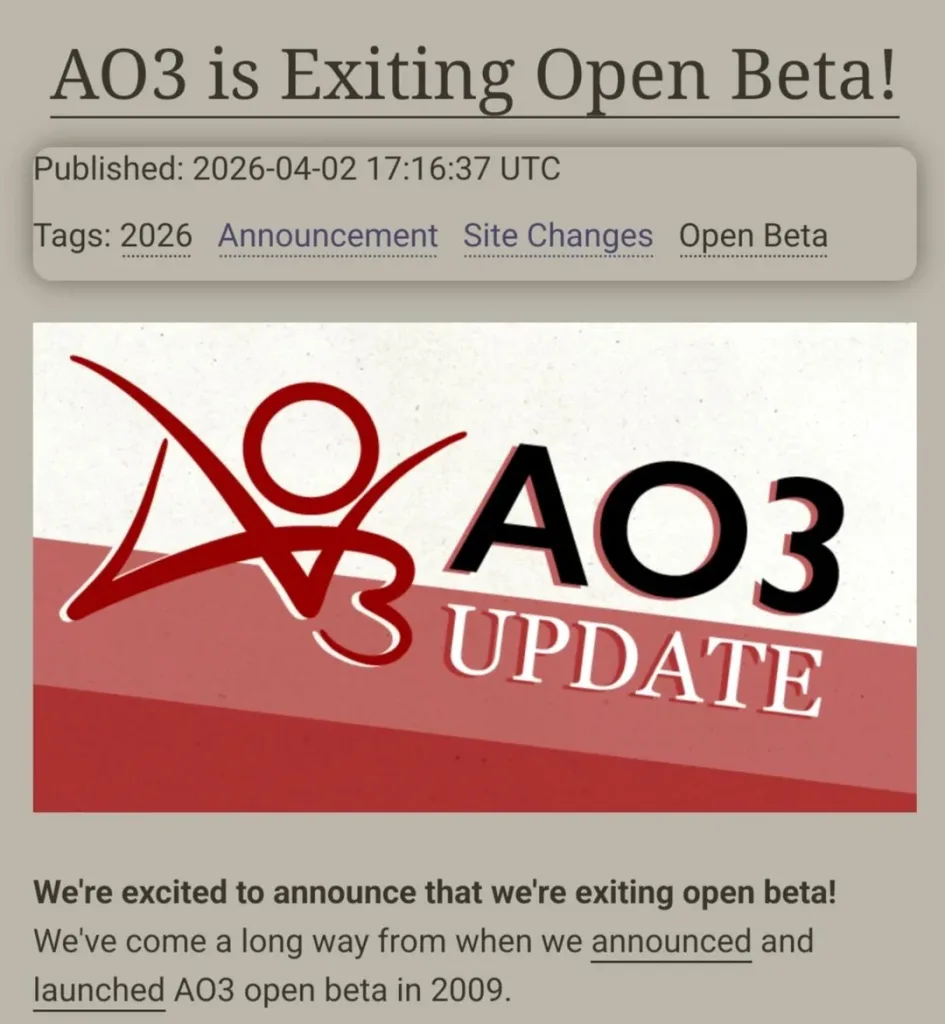
The Verge reported that the official beta exit happened in early 2026, marking a quiet but meaningful milestone. No press conference. No product launch event. Just a version number change and a community announcement that rippled through every fandom corner of the internet.
Here’s the thing — the “beta” label was largely symbolic for the past decade. The site functioned at full scale, won a Hugo Award in 2019, and survived traffic surges that’d cripple most commercial platforms. The exit from beta is less a technical upgrade and more a formal acknowledgment: this thing works, and it’s not going anywhere.
AO3 vs The Competition: How Fan Fiction Platforms Actually Stack Up
Fan fiction hosting isn’t a crowded commercial battlefield. Still, the alternatives to AO3 are worth examining honestly.
| Platform | Founded | Works Hosted | Ads | Ownership |
|---|---|---|---|---|
| AO3 | 2008 | 13M+ | None | Nonprofit (OTW) |
| FanFiction.net | 1998 | ~12M | Yes | Private (Xing Li) |
| Wattpad | 2006 | 1B+ stories | Yes | Naver (corporate) |
| Tumblr | 2007 | Varies | Yes | Automattic |
The contrast is stark. Wattpad, now owned by Korean tech giant Naver, has leaned hard into monetization and AI-generated content recommendations. FanFiction.net hasn’t meaningfully updated its interface since roughly 2012 (seriously — it still looks like 2012). AO3, meanwhile, operates on donations and volunteer labor, with no investor pressure and no algorithm pushing content for ad revenue.
Worth noting: AO3’s tagging system — a community-built taxonomy of thousands of tags — is genuinely one of the most sophisticated content organization systems on the open web. No commercial platform has come close to replicating it.
Real-World Impact of AO3’s Beta Exit on Writers and Readers
Practically speaking, the beta exit doesn’t flip a switch on features. But symbolically — and structurally — it matters.
The OTW has signalled that leaving beta means committing to a more formal development roadmap. That includes accessibility improvements, better mobile performance, and a more stable API for third-party tools that fans use to download and organize works offline. If you’ve ever tried to cancel jio official services and navigate confusing platform interfaces, you’ll understand why clean, user-controlled tools matter enormously to dedicated communities.
The real question is: does this change anything for the 5+ million registered users who post and read daily?
Not immediately. But the signal it sends is significant. A platform that spent 17 years in beta wasn’t stalling — it was refusing to rush. That kind of deliberate pace is almost unheard of in tech, where shipping fast and breaking things is treated as gospel.
And the timing isn’t accidental. AI-generated content is flooding every creative platform right now. Wattpad has faced backlash for its AI integrations. FanFiction.net has no clear policy. AO3, by contrast, has been vocal about protecting human-created works — and exiting beta with that stance intact sends a clear message to its community: this platform is still yours.
For writers specifically, the formal launch also strengthens OTW’s legal standing when defending fan works against copyright challenges. That’s not a small thing. It’s the difference between a scrappy beta project and an established institution with documented governance.
FAQ: What AO3’s Official Launch Actually Changes
Q: What does AO3 exiting beta actually mean for users?
For most readers and writers, the day-to-day experience won’t change overnight. The beta exit signals a formal commitment to a structured development roadmap, better accessibility, and improved mobile performance going forward.
Q: Is AO3 still free to use after the official launch?
Yes — completely free, with no ads. The platform runs entirely on donations to the Organization for Transformative Works (OTW), and that model isn’t changing.
Q: How does AO3 handle AI-generated fan fiction?
As of early 2026, the platform has maintained a strong stance in favor of human-created works. AO3’s volunteer moderators and community guidelines actively discourage AI-generated content, though enforcement at scale remains a challenge.
Q: Why did AO3 stay in beta for 17 years?
Because the O TW is a nonprofit run by volunteers, not a VC-backed startup chasing a launch deadline. The beta label was largely technical — the platform was fully functional and widely used for most of that period. As The Verge noted, it’s less a story of delay and more one of deliberate, community-paced development.
Q: Does the official launch affect AO3’s stance on copyright and fan works?
The formal launch actually strengthens OTW’s institutional position. A documented, officially released platform carries more legal weight than a perpetual beta project when defending fan creativity against copyright pressure.
The AO3 story isn’t really about a version number. It’s about what happens when a platform is built by its community, for its community — with no investors, no ads, and no algorithm deciding what you should read next.
Seventeen years in beta, and it still works better than most platforms that launched with millions in funding. That’s worth paying attention to. And if you want to explore how modern platforms handle long-term tech architecture decisions, our breakdown of AMD Ryzen official hardware launches shows just how differently the commercial tech world operates.