QAD0
QAD0 ALS0
ALS0 AQAJ0
AQAJ0 PAK0
PAK0 GAL0
GAL0 FEN0
FEN0 PSG
PSG LYON
LYON SEV
SEV OSA
OSA NED
NED OMA
OMA NZ
NZ IND
IND NAM
NAM IRE
IRE PAK
PAK SL
SL SA
SA AUS
AUS Abha
Abha Al Faisaly
 MBSG1
MBSG1 CFC0
CFC0 Barcelona1
 Real Madrid2
 Udinese0
 Milan2
 Real Sociedad2
 Levante1
 BRB
BRB MIS18/1 (1/20 ov)
 NZ-A317
 IND-A113 & 488/8 (119 ov)
 SYL575/4 (167.3 ov)
 KHU
KHU MYMS465/7d
 CHATT424/6 (121 ov)
 DHA521
 RAJ162 & 215/5 (59.1 ov) (f/o)
 RAN402 & 5/0 (2.3 ov)
 BAR443/9d
 SIKM30/1 (15 ov)
 NAGA187
 JHK
JHK DELHI309/5 (90 ov)
 ODSA194
 SVCS13/0 (5 ov)
 BRODA259/6 (86 ov)
 J & K
J & K CHD363/2 (87 ov)
 HP
HP CGR35/1 (14 ov)
 AP231
AP231 BAN
BAN WI
WI BIK
BIK CHR
CHR JER
JER KUW
KUW MEX-W51 (12.5/20 ov, target 187)
 ARG-W186/7
 NGA148
 UGA147/9 (20 ov, target 149)
 GMB112/9
 LES109 (19.5/20 ov, target 113)
 MOZ110/7 (19/20 ov, target 110)
 ZMB109/9
 IND-W328/6
 ZIM-W207 (48.5/50 ov, target 329)
 ENG241
 KBH0
KBH0 OBK1
OBK1 UAI0
UAI0 VSC0
VSC0 DEF0
DEF0 SAN0
SAN0 Sassuolo
 Lazio
Lazio AS Roma
 Cagliari
 Torino
 Como
Como CDSC
CDSC SLB
SLB CFC
CFC GRE
GRE Lecce0
 Juventus2
 Sunderland0
 Leeds0
Let us begin with a moment of honest self-reflection: we should never again tip Türkiye as World Cup dark horses.
Yes, they reached the semi-finals in 2002. Yes, they have Arda Güler, Kenan Yıldız, and Hakan Çalhanoğlu — players of genuine quality at elite European clubs. And yet here we are, Türkiye eliminated on day nine of the 2026 World Cup, having posted one of the most statistically catastrophic attacking records in the tournament’s recorded history.
To contextualise the scale of the failure: Türkiye survived in the tournament for precisely two and a half hours longer than Haiti. Haiti, whose football culture is still in its early developmental stages, was breaking new ground simply by being here. Türkiye’s campaign, by contrast, should be buried beneath that same ground — a monument to misplaced expectation and spectacular shooting futility.
The Number That Defines an Era of Futility
62 shots. Zero goals.
Across their two World Cup matches — against Australia and Paraguay — Türkiye produced 62 attempts on goal without the ball crossing the line a single time. According to records maintained since statisticians began comprehensive tracking in 1966, there is no precedent for a team failing to score from so many attempts across a two-match span at a men’s World Cup.
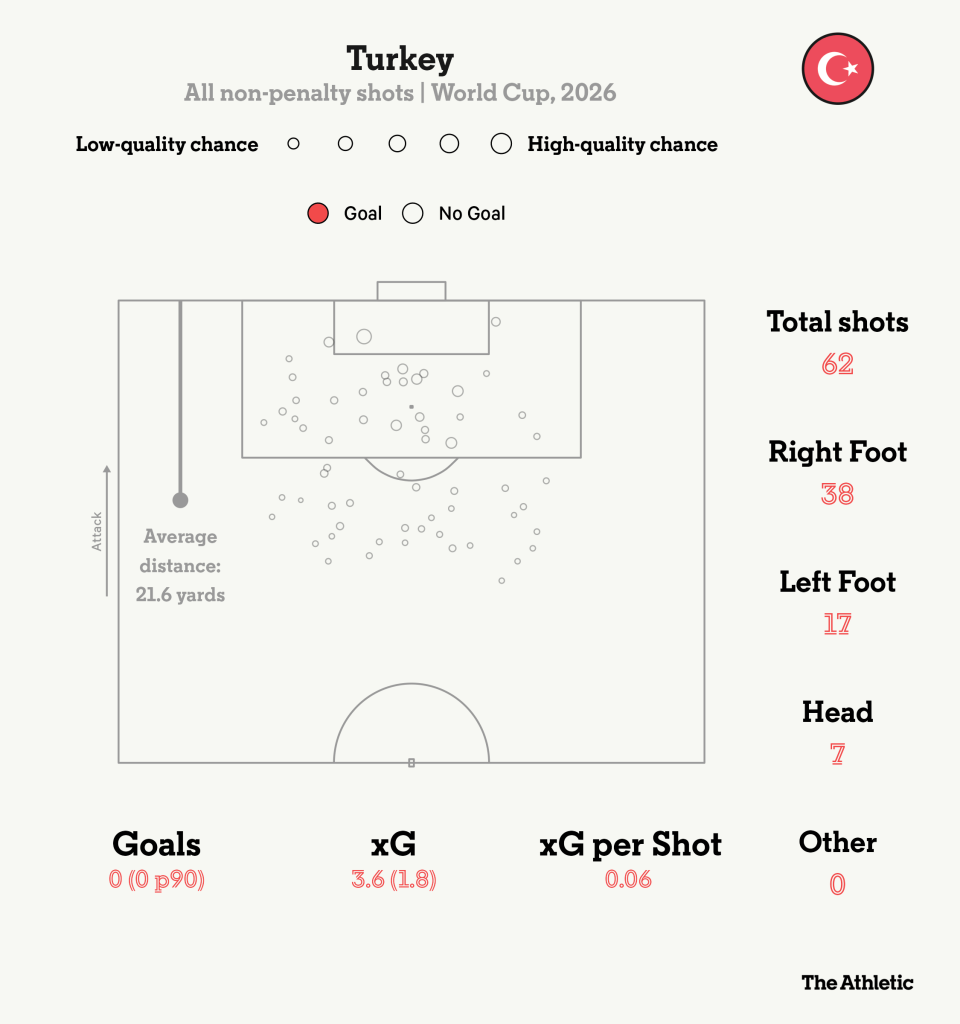
| Türkiye’s Shooting Record — World Cup 2026 | Stat |
|---|---|
| Total shots (both matches) | 62 |
| Goals scored | 0 |
| Expected goals (xG) | 3.6 |
| xG per shot | ~0.058 |
| Shots from outside the box | 51.4% |
| Shots from 24+ yards | 29 |
| Players who attempted a shot | 14 |
| Historical precedent for 0 goals from 62+ shots across 2 WC games | None (since 1966) |
Their xG total of 3.6 across 62 shots tells a damning story. Based purely on the quality of the positions from which they were shooting, Türkiye should have scored approximately three or four times. The fact that they scored zero is an extraordinary underperformance even accounting for the dire shot selection — approximately one goal expected every 17 attempts is already a dreadful ratio before accounting for the additional failure to even meet that low expectation.
The Shot Selection Problem: A Clinic in What Not to Do
Of those 62 shots, 51.4% were struck from outside the penalty box. 29 of them came from a distance of 24 yards or greater — well beyond the range at which even the most gifted strikers operate efficiently.
This is not just bad strategy. It is a pattern that reveals something deeper: a team that had no coherent plan for breaking down organised defences and resorted, with increasing desperation, to hitting the ball from unlikely positions and hoping something miraculous would happen.
It did not.
Güler, Türkiye’s most technically gifted player and one of the most creative midfielders at Real Madrid, contributed 11 shots of his own — the equivalent of a concert conductor performing brilliantly while the orchestra flails around him with instruments they don’t quite know how to play. The supporting cast followed suit:
| Top Türkiye Shot-Takers — World Cup 2026 | Shots |
|---|---|
| Kenan Yıldız | 12 |
| Arda Güler | 11 |
| Hakan Çalhanoğlu | 11 |
| Others | 28 (across 11 more players) |
In total, 14 different players attempted shots for Türkiye across the two matches. Goalkeeper Uğurcan Çakır was not among them — though by the end of the Paraguay game, he had joined the attack for a last-gasp free kick in pure desperation. It did not work. Nothing worked.
The Paraguay Game: Worse Than It Sounds
The Paraguay match deserves particular examination because of the circumstances that surrounded it.
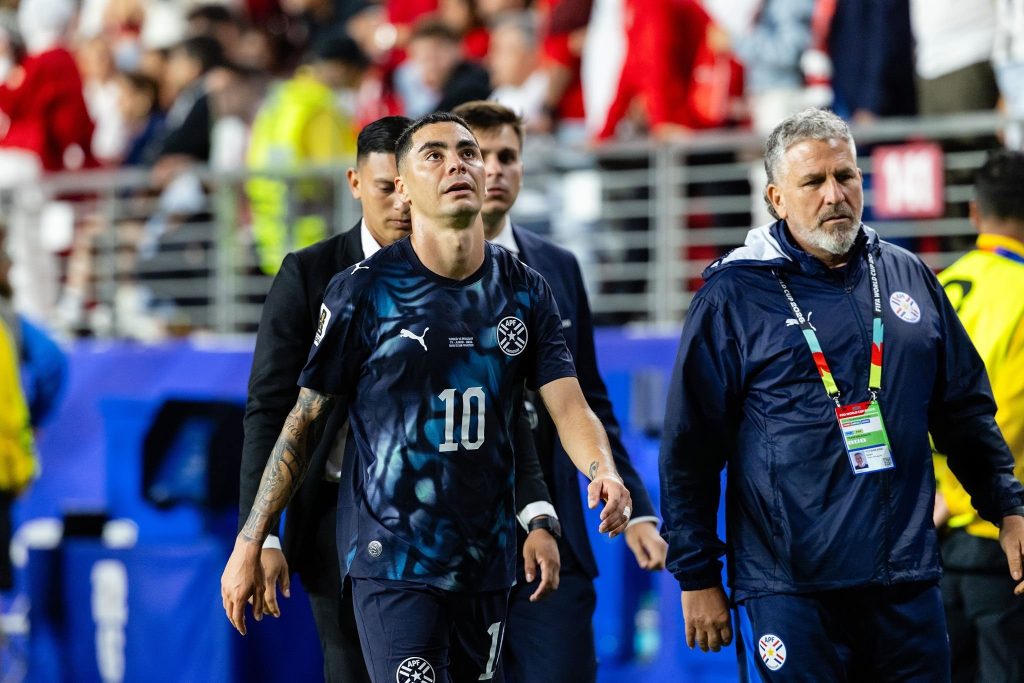
Miguel Almirón was sent off for breaking the new rule prohibiting players from speaking to opponents with their mouths covered — a dismissal that generated considerable controversy and discussion in its own right. Paraguay were reduced to ten men for more than 45 minutes, and Türkiye could not score.
Let that settle for a moment.
Vincenzo Montella had a numerical advantage for nearly half a game against a side that had been organised primarily to defend a single goal lead. He had — in theory — some of the most technically gifted attacking players at the tournament at his disposal. He had Güler, Yıldız, Çalhanoğlu. And across that entire period, not one of Türkiye’s many, many attempts found the back of the net.
Merih Demiral, throwing himself forward in the dying minutes, came closest to the kind of miracle that would have extended the tournament for Türkiye — a late header that glanced wide rather than in. The margin between an extraordinary comeback and the ignominious exit that actually occurred was perhaps six inches.
He stayed on trend. The header went wide.
The Structural Problem: Defences That Figured Them Out
The screenshots from both matches paint a consistent picture. Australia and Paraguay were able to set their defensive shape and shift their lines to contain Türkiye’s attacking thrusts almost at will, because those thrusts were predictable.
The core tactical problem was a lack of variation. When Türkiye’s more direct approaches — Güler threading passes, Yıldız driving forward — were successfully contained by organised defensive blocks, the response was to retreat further from goal and attempt increasingly ambitious long-range strikes rather than to find creative solutions closer to the opposition’s defensive line.
Both opponents recognised the pattern within the first 20 minutes of their respective matches and adjusted accordingly. Once that adjustment was made, Türkiye had no reliable counter-response.
This raised questions not just about individual quality — because the players involved are genuinely talented — but about tactical preparation. Did Montella’s side have a clear plan B when opponents successfully nullified the central creative play? The evidence of 62 shots from increasingly unlikely positions suggests the plan B was simply: shoot more.
The Montella Question: A Good Coach in an Impossible Position?
Vincenzo Montella is, by any fair assessment, not a bad coach. His career record is respectable, his knowledge of European football is extensive, and his previous spells in charge have produced creditable results.
As a player, he was part of the Italy side that reached the Euro 2000 final — a night when the Azzurri led in extra time before David Trezeguet’s golden goal denied them the trophy in what remains one of the most heartbreaking final-minute reversals in major tournament history. He was no mug on a football pitch.

As Türkiye’s manager, he took a team ranked in the top 30 in the world to a World Cup for only the third time in their history and navigated them through a difficult UEFA play-off path. The qualification achievement should not be dismissed.
But the tactical failure in North America — and specifically the inability to devise a mechanism for breaking down compact defences with a team of this attacking quality — will define his time in charge. The opportunity was real. Güler and Yıldız are genuine world-class talents at 21 and 22 years old respectively. Çalhanoğlu is one of the best ball-playing midfielders in Serie A. This was not a team without resources.
The resources simply did not produce goals. Or even a single goal.
The Historical Comparison That Makes This Worse
To understand why 62 shots, 0 goals across two matches is so extraordinary, it helps to consider what typically happens at World Cups.
Even teams that lose heavily, even teams that struggle with possession, even teams that are clearly outclassed — they tend to score something. The expanded tournament format brings mismatches. The group stage regularly features nations of significantly different quality. And yet the record books, going back to 1966, cannot produce a parallel for what Türkiye managed across their two matches.
The closest comparable situations — teams that came close to shutting out their own scoring opportunities across multiple matches through a combination of poor shot selection and bad finishing — do not reach the same figure. 62 shots without a single goal across two matches. It stands alone.
What This Means for Türkiye’s Football Future
The most dangerous thing about this World Cup campaign is what it might do to a generation of genuinely talented players.
Güler and Yıldız are young enough that their international careers stretch well into the 2030s. Both have the technical quality to be significant World Cup contributors. The danger is that a campaign as demoralising as this one — combined with the weight of the constant “dark horses” label that Turkish football teams tend to carry — creates psychological burden rather than motivation.
At the same time, the shooting data reveals something correctable. The quality of positions being selected for shots — with over half coming from outside the box and 29 from beyond 24 yards — is a tactical and psychological issue as much as a technical one. Players were attempting shots they had no realistic chance of scoring from because the alternative — constructing more intricate approaches to goal — was too difficult against organised opponents.
Better preparation, clearer tactical frameworks for breaking down defensive blocks, and possibly a more direct physical presence up front (something Türkiye notably lacked) could transform those numbers significantly.
The Summarising Thought
Somewhere in the Türkiye camp in the hours after their elimination, there will be silence heavier than any result can usually produce. Not the silence of a close defeat, or a shootout loss, or an unfortunate early exit — but the silence that follows two matches in which you dominated the shot statistics and came away with nothing.
62 shots. 3.6 expected goals. Zero actual goals. Eliminated on day nine.
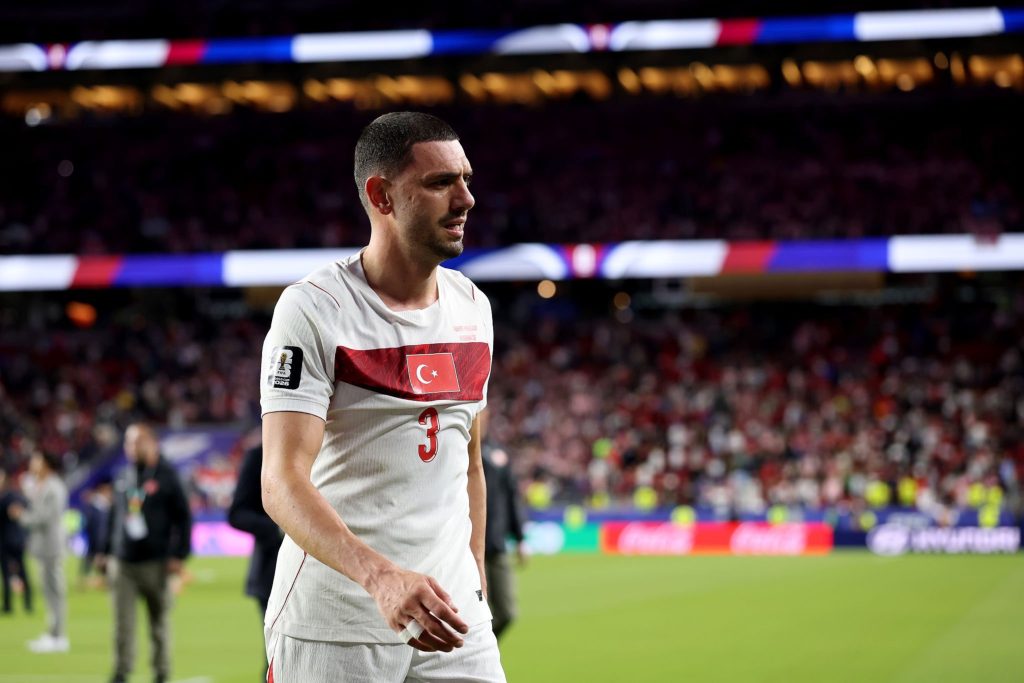
The dark horse label will presumably follow Türkiye to the next tournament, to the qualification campaign before it, and to the one after that. Football fans are not good at learning lessons from statistical evidence.
But the evidence is there for anyone who wants to examine it.
Read More: Why the Netherlands’ New-Look Attack Could Take Them Deep at the World Cup