PAK221/9 (44.2/50 ov, target 242)
 ENG241
 IND-W328/6
 ZIM-W207/9 (48.4/50 ov, target 329)
 NGA
NGA UGA
UGA MEX-W
MEX-W ARG-W
ARG-W CRY0
CRY0 NEW1
NEW1 HUL1
HUL1 BRE0
BRE0 LIV2
LIV2 BHA0
BHA0 MAN0
MAN0 BOU2
BOU2 CEL
CEL BET
BET AUX
AUX MNS
MNS ANG
ANG LOR
LOR OLM
OLM HAC
HAC REN
REN STR
STR TOU
TOU TRY
TRY SUN
SUN LEE
LEE SCF
SCF MUN
MUN ATH4
ATH4 GET0
GET0 INT2
INT2 FIO1
FIO1 CHU2
CHU2 PFC3
PFC3 GMB112/9
 LES109 (19.5/20 ov, target 113)
 DEN
DEN PNG
PNG LIMWn
LIMWn NW-W
NW-W NCWmn
NCWmn FsWm
FsWm BOL137/9 (20 ov)
 TITNS137/8
 NWEST22/3 (3.1/20 ov, target 181)
 NCAPE180/3
 MIS
MIS VAG115/4 (14.3/20 ov)
 NZ-A317
 IND-A113 & 106/2 (36 ov)
 SYL280/2 (84 ov)
 KHU
KHU BRB
BRB MOW
MOW TOK
TOK SIKM
SIKM NAGA
NAGA JHK
JHK DELHI
DELHI ODSA
ODSA SVCS
SVCS CGR
CGR AP
AP BRODA
BRODA J & K
J & K MOZ110/7 (19/20 ov, target 110)
 ZMB109/9
 UAE244/8
 NED245/7 (43.5/50 ov, target 245)
 ATA3
ATA3 FRO3
FRO3 GEN1
GEN1 VEN0
VEN0 MON0
MON0 LILL1
LILL1 KER0
KER0 MCFC0
MCFC0 TSG0
TSG0 B040
B040 NEC2
NEC2 GRO2
GRO2 PSV1
PSV1 FEY1
FEY1 Motherwell0
 Hearts1
 Atlético1
 Deportivo0
 Lazio2
 Parma1
 Lens2
Lens2 Paris FC1
Having progressed beyond the group stage just once in their World Cup history — a run to the Round of 16 in 2006 — Ecuador arrive in North America on the back of arguably the finest qualification campaign they have ever produced.
La Tri conceded just five goals across 18 CONMEBOL qualifiers and kept 13 clean sheets — no South American nation boasted a stronger defensive record. They also arrive unbeaten in four post-qualification friendlies, including a draw away at the Netherlands in March, and enter this tournament on the back of a 15-game unbeaten run.
In Group E alongside Germany, Ivory Coast, and Curaçao, those foundations could prove crucial.
Defensive Stability: The Numbers That Define Ecuador
The defensive record deserves to be stated plainly. Ecuador conceded just five goals in 18 qualifying matches — half the tally of the next-best team, reigning world champions Argentina.
| CONMEBOL Qualifying Defensive Record | Clean Sheets | Goals Conceded | xG Against |
|---|---|---|---|
| Ecuador | 13 | 5 | 13.3 |
| Argentina | — | 10 (approx) | — |
| Only Argentina and Brazil | — | — | Lower xG against |
Only Argentina and Brazil conceded chances worth a lower expected goals (xG) total than Ecuador’s 13.3 xG against during qualification. Their opponents’ shot map illustrates a team that protected central spaces close to their own goal with exceptional discipline — limiting chances to wide areas in the box or from long range.
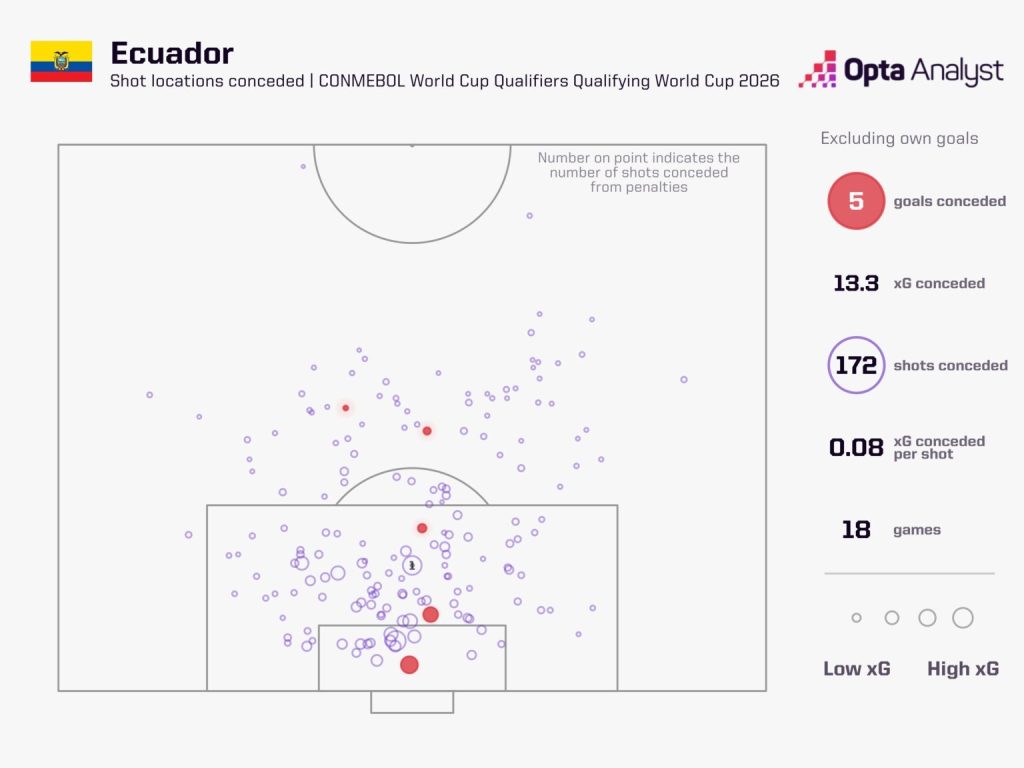
Under Sebastián Beccacece, they have developed into a disciplined defensive unit built to utilise speed and attacking efficiency on the break. The Argentine head coach used seven different formations across qualifying — variations of a back four in 10 matches and a back three in the remaining eight — demonstrating a tactical adaptability that could become a significant asset when different opponents and game states demand constant adjustment.
Only 97 Minutes Behind Across 18 Matches
The consequence of conceding so rarely is that Ecuador almost never had to chase games.
They spent just 97 minutes behind across all 18 qualifying matches — just 5.5% of their total match time. No other South American nation came close. Uruguay ranked second and still spent significantly more time behind (243 minutes).
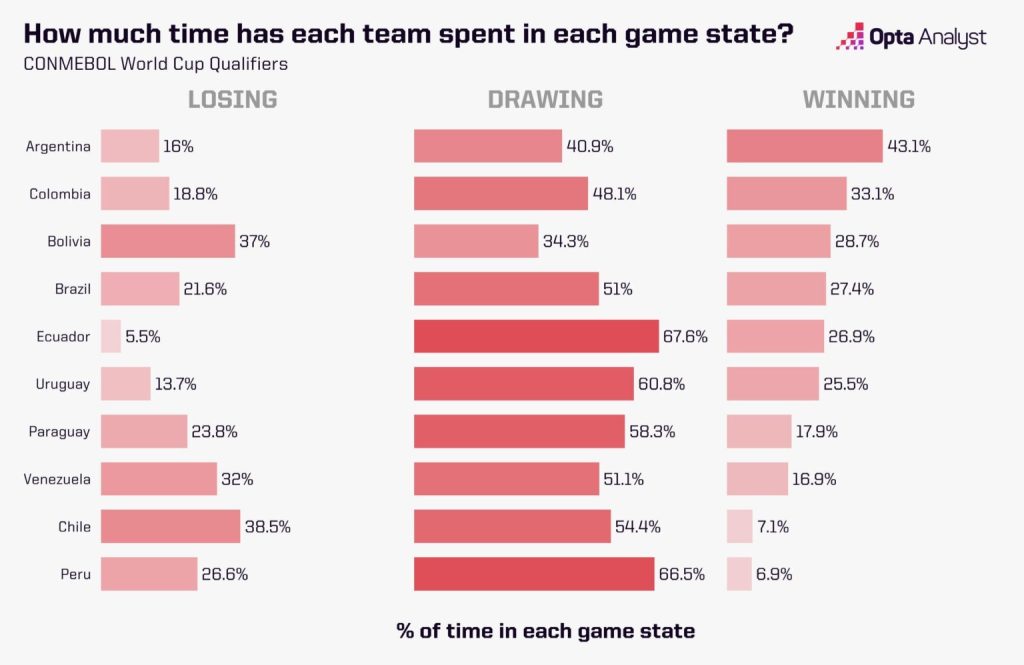
| Time Spent Trailing in CONMEBOL Qualifying | Team | Minutes Behind |
|---|---|---|
| Ecuador | 97 | 5.5% of match time |
| Uruguay (2nd) | 243 | — |
That positional comfort allowed Ecuador to lean consistently on their counter-attacking threat rather than being forced to open up in search of goals. Beccacece’s side scored three goals directly from counters during qualification — second only to Colombia’s six — and managed 23 direct attacks in total, just one fewer than Venezuela, Uruguay, and Brazil (all 24).
The Attacking Trade-Off
The trade-off for this defensive excellence has been limited attacking output. Among the CONMEBOL nations that qualified for this World Cup, no side scored fewer goals than Ecuador’s 14 in 18 matches. They drew four consecutive games 0-0 during qualification, which drew criticism from sections of the national media and fanbase.
That lack of cutting edge has been the most significant point of debate around this team. But Ecuador’s pragmatic approach is, in many ways, precisely what succeeds in tournament football — particularly in knockout rounds where patience, defensive organisation, and the ability to strike on the break can nullify technically superior opponents.
If Beccacece’s side can escape Group E and reach the knockouts, their style becomes considerably more potent.
A Spine of Genuine Quality
With elite-level talent running through the centre of the team, Ecuador’s rise to 24th in the FIFA World Rankings is no surprise.
Willian Pacho — The Foundation
The 24-year-old centre-back enjoyed another outstanding season with PSG, winning the Ligue 1 title and playing every minute of their Champions League campaign. His influence in qualification was immense.
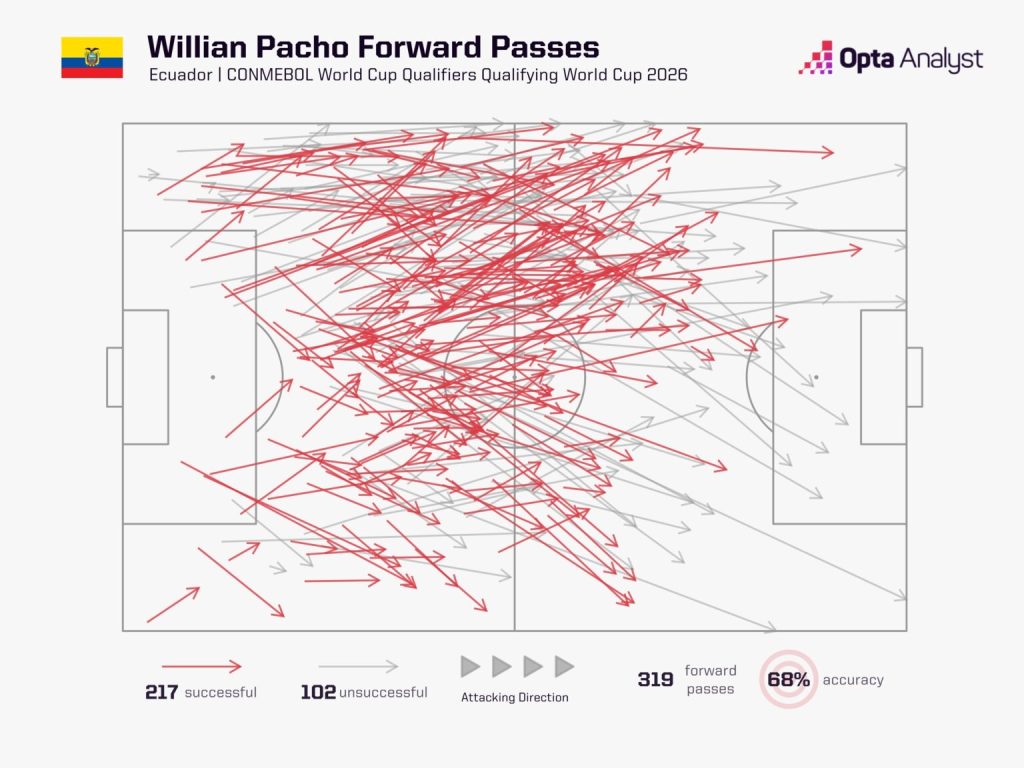
| Willian Pacho — CONMEBOL Qualifying | Stat | Ranking |
|---|---|---|
| Blocks made | 15 | Joint-first among all players |
| Clearances | 65 | 4th among all players |
| Total touches | 1,290 | 4th among all players |
| Forward passes attempted | 319 | Top 3 among outfielders |
| Forward pass accuracy | 68% | — |
Beyond his defensive work, Pacho’s passing range allows Ecuador to transition quickly — relieving pressure and launching attacks from deep with a composure rare for a defender his age.
Moisés Caicedo — The Heartbeat
Caicedo (Chelsea) is the engine that powers Ecuador’s defensive structure in midfield. His physicality, ball-winning, and relentless energy make him one of the most complete defensive midfielders in the tournament.
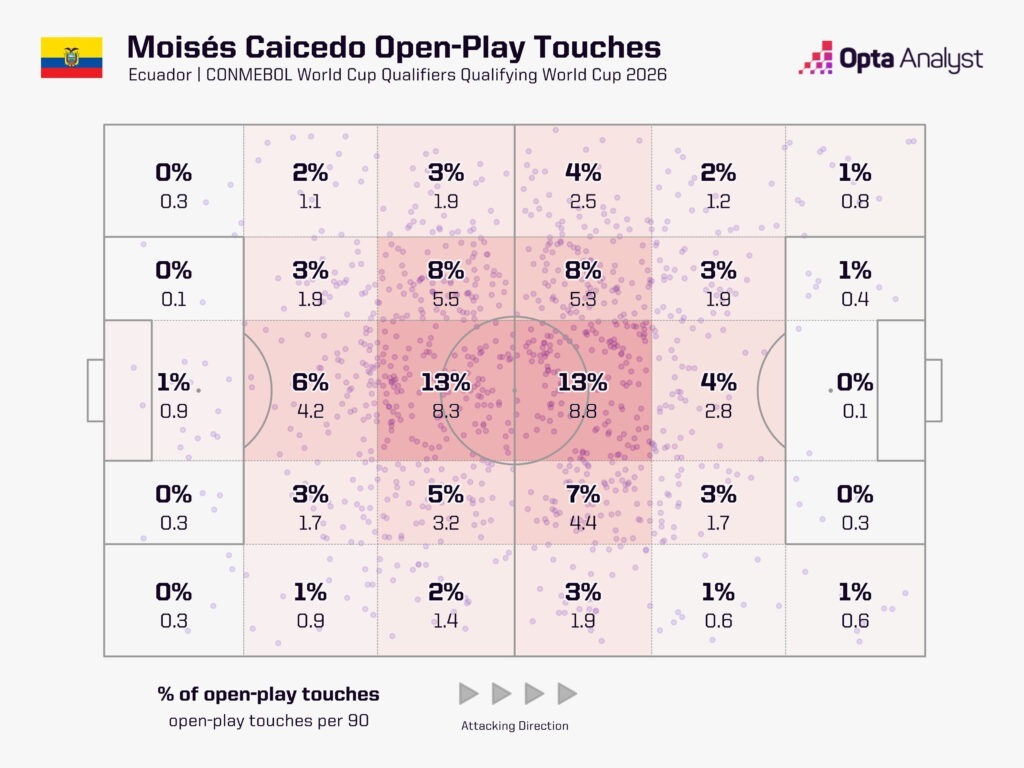
| Moisés Caicedo — 2025-26 Club and International | Stat | Context |
|---|---|---|
| Interceptions (Premier League) | 59 | One of only 3 players in Europe’s top 5 leagues with 50+ interceptions and 85+ tackles |
| Tackles (Premier League) | 97 | — |
| Possession regains (CONMEBOL qualifying) | 92 | 2nd highest among all qualifying players |
| Duels won (CONMEBOL qualifying) | 102 | Top 3 among all players |
| Assists (CONMEBOL qualifying) | 3 | Surpassed by only 3 players |
His three assists in qualification — surpassed by only three other players across the entire CONMEBOL section — underline that Ecuador will need midfield contributions to supplement the attack. With just 14 goals in 18 matches, Caicedo’s ability to contribute beyond defensive work will be vital this summer.
Enner Valencia — The Veteran Leader
Valencia remains Ecuador’s record scorer and one of their greatest ever international players. He leads the attack at a World Cup for the third time and remains the focal point of everything they do offensively.
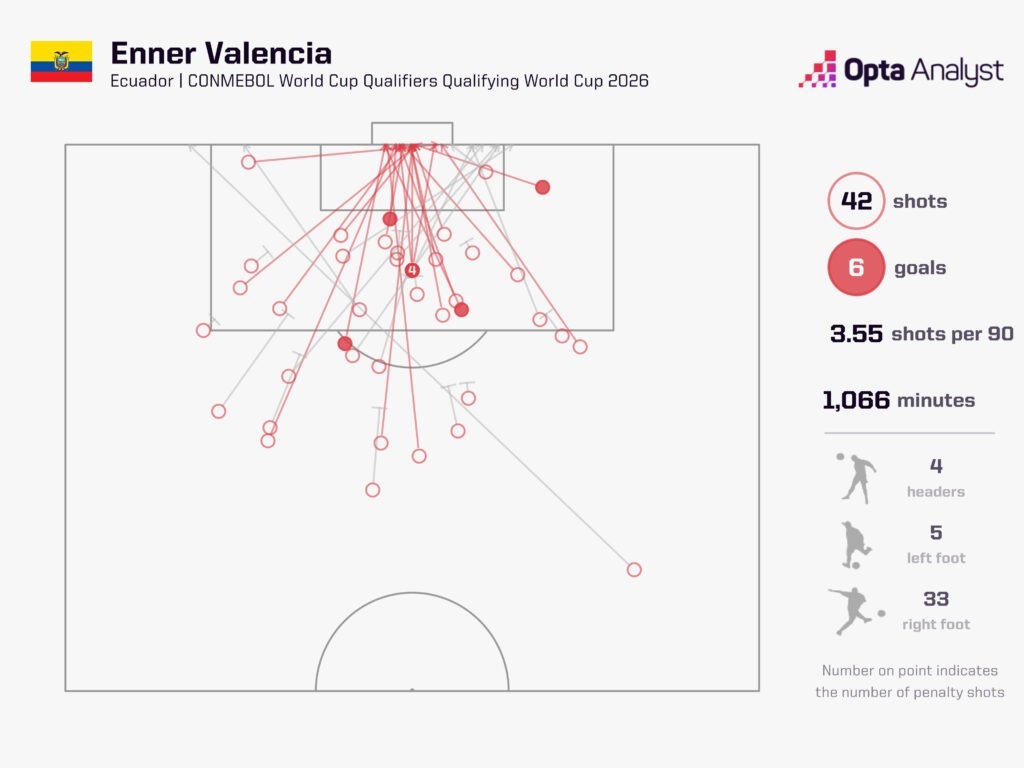
| Enner Valencia — CONMEBOL Qualifying | Stat | Ranking |
|---|---|---|
| Goals | 6 | Top 4 among all qualifying players |
| Shots on target | 21 | Joint-first among all players |
| Expected goals (xG) | 7.1 | 2nd |
| Total shots | 42 | 3rd |
Six of Ecuador’s 14 qualifying goals came from Valencia. The dependency on him is significant — and he carries the weight of that responsibility with experience and composure. At 36, this is almost certainly his final World Cup. He will know it.
Why This Could Be Their Year
Ecuador are not going to win the 2026 World Cup. But they are built for tournament football in a way that pure attacking sides often are not.
Their 13 clean sheets in 18 qualifying games, their 97 minutes spent trailing, their tactical flexibility across seven formations, and a defensive partnership between Pacho and Caicedo that operates at Champions League and Premier League level respectively — these are the ingredients of a team that makes life extremely difficult for every opponent.
If they can find just enough attacking output through Valencia, Caicedo’s contributions from midfield, and the collective counter-attacking threat they demonstrated in qualification, Ecuador are capable of troubling higher-profile opponents and advancing further than they ever have at a World Cup.
The nation’s best-ever finish at football’s biggest tournament is well within reach. Their defensive steel is the reason why.
Read More: World Cup 2026: Group E Predictions and Preview