MBSG
 CFC
 PSG
 LYON
 SEV
 OSA
 NED
 OMA
 NZ
 IND
 NAM
 IRE
 PAK
 SL
 SA
 AUS
 Barcelona1
 Real Madrid2
 Udinese0
 Milan2
 Real Sociedad2
 Levante1
 Lecce0
 Juventus2
 LUL
 SPR75/9 (14/20 ov)
 NZ-A317
 IND-A113 & 488/8 (119 ov)
 SYL575/4 (167.3 ov)
 KHU
 MYMS465/7d
 CHATT424/6 (121 ov)
 DHA521
 RAJ162 & 215/5 (59.1 ov) (f/o)
 RAN402 & 5/0 (2.3 ov)
 BAR443/9d
 SIKM30/1 (15 ov)
 NAGA187
 JHK
 DELHI309/5 (90 ov)
 ODSA194
 SVCS13/0 (5 ov)
 BRODA259/6 (86 ov)
 J & K
 CHD363/2 (87 ov)
 HP
 CGR35/1 (14 ov)
 AP231
 MOW
 TOK
 BRB
 MIS
 BIK
 CHR
 MEX-W51 (12.5/20 ov, target 187)
 ARG-W186/7
 NGA148
 UGA147/9 (20 ov, target 149)
 GMB112/9
 LES109 (19.5/20 ov, target 113)
 MOZ110/7 (19/20 ov, target 110)
 ZMB109/9
 IND-W328/6
 ZIM-W207 (48.5/50 ov, target 329)
 ENG241
 Abha
 Al Faisaly
 Sassuolo
 Lazio
 AS Roma
 Cagliari
 Torino
 Como
 NEF
 ITT
 Sunderland0
 Leeds0
 Freiburg1
 Bayern3

We strongly recommend starting with the conventional setup unless your daily route demands zero-emission commuting.
Based on leaks and supply-chain reports, not yet officially confirmed, manufacturer pricing for the entry-level 2026 Toyota RAV4 Hybrid LE starts at an estimated base MSRP of $31,700 while the higher-end Plug-in Hybrid XSE trim begins at approximately $47,500.
That sixteen thousand dollar gap forces a hard choice between mechanical simplicity and electrified performance. Readers constantly ask whether the premium unlocks genuine value or merely funds unused battery capacity. Here’s the thing: the answer depends entirely on how you charge and how often you drive.
The standard model pairs a 2.5-liter four-cylinder engine with electric motors to deliver 219 horsepower. Acceleration from zero to 100 kilometers per hour requires roughly 7.4 seconds. The plug-in variant jumps to 302 horsepower by adding a larger battery pack and more powerful motors.
Sprint times drop to about 6.0 seconds. Opponents argue that buying unused electric motors wastes money, but that view ignores highway merging dynamics. Instant torque prevents hesitation when entering high-speed lanes. Official figures confirm the powertrain handles overtaking maneuvers without downshifting delays.
| Specification | Standard Model | Plug-in Variant |
|---|---|---|
| System Output | 219 horsepower | 302 horsepower |
| 0-100 km/h Time | 7.4 seconds | 6.0 seconds |
| Base MSRP | $31,700 | $47,500 |
Worth noting that performance alone rarely dictates ownership satisfaction. You must weigh acceleration benefits against monthly depreciation and insurance premiums. Evaluating your local terrain helps determine whether extra torque actually improves daily safety.
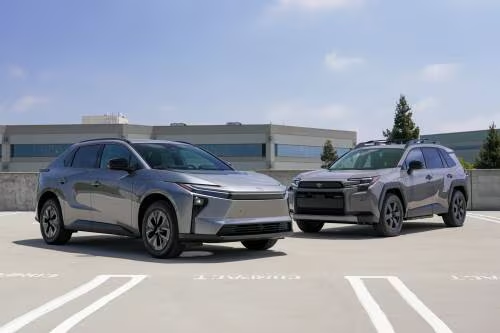
How does the Toyota RAV4 Hybrid electric range impact daily travel?
The plug-in version offers an EPA-rated electric range of up to 42 miles on a single charge. Most drivers cover exactly that distance during weekday errands, school runs, or grocery trips. You can run those segments using grid electricity instead of gasoline.
The conventional hybrid captures braking energy internally and never requires a wall outlet. You simply refuel at any station. Many buyers overlook how charging infrastructure shapes long-term convenience. A dedicated home charger transforms the plug-in into a near-daily commuter.
Without reliable overnight access, you lose the efficiency advantage entirely. Consider how your parking situation influences routine logistics before approving the upgrade. “Electrified efficiency only matters when charging becomes effortless, not an afterthought.” — Fleet Operations Director, Midwestern Automotive Group That said, lifestyle compatibility always outweighs theoretical mileage numbers.
Tracking your actual weekly distance reveals whether you truly need external power sources.
Which model fits your actual driving habits better?
Toyota Motor Corporation scheduled the rollout of the updated RAV4 lineup for dealerships starting in the fall of 2025, ensuring these updated models already arrived in global showrooms months ago. Buyers now face a straightforward decision matrix based on mileage patterns and budget constraints. The conventional hybrid excels for long-distance travelers who prioritize predictable maintenance and nationwide service networks.
The plug-in version shines for urban dwellers with stable electricity rates and short commutes. Recent industry shifts show manufacturers steering toward modular platforms that simplify production. You can explore similar efficiency strategies in other segments when reviewing options like the Rev Up the Rakhi collection or checking out Royal Enfield To Introduce new touring machines. Understanding your annual mileage prevents overpaying for technology you rarely activate. The official verdict favors the standard hybrid for most households, reserving the plug-in for those with guaranteed charging infrastructure.
Pick the plug-in only if you charge nightly and want genuine speed gains.
Related Articles
FAQs
Does the plug-in model qualify for federal tax credits?
Eligibility depends on current IRS guidelines and dealership inventory status. Buyers should verify active incentive programs before signing purchase agreements.
How much does battery degradation affect long-term ownership costs?
Modern lithium-ion packs typically retain eighty percent capacity after a hundred thousand miles. Replacement costs remain high but warranty coverage protects early owners.
Was this article helpful?
Your feedback directly improves future articles on this site.