Christopher Nolan doesn’t do faithful adaptations quietly — and “The Odyssey” is no exception. While the bones of Homer’s ancient poem remain intact, Nolan reshaped several major characters, scenes, and story beats to fit his three-hour blockbuster vision. Here’s what actually changed.
The Odyssey: The Biggest Changes, Side by Side
| Element | Homer’s Version | Nolan’s Version |
|---|---|---|
| Starting Point | Begins 20 years later, war told in flashback | Opens inside the Trojan War itself |
| Penelope & Telemachus | Telemachus dismisses his mother’s voice | Penelope openly challenges her son’s immaturity |
| The Sea Peoples | Not mentioned by name | Referenced frequently as raiders |
| Sinon | Doesn’t appear in the poem | Introduced as Antinous’s cousin and substitute soldier |
| Laestrygonians | Cannibalistic islanders | Reimagined as towering armored warriors |
| Aeolus’s Winds & Phaeacians | Key parts of the journey home | Left out entirely |
Putting the War Front and Center
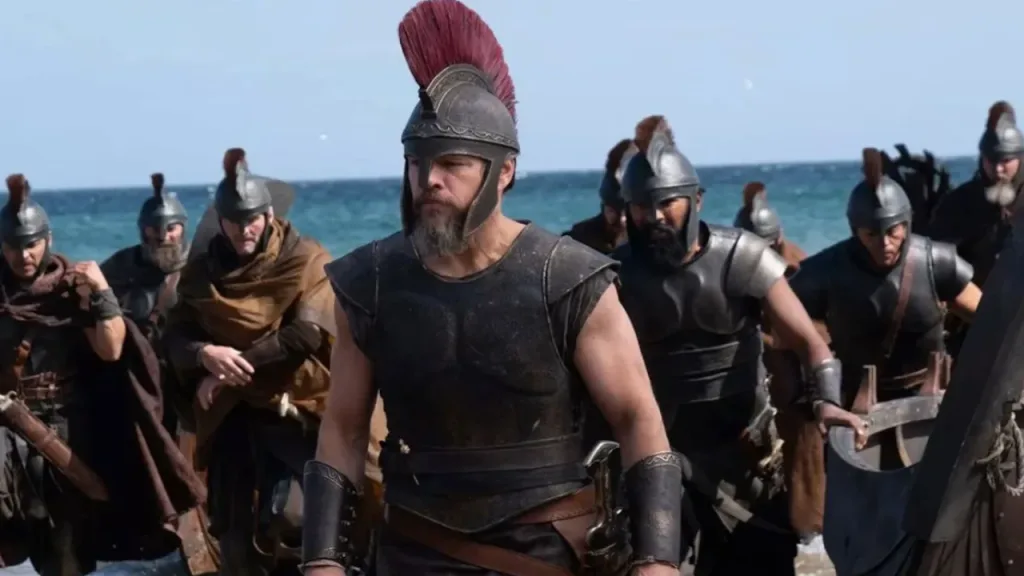
Homer’s “Odyssey” famously skips the Trojan War itself, opening years after Troy has already fallen and letting the conflict unfold through memory. Nolan flips that structure, pulling audiences directly inside the Trojan Horse and into the brutal aftermath, including the desecration of a statue of Athena — a moment that sets the emotional stakes for everything that follows.
Penelope Gets a Sharper Voice
One of the more striking character shifts involves Penelope and her son. In the original poem, Telemachus repeatedly silences his mother, at one point ordering her back to her weaving. Nolan reverses that dynamic entirely, giving Penelope the sharper tongue and having her openly criticize her son’s behavior — including declaring she’d happily watch her suitors burn.
New Characters, Borrowed From Elsewhere
Sinon, the double-crossing soldier responsible for tricking the Trojans into accepting the wooden horse, never actually appears in Homer’s “Odyssey” or “Iliad.” He’s pulled instead from Virgil‘s “Aeneid,” with Nolan linking him directly to Antinous through a drawing-of-lots scene that sends him to Troy in another soldier’s place.
What Got Cut
Despite the film’s sprawling runtime, a few classic detours didn’t make it in. Aeolus’s bag of winds — which sends Odysseus back out to sea just as Ithaca comes into view — is gone, as are the Phaeacians who help him complete his journey home. Meanwhile, most of the poem’s signature threats, including the Cyclops Polyphemus, the Sirens, and the sea monsters Scylla and Charybdis, remain largely intact on screen.
For more movie breakdowns and adaptation deep-dives, check out our latest coverage on TechnoSports.