NED
NED OMA
OMA NZ123/3 (11.6/20 ov)
 IND
IND NAM37/1 (8/50 ov)
 IRE
IRE PAK0/0 (0.3/50 ov)
 SL
SL SA
SA AUS
AUS ABH
ABH ALF
ALF AFG
AFG ZIM
ZIM SAS
SAS LAZ
LAZ ROMA
ROMA CAG
CAG TOR
TOR COMO
COMO BAN
BAN WI
WI IND-W
IND-W ZIM-W
ZIM-W Sevilla2
 Osasuna0
 PSG2
PSG2 Lyon0
Lyon0 Mohun Bagan1
 Chennaiyin0
 Flamengo3
 Atlético-MG2
 JER
JER KUW
KUW PNG
PNG QAT
QAT BIK
BIK CHR117/3 (16.4/20 ov)
 SYL575/4 (167.3 ov)
 KHU
KHU MYMS465/7d
 CHATT424/6 (121 ov)
 RAN402 & 5/0 (2.3 ov)
 BAR443/9d
 SIKM184
 NAGA187 & 9/0 (8 ov)
 JHK
JHK DELHI515/5d (130 ov)
 JAB
JAB KAY
KAY DEN
DEN KENYA
KENYA POA
POA SPR
SPR BRB149/5 (16.2/20 ov, target 148)
 MIS147
 MOW107/9
 TOK111/5 (18.4/20 ov, target 108)
 LUL88/3 (9.5/20 ov, target 88)
 GOA
GOA SC Delhi
 Milan
Milan Bologna
 Parma
Parma Udinese
 Venezia
 Inter Milan
 Coritiba0
 Grêmio1
 Santa Clara1
 Benfica2
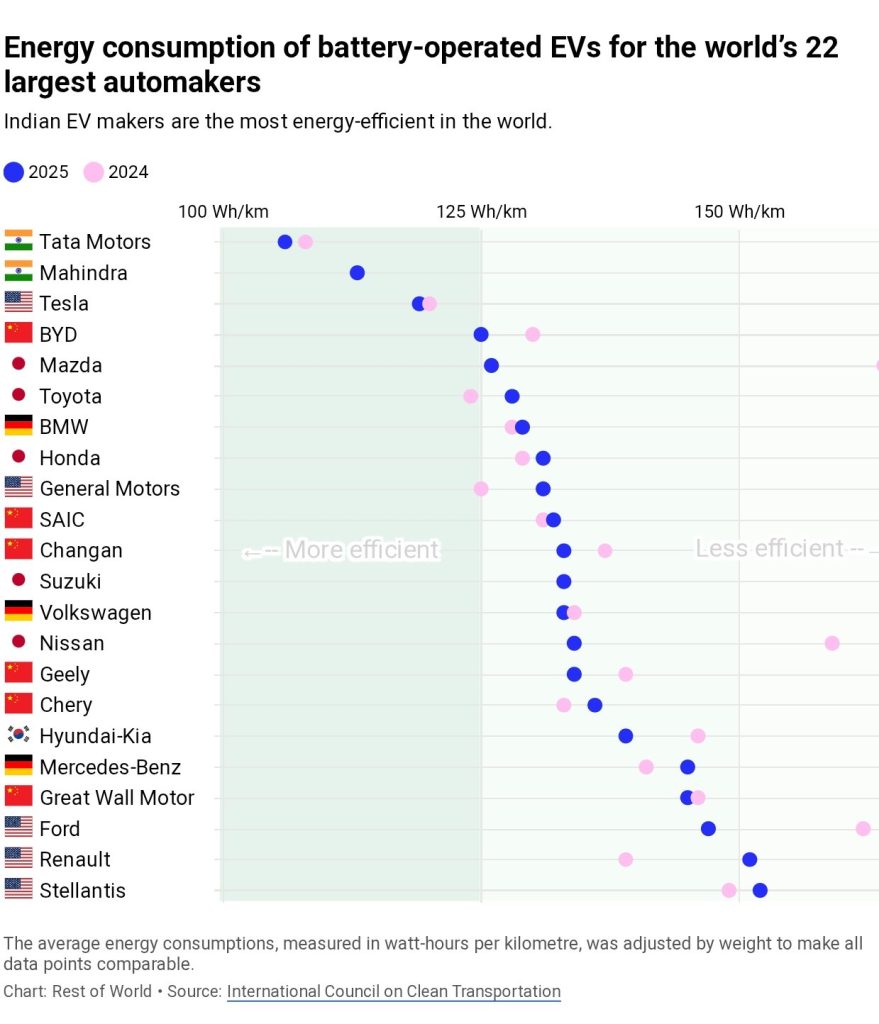
Forget flashy range claims for a second — when it comes to squeezing the most distance out of every watt-hour, India is quietly winning. A new global study just crowned Tata Motors and Mahindra as the world’s most battery-efficient EV makers, ahead of Tesla and BYD.
Global EV Efficiency: The Numbers That Matter
The ICCT Global Automaker Rating 2025, published by the International Council on Clean Transportation, evaluated 22 of the world’s largest automakers on adjusted energy consumption — essentially, how much power a brand’s EVs use per kilometre once weight differences are accounted for.
| Automaker | Energy Consumption |
|---|---|
| Tata Motors | 106 Wh/km |
| Mahindra | 113 Wh/km |
| Tesla | ~118 Wh/km |
| BYD | ~120 Wh/km |
| Global average | 131 Wh/km |
Lower numbers win here — it means the EV travels farther on less electricity, translating into smaller (and cheaper) battery packs for the same real-world range.
Why This Is a Big Deal
Tata topped the chart outright, while Mahindra — included in the rating for the very first time — landed second, edging out household names like BMW, Volkswagen, Hyundai-Kia and Mercedes-Benz on this specific metric. It’s a strong signal for anyone following India’s electric vehicle push, where compact, lightweight crossovers are proving to be a genuine engineering advantage rather than a compromise.
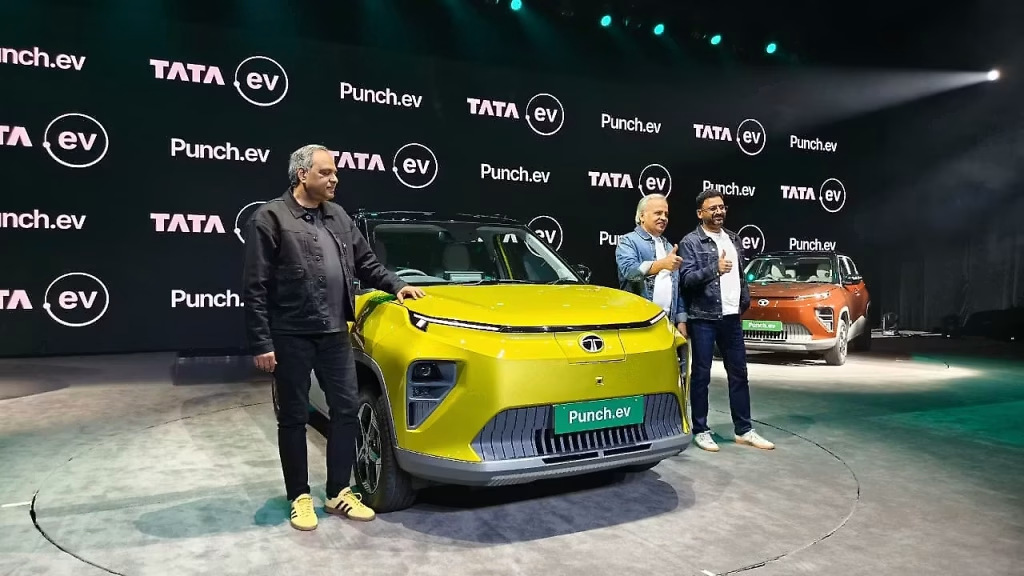
The efficiency edge largely comes down to design philosophy. Indian EVs tend to be smaller, lighter crossovers built for dense cities and shorter daily commutes, while brands like Tesla often use efficiency gains to stretch range on larger, heavier vehicles instead.
Efficient, But Not Necessarily “Best”
It’s worth being clear-eyed here: this ranking measures one metric — energy efficiency — not overall EV quality. Tata and Mahindra didn’t top ICCT’s broader “Leaders, Transitioners, Laggards” transition scorecard, which also weighs charging infrastructure, range, and manufacturing decarbonisation. Indian EVs still trail on outright driving range and fast-charging speed.
Still, for readers tracking India’s growing footprint in global automotive innovation, this is a milestone worth noting — proof that engineering efficiency doesn’t require a Silicon Valley or Shenzhen address.
The Takeaway
Tata and Mahindra aren’t just building EVs for India — they’re building some of the most energy-frugal ones on the planet. Keep following our EV and auto-tech coverage as Indian automakers continue closing the gap on range and charging speed too.