NVIDIA Blackwell Ultra: Imagine an AI agent that reads your entire codebase, reasons across millions of lines, and responds in real time — without breaking a sweat. That’s not a far-off dream anymore. NVIDIA’s latest benchmarks for the Blackwell Ultra GB300 NVL72 show numbers so staggering, they’re forcing the AI industry to rewrite its economics from scratch.
Table of Contents
The Benchmark That Shook the AI World
New SemiAnalysis InferenceMAX data reveals Blackwell Ultra’s GB300 NVL72 platform doesn’t just beat its predecessor — it absolutely demolishes it. Compared to NVIDIA’s own Hopper architecture (the H100, which many hyperscalers built their empires on), the numbers tell a dramatic story.
| Metric | GB300 NVL72 vs Hopper |
|---|---|
| Throughput per Megawatt | Up to 50x higher |
| Cost per Million Tokens | Up to 35x lower |
| Attention Processing Speed | 2x faster than GB200 |
| NVFP4 Compute Performance | 1.5x higher than GB200 |
| TensorRT-LLM Low-Latency Gains | 5x better vs 4 months ago |
| Interconnect Bandwidth | 130 TB/s via NVLink Fabric (72 GPUs) |
As Jensen Huang put it bluntly: “Reasoning and agentic AI demand orders of magnitude more computing performance. We designed Blackwell Ultra for this moment.”

Why Agentic AI Is the Real Driver Here
Here’s the context most headlines miss. AI query patterns have shifted dramatically — software programming-related AI queries jumped from just 11% to nearly 50% of all queries last year, according to OpenRouter’s State of Inference report. Coding assistants and AI agents aren’t niche anymore; they’re the mainstream use case.
And agents are hungry. Unlike a simple chatbot answering a question, an agent needs to maintain context across an entire codebase, reason step-by-step across workflows, and respond with near-zero latency at every turn. Every millisecond of delay compounds across multi-step tasks. This is precisely where Blackwell Ultra earns its keep.
The Secret Weapon: NVLink + NVFP4
So how does NVIDIA pull off these jaw-dropping numbers? Two key innovations:
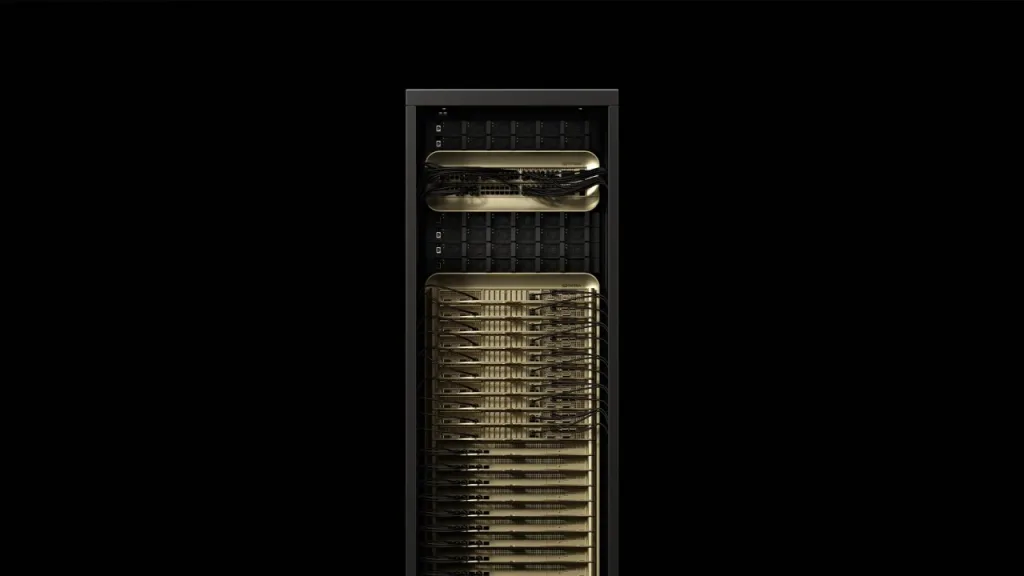
NVLink Fabric at Scale — Blackwell Ultra connects 72 GPUs into a single unified fabric with 130 TB/s of connectivity. Compare that to Hopper’s 8-chip NVLink design, and you begin to understand the generational leap. The entire rack behaves as one massive GPU.
NVFP4 Precision — NVIDIA’s ultra-low-precision format doubles throughput while maintaining accuracy. It’s the architectural magic that enables Blackwell Ultra to serve far more tokens per watt than anything before it. Combined with the open-source NVIDIA Dynamo inference framework, software optimizations have nearly doubled throughput at certain interactivity levels since October 2025 alone.
Who’s Already Deploying It?
This isn’t vaporware — the world’s biggest cloud providers are already going all in:
- Microsoft deployed the world’s first large-scale GB300 NVL72 supercomputing cluster, validated at over 1.1 million tokens per second on a single rack
- CoreWeave was the first AI cloud to deploy GB300 NVL72 in production
- Oracle Cloud (OCI) is scaling Superclusters beyond 100,000 Blackwell GPUs
- AWS and Google Cloud are among the first to offer Blackwell Ultra-powered instances
Meanwhile, inference providers like Baseten, DeepInfra, Fireworks AI, and Together AI are already reporting up to 10x cost reductions on the standard Blackwell platform — Blackwell Ultra takes this even further.
What This Means for Developers and Enterprises
The 35x cost reduction isn’t just a bragging-rights number — it fundamentally changes what’s economically viable. Tasks that were previously too expensive to run continuously (like real-time code review, autonomous debugging, or AI-powered legal document analysis) suddenly become feasible at scale.
For Indian tech companies and startups riding the AI wave, this is particularly significant. Lower inference costs mean faster iteration, cheaper API calls, and AI-powered products reaching more users at lower price points. The democratization of AI compute just got a massive boost.
What’s Next: Rubin on the Horizon
Blackwell Ultra isn’t NVIDIA’s final card. The company has already previewed Vera Rubin, its next-generation platform projecting a further 10x performance improvement over Blackwell. With NVIDIA maintaining its dominance across all MLPerf AI training benchmarks and locking in wins at every tier, the moat around Team Green keeps widening.
The age of agentic AI is here — and NVIDIA just handed it the engine it needed.
Stay updated on the latest AI hardware developments and GPU performance benchmarks at Technosports.