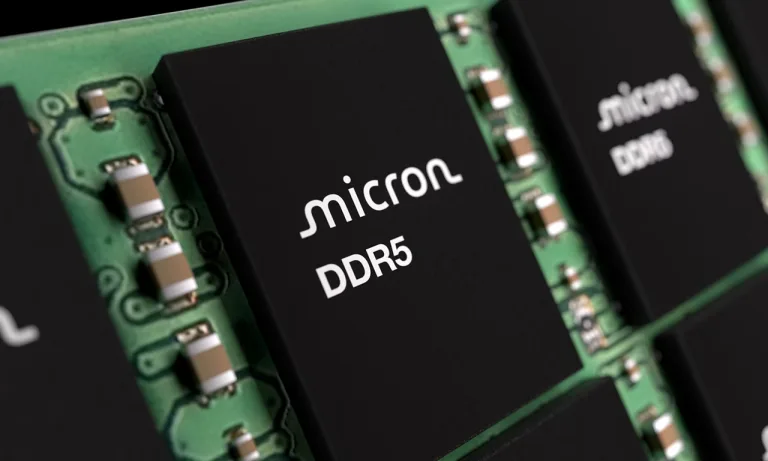
Micron has demonstrated the world’s first 512GB DDR5 RDIMM, targeting AI servers, databases, analytics platforms and simulation systems that are hitting memory-capacity limits. The module matters because keeping large datasets in DRAM can reduce transfers to slower storage, while lower memory power can cut the open.
Micron 512GB DDR5 RDIMM: The Capacity Problem
Modern AI inference, large language models, in-memory databases and virtualised infrastructure often need more memory than standard server modules can provide efficiently. When datasets spill into storage, processors spend more time waiting for data, which can reduce throughput and increase power consumption across the server.
Micron’s solution combines vertically stacked DRAM dies with through-silicon vias, or TSVs. This packaging approach allows more memory capacity within a single registered dual in-line memory module, rather than spreading the same capacity across several lower-capacity modules. As first reported by Notebookcheck, Micron’s module is rated for speeds of up to 9,200 MT/s. The company has not positioned it as a universal replacement for every server configuration, since platform support, processor memory controllers and motherboard layouts will determine where it can be deployed.

Micron 512GB DDR5 RDIMM Power and Performance
Micron says one 512GB RDIMM consumes 16W. Four 128GB modules delivering the same 512GB capacity consume 44.2W, giving the single-module design a claimed power reduction of more than 60%.
| Configuration | Total capacity | Rated power | Main trade-off |
|---|---|---|---|
| One Micron 512GB RDIMM | 512GB | 16W | Requires compatible server platform |
| Four 128GB DDR5 modules | 512GB | 44.2W | More slots and higher memory power |
| Dual-socket server with 24 slots | Up to 12TB | Not specified | Depends on system validation |
| 256GB DDR5 configuration | 256GB | Not specified | Lower capacity for memory-heavy workloads |
The capacity also changes server design options. A dual-socket system with 24 memory slots could reach up to 12TB of DDR5 memory using these modules, according to Micron. That density may free expansion slots and reduce the number of modules needed for a target capacity, but the module’s availability,
Micron cites up to 1.4 times the performance in Spark SVM-based data analytics compared with systems using 256GB DDR5 configurations. The comparison is workload-specific rather than a general processor benchmark, so buyers should not treat the figure as a guaranteed uplift for every database or AI application.
The company also points to RocksDB and Redis, where higher memory capacity may support greater throughput and concurrency. These gains depend on software configuration, access patterns and whether the workload is limited by memory capacity, bandwidth or CPU resources. The Humyn Labs Report highlights how AI systems can face operational constraints beyond raw compute, a relevant warning for organisations planning dense infrastructure.
Competing Solutions and Their Trade-Offs
Server operators have three practical paths: install multiple conventional modules, adopt Micron’s high-capacity RDIMM when supported, or move part of the dataset to storage and accept slower access. Multiple 128GB modules use familiar hardware and may be easier to source, but they consume more power and occupy additional slots.
Storage-backed architectures reduce the need for expensive DRAM, yet latency-sensitive services can lose performance when data repeatedly moves between memory and storage. Micron’s 512GB module offers the strongest capacity-per-slot argument, although its downside is platform dependence. Server manufacturers must validate signal integrity, firmware support, thermal behaviour and processor compatibility before customers can deploy it at scale. Camera and device infrastructure also faces specialised capacity decisions, as coverage around the Sony FE 8-14mm F3.5 shows in a different hardware category.
What Happens Next for Micron 512GB DDR5 RDIMM
The next test is commercial adoption, not the demonstration itself. Micron must establish pricing, production availability and support across server platforms before data-centre operators can measure the full value against conventional 128GB modules. For AI inference, large databases and high-concurrency caching, the module could reduce memory pressure and simplify system layouts.
Smaller deployments may still prefer established modules because they offer easier procurement and broader compatibility. If your workload regularly exceeds available DRAM, choose Micron’s high-capacity design when your server vendor validates it; if capacity is comfortable, conventional RDIMMs remain the safer cost-controlled option. The Ai+ Smartphone Service Network reflects the same wider trend: expanding AI services will keep infrastructure efficiency tied to hardware capacity. Micron’s 512GB DDR5 RDIMM is therefore best viewed as a targeted server upgrade for memory-bound workloads, not a guaranteed performance boost for every data centre.
FAQs
What is Micron’s 512GB DDR5 RDIMM?
It is a registered DDR5 server memory module with 512GB of capacity, designed for AI, databases, analytics, simulation and other memory-intensive workloads.
How much power does it use?
Micron rates the module at 16W, compared with 44.2W for four 128GB modules delivering the same total capacity.
How much memory can a server support with it?
A dual-socket server with 24 memory slots could reach up to 12TB of DDR5 memory, according to Micron.
Is the performance improvement guaranteed?
No. Micron cites up to 1.4 times the performance in a specific Spark SVM analytics comparison, while results for other workloads will vary.
Was this article helpful?
Your feedback directly improves future articles on this site.