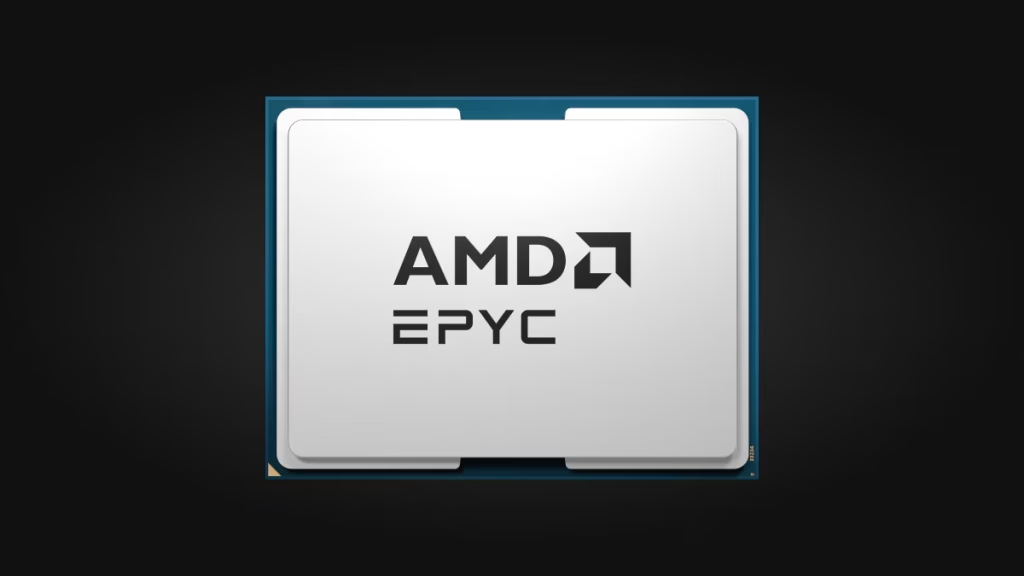
AMD’s Zen 5 server lineup just got a crucial new tier. AMD has formally launched the EPYC 8005 processor series, codenamed “Sorano,” as the successor to the EPYC 8004 “Siena” family — expanding its Zen 5 server portfolio with a lineup focused on power-efficient single-socket deployments for edge infrastructure, telecommunications, software-defined storage, and dense virtualisation workloads.
The announcement was previewed at MWC 2026 earlier this year, but today marks the full embargo lift with the complete SKU table, specifications, and pricing published.
Table of Contents
Full EPYC 8005 SKU Lineup
The EPYC 8005 lineup is headlined by the EPYC 8635P — an 84-core, 168-thread CPU with a 4.5GHz boost clock, 1.6GHz base clock, 384MB of L3 cache, and a 225W default TDP. The full stack runs as follows:
| SKU | Cores / Threads | Boost Clock | L3 Cache | TDP | 1KU Price |
|---|---|---|---|---|---|
| EPYC 8635P | 84C / 168T | 4.5 GHz | 384MB | 225W | $5,799 |
| EPYC 8535P | 64C / 128T | 4.5 GHz | 256MB | 210W | ~$5,499 |
| EPYC 8435P | 48C / 96T | 4.5 GHz | 256MB | 200W | — |
| EPYC 8325P | 32C / 64T | 4.5 GHz | 256MB | 175W | — |
| EPYC 8225P | 24C / 48T | 4.5 GHz | 128MB | 160W | — |
| EPYC 8125P | 16C / 32T | 4.5 GHz | 128MB | 95W | $799 |
| EPYC 8025P | 8C / 16T | 4.5 GHz | 64MB | 70W | $529 |
Clock speeds across all current SKUs reach 4.5GHz — up from 3.15GHz in the previous EPYC 8004 generation. AMD is also using full Zen 5 cores rather than the compact Zen 5c variant found in the EPYC 9005 “Turin Dense” family, which means significantly more L3 cache per core than previous generations.

The Architecture Jump — Why Full Zen 5 Matters
The platform sits between AMD’s flagship EPYC 9005 processors and the entry-level EPYC 4005 lineup, prioritising core density, I/O bandwidth, and energy efficiency over maximum single-threaded frequency.
All models support six channels of DDR5-6400 ECC memory with capacities up to 3TB per socket. Each processor provides 96 PCIe Gen 5 lanes alongside full AVX-512 instruction support, enabling dense storage and networking configurations for modern edge infrastructure.
Performance vs Previous Gen — and Intel
Compared to its 64-core predecessor, the new 84-core AMD EPYC 8635P delivers 40% higher top-of-stack integer performance and 9.5% higher performance per watt. In CephFS storage benchmarks, the EPYC 8635P delivers a 40% geomean improvement over the EPYC 8534P across write, read, random read throughput, IOPS, and latency.
The Intel comparison is more striking. Within the same TDP class, the 84-core EPYC 8635P delivers more than double the cores of the 40-core Intel Xeon 6716P-B at 10 watts lower TDP. A single-socket server built with the EPYC 8635P delivers 48% better integer performance per CPU watt per CPU dollar than a single-socket server built with Intel’s 72-core Xeon 6776P-B.
Doubling the cores at lower power consumption — in the same TDP envelope — is not a marginal improvement. It is a category-level gap.

Built for 5G, Edge AI, and Dense Storage
AMD EPYC 8005 CPUs are designed for challenging edge environments — delivering leadership performance per watt and per dollar while enabling up to 84-core single-socket deployments optimised for telecommunications. For vRAN workloads, AMD has introduced targeted LDPC (Low-Density Parity Check) decoding optimisations that reduce latency and accelerate forward-error-correction for 5G — an essential contributor to overall vRAN throughput.
Samsung ran a compelling real-world test: 54 vRAN cells running on a single EPYC 8005 server — a density figure that makes a direct case for replacing multiple lower-core servers with a single Sorano-based node in live 5G deployments.
Wide thermal operating ranges support quiet, air-cooled systems, helping organisations deploy servers where space and power are at a premium — including outdoor cell sites, remote edge cabinets, and environmentally challenging telco environments through NEBS-compliant platform designs.
Who Is Shipping It?
OEM and ODM support is already confirmed at launch. GIGABYTE has announced a phased rollout of BIOS updates for EPYC 8005 support, with the ME03-CE0 board being first in line. Existing EPYC 8004 platforms on the LGA 4844 socket receive a BIOS update to support the new generation, simplifying upgrades for existing deployments.
Supermicro, HPE, Dell, and Lenovo are all confirmed server partners through the standard EPYC OEM ecosystem.
India and Cloud Relevance
For Indian cloud infrastructure teams, data centre operators, and telco engineers planning Jio 5G expansion and edge AI deployments, the EPYC 8005 represents a compelling single-socket option that avoids the cost and complexity of multi-socket scaling. The $529 entry point for the 8-core EPYC 8025P and $799 for the 16-core EPYC 8125P make the platform accessible for smaller edge nodes, while the 84-core EPYC 8635P at $5,799 targets high-density telco and storage workloads directly.
For developers already running local AI inference on RTX 5060 Ti setups, the EPYC 8005’s 96 PCIe Gen 5 lanes mean a Sorano-based server can connect multiple GPU accelerators without bottlenecking — making it a natural foundation for edge AI inference racks.
Read the full official announcement at AMD’s blog.
The Bottom Line
AMD EPYC 8005 Server CPUs are a triple threat — big performance, low power, small footprint — delivering eight to 84 proven Zen 5 cores in a 70 to 225 watt single-socket platform. The jump from Zen 4c to full Zen 5 cores, combined with clock speeds more than 40% higher than the previous generation and a devastating performance-per-watt-per-dollar advantage over Intel’s competing Xeon parts, makes Sorano the most compelling edge and telco server CPU AMD has ever shipped.
Stay tuned to TechnoSports for the latest server hardware, AI infrastructure, and semiconductor news.