LAZ2
LAZ2 PAR0
PAR0 RCL1
RCL1 PAR1
PAR1 MEX-W
MEX-W ARG-W
ARG-W ATM1
ATM1 DEP0
DEP0 ADO1
ADO1 HEE2
HEE2 CLB2
CLB2 TOR0
TOR0 GVFC0
GVFC0 FCP0
FCP0 Internacional2
 Botafogo0
 UAE
UAE NED
NED PAK
PAK ENG
ENG IND-W
IND-W ZIM-W
ZIM-W GMB
GMB LES
LES MOZ
MOZ ZMB
ZMB Inter Milan
 Fiorentina
 Churchill
 Punjab FC
 NGA
NGA UGA
UGA RIY2
RIY2 TAA1
TAA1 CHE0
CHE0 TOT2
TOT2 VAL1
VAL1 VIL2
VIL2 DOR1
DOR1 SGE0
SGE0 NZ-A135/3 (41 ov)
 IND-A113
 SYL
SYL KHU
KHU MYMS299/4 (87 ov)
 CHATT
CHATT DHA293/3 (84.1 ov)
 RAJ
RAJ RAN320/5 (80 ov)
 BAR
BAR DEN
DEN PNG
PNG NAM321/6
 IRE290 (47.3/50 ov, target 322)
 NZ180/5
 IND181/6 (19.5/20 ov, target 181)
 Mirassol1
 São Paulo1
 Vitória1
 Athletico-PR1
 Athletic
 Getafe
 C Palace
 Newcastle
 Hull
Hull Brentford
 Liverpool
 Brighton
 Man United
 Bournemouth
 Atalanta
 Frosinone
 NAP3
NAP3 ROMA3
ROMA3 KHO0
KHO0 ETT3
ETT3
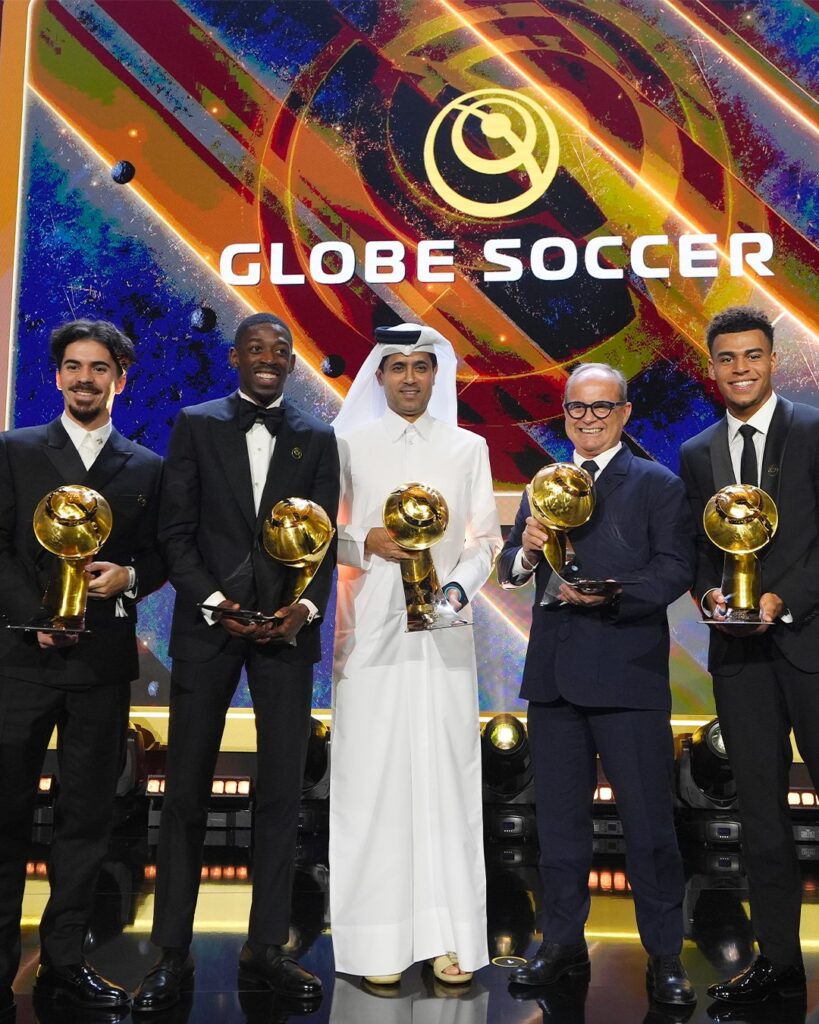
Paris Saint-Germain emerged as the undisputed champions of the Globe Soccer Awards 2025, sweeping seven prestigious honors at the glittering ceremony held at Atlantis The Royal in Dubai on December 28. The French capital club’s extraordinary haul reflected a transformative year that saw PSG achieve unprecedented success both domestically and on the European stage, cementing their status among football’s global elite.
The Seven-Trophy Triumph: Complete Awards Breakdown
PSG’s dominance at the Globe Soccer Awards ceremony was absolute, with the club collecting accolades across every major category. The recognition spanned individual excellence, institutional leadership, and collective achievement, demonstrating the comprehensive nature of the Parisian project under Luis Enrique’s guidance.
| Award Category | Winner | Recognition |
|---|---|---|
| Best Men’s Club | Paris Saint-Germain | Club of the Year |
| Best Men’s Player | Ousmane Dembélé | Top Individual Award |
| Best Coach | Luis Enrique | Managerial Excellence |
| Best Midfielder | Vitinha | Positional Honor |
| Emerging Player | Désiré Doué | Youth Development |
| Best Sporting Director | Luis Campos | Administrative Success |
| Best President | Nasser Al-Khelaïfi | Leadership Recognition |
This unprecedented sweep established PSG as the most decorated club in the history of the Globe Soccer Awards, with seven honors claimed in a single ceremony representing a record that may never be matched. The achievement reflected excellence at every organizational level, from boardroom decisions to on-field execution.
Historic Six-Trophy Season: The Foundation of Glory
PSG’s recognition as Best Men’s Club stemmed directly from the most successful campaign in the institution’s 55-year history. The 2025 calendar year delivered six major trophies, a feat never before accomplished by any French club and rarely achieved across European football.
The Complete Trophy Cabinet
UEFA Champions League The pinnacle achievement arrived in May when PSG defeated Inter Milan 5-0 in the Champions League final, securing the club’s maiden European Cup. This comprehensive victory ended years of near-misses and heartbreak, finally delivering the trophy that had eluded the Qatari-backed project since its inception. The 5-0 scoreline represented the most emphatic Champions League final victory since AC Milan’s triumph over Barcelona in 1994.
Ligue 1 Championship (Unbeaten) PSG’s domestic dominance reached historic proportions as they claimed their 13th Ligue 1 title in unprecedented fashion. The Parisians became the first team in club history to secure the championship without losing a single match, finishing with 23 wins and 5 draws from 28 games. This achievement surpassed what Lionel Messi, Neymar, and Kylian Mbappé accomplished during their time at the club, establishing a new benchmark for domestic supremacy.
| Ligue 1 Statistics (2024-25) | Record |
|---|---|
| Title Secured | With 6 matches remaining |
| Unbeaten Run | 28 matches |
| Wins | 23 |
| Draws | 5 |
| Losses | 0 |
| Points Ahead of Second Place | 20+ |
| Away Unbeaten Streak | 32 consecutive matches |
The championship was secured with six matches remaining in the season, allowing Luis Enrique to rotate his squad for the latter stages of European competition. PSG’s away form proved particularly remarkable, extending their unbeaten run on the road to 32 consecutive Ligue 1 matches, tying the third-longest such streak in European top-flight history.
Coupe de France The domestic double materialized through victory in the French Cup, with PSG maintaining their stranglehold on the competition. This represented Luis Enrique’s second consecutive Coupe de France triumph, having also won the trophy in his debut season. The silverware completed PSG’s collection of every available domestic honor for the 2024-25 campaign.
Trophée des Champions (French Super Cup) The season’s trophy collection began in August with victory in the traditional curtain-raiser to French football. This thirteenth Super Cup triumph extended PSG’s record in the competition, with club captain Marquinhos now holding a French record nine such titles.
UEFA Super Cup Following their Champions League breakthrough, PSG faced Sevilla for European supremacy and emerged victorious. The UEFA Super Cup added continental validation to their Champions League triumph, establishing PSG as the team to beat across European competition.
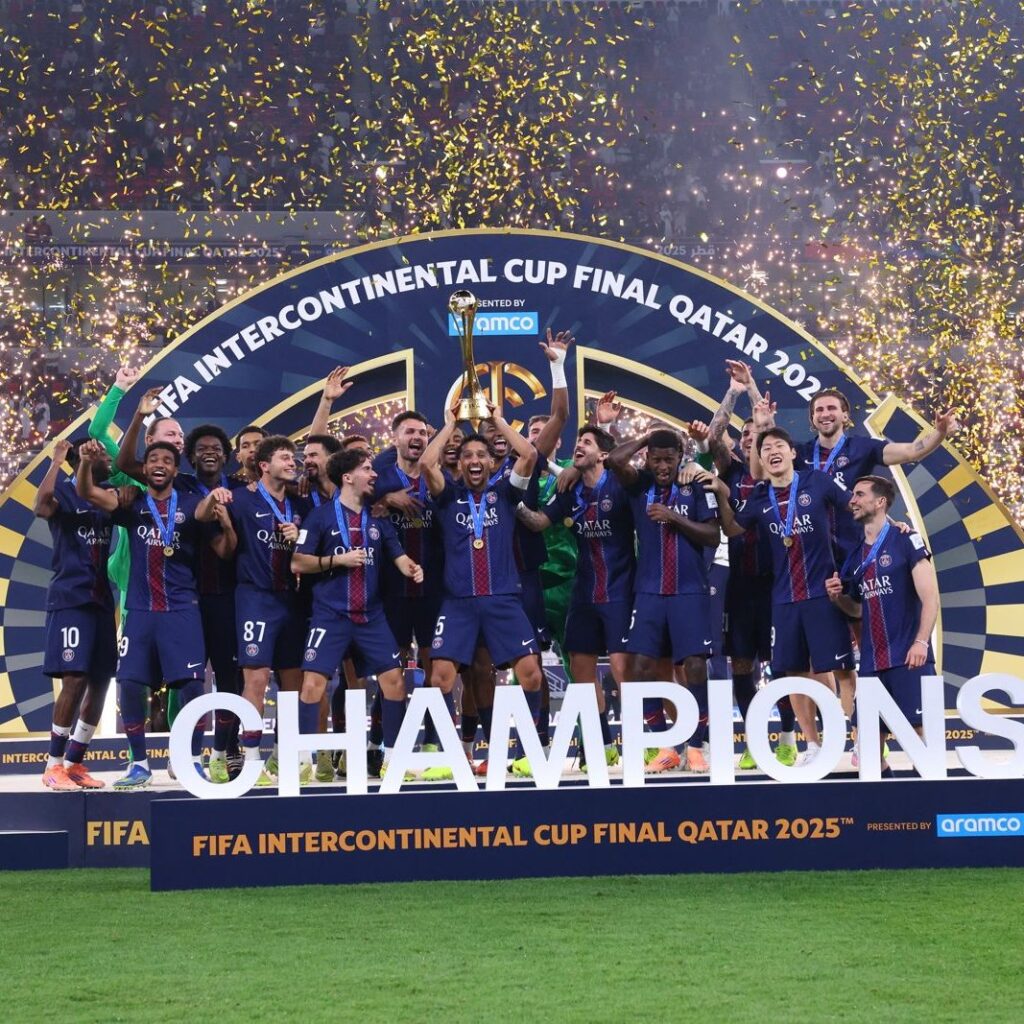
FIFA Intercontinental Cup The calendar year concluded with global glory as PSG defeated Brazilian giants Flamengo in Doha to claim the Intercontinental Cup. Midfielder Vitinha earned Player of the Tournament honors, capping a remarkable individual campaign that would later see him recognized as Globe Soccer’s Best Midfielder. This sixth trophy completed an unprecedented sextuple that no French club had ever achieved.
Ligue 1 Dominance: Statistical Supremacy
PSG’s domestic stranglehold on French football reached new heights during the 2024-25 campaign, with statistical dominance that bordered on the absurd. The team’s performance metrics established benchmarks that future generations will struggle to approach.
Record-Breaking Campaign Numbers
The Parisians led Ligue 1 from start to finish, topping the table from Matchday 2 onward and never relinquishing control. By late January, after just 19 fixtures, PSG commanded a ten-point advantage over second-placed Monaco. From that moment, the championship became a procession rather than a competition.
Only five teams managed to avoid defeat against PSG throughout the entire Ligue 1 campaign. Stade de Reims held the Parisians to 1-1 draws in both encounters, while Nice (1-1), Nantes (1-1), and Auxerre (0-0) also claimed single points. These five draws represented the entirety of points dropped across 28 league matches.
The team scored 182 goals across all competitions in the calendar year 2025, breaking their previous record of 165. In 67 matches played throughout the year—itself a new club record surpassing the previous high of 61—PSG registered 50 victories, establishing another institutional benchmark.
Tactical Evolution Under Luis Enrique
The statistical excellence reflected tactical sophistication rather than mere talent accumulation. Following Kylian Mbappé’s departure to Real Madrid, many observers questioned whether PSG possessed the individual quality to compete at the highest level. Luis Enrique’s answer proved emphatic: collective organization trumps individual brilliance.
The Spanish tactician implemented a high-intensity pressing system combined with sophisticated positional rotations. Players understood multiple roles and adapted their positioning based on game situations. This flexibility proved crucial in both domestic domination and European success, with PSG demonstrating capacity to control possession against weaker opponents while executing devastating counter-attacks against elite teams.

The integration of younger talents alongside established stars created a blend of experience and energy. Désiré Doué’s emergence as a genuine first-team contributor earned him recognition as the Globe Soccer Awards’ Emerging Player, while Portuguese midfielder Vitinha’s evolution into one of Europe’s premier playmakers saw him claim the Best Midfielder honor.
Individual Excellence: Ousmane Dembélé’s Crowning Achievement
The Globe Soccer Awards ceremony concluded with Ousmane Dembélé receiving the Best Men’s Player award, the evening’s most prestigious individual honor. The French winger’s recognition followed his Ballon d’Or triumph several months earlier, completing a remarkable year of personal accolades.
Dembélé’s transformation from injury-plagued talent to world-class performer reached its apex during PSG’s historic campaign. His consistency across domestic and European competition proved instrumental in the club’s success, with the 28-year-old delivering match-winning performances in crucial fixtures throughout the season.
The winger’s statistical output matched his aesthetic brilliance. He contributed goals and assists across all competitions while maintaining the dribbling capacity and creative vision that have defined his career. More importantly, Dembélé embraced defensive responsibilities within Luis Enrique’s pressing system, demonstrating the tactical maturity that had occasionally eluded him during his Barcelona tenure.
His recognition ahead of an elite shortlist featuring Kylian Mbappé, Lamine Yamal, Vitinha, and Raphinha underscored the magnitude of his individual campaign. For PSG, Dembélé’s triumph represented validation that the post-Mbappé era could achieve heights matching or exceeding what came before.
Institutional Recognition: Leadership Validated
While on-field success generates headlines, the Globe Soccer Awards also recognized the administrative excellence that enabled PSG’s transformation. President Nasser Al-Khelaïfi’s selection as Best President and sporting director Luis Campos’s recognition as Best Sporting Director acknowledged the strategic vision guiding the club’s evolution.
Nasser Al-Khelaïfi: Thirteen Years of Transformation
Al-Khelaïfi’s presidency, which began in 2011, has fundamentally altered French football’s landscape. Under his leadership, PSG has won 39 total trophies, including three international titles in 2025 alone. His recognition as Best President reflected not merely trophy accumulation but the strategic repositioning of PSG as a genuine European powerhouse.
The president’s willingness to support Luis Enrique’s tactical vision even during periods of skepticism proved crucial. When critics questioned whether PSG could compete without marquee superstars, Al-Khelaïfi backed his coach’s preference for collective strength over individual celebrity. This alignment between presidential vision and managerial philosophy created the stability necessary for sustained excellence.
Al-Khelaïfi now holds 39 total titles as PSG president, establishing him as the most successful club president in French football history. His tenure has seen PSG win 11 of the last 13 Ligue 1 championships, transforming what was once a modest Parisian club into a global football brand.
Luis Campos: The Architect Behind the Squad
Sporting director Luis Campos, recognized as Best Sporting Director, orchestrated the recruitment strategy that enabled PSG’s success. His identification and acquisition of players who fit Luis Enrique’s tactical requirements rather than chasing commercial appeal represented a maturation of PSG’s approach to squad building.
Campos’s previous success at Monaco and Lille—where he built title-winning squads on modest budgets—translated seamlessly to PSG’s more substantial resources. His signings of players like Vitinha, João Neves, and Willian Pacho proved transformative, providing the technical quality and tactical intelligence required for Enrique’s sophisticated system.
The symbiotic relationship between Campos’s recruitment and Enrique’s coaching created an organizational coherence that had occasionally eluded PSG during previous eras. Rather than accumulating superstars and hoping they coalesced, PSG now acquired players specifically suited to defined tactical roles.
Youth Development: Désiré Doué’s Breakthrough
Among PSG’s seven Globe Soccer Awards, Désiré Doué’s recognition as Emerging Player highlighted the club’s renewed emphasis on youth development. The 19-year-old French talent’s integration into the first team represented exactly the type of progression PSG had struggled to achieve during their superstar era.
Doué’s versatility—capable of operating across multiple attacking positions—aligned perfectly with Luis Enrique’s tactical philosophy. Rather than being restricted to a single role, the teenager demonstrated understanding of various positions and the intelligence to adapt his game based on opponents and game situations.
His emergence alongside fellow young talents like Warren Zaïre-Emery and Bradley Barcola suggested PSG’s youth development infrastructure was finally producing players capable of contributing at the highest level. For a club often criticized for prioritizing expensive acquisitions over academy development, these breakthroughs carried particular significance.
Comparing European Giants: PSG’s Competitive Context
PSG’s recognition as Best Men’s Club at the Globe Soccer Awards placed them ahead of fierce European competition. The shortlist included defending champions and traditional powerhouses, making the Parisian triumph particularly meaningful within the context of continental football’s hierarchy.
| Club | Major Achievements 2025 | Globe Soccer Recognition |
|---|---|---|
| Paris Saint-Germain | 6 trophies including Champions League | Best Men’s Club |
| Real Madrid | La Liga, Copa del Rey | Finalist consideration |
| Barcelona | Spanish Super Cup | Women’s Club recognition |
| Manchester City | Premier League | Previous year champion |
| Bayern Munich | Bundesliga | European competition |
The recognition validated PSG’s transformation from French domestic champions to genuine European powerhouse. For years, critics dismissed Ligue 1 success as insufficient validation of elite status, pointing to PSG’s repeated Champions League failures as evidence of limitations. The 2025 campaign definitively answered those criticisms.
The Luis Enrique Effect: Tactical Mastery Recognized
Head coach Luis Enrique’s selection as Best Coach—his third major coaching honor in recent months following the Ballon d’Or and FIFA The Best awards—reflected widespread recognition of his tactical genius. His achievement in rebuilding PSG following the departures of Messi, Neymar, and Mbappé while actually improving the team’s competitive level represents one of modern football’s most impressive managerial accomplishments.
Enrique’s tactical philosophy emphasized pressing intensity, positional flexibility, and collective responsibility. Rather than building the team around individual stars, he created a system where excellence emerged from coordination rather than isolation. This approach required buy-in from every squad member and unwavering commitment to tactical principles even during difficult moments.
The Spanish manager’s personal journey—continuing to achieve professional excellence while processing profound personal loss following his daughter Xana’s passing in 2019—added emotional depth to his sporting success. His ability to maintain focus and drive despite tragedy earned widespread admiration throughout the football community.
Vitinha: The Midfielder Orchestrating Success
Portuguese international Vitinha’s recognition as Best Midfielder acknowledged his emergence as one of Europe’s premier playmakers. The 24-year-old’s evolution under Luis Enrique transformed him from promising talent to genuine world-class operator, with his technical ability and tactical intelligence proving crucial to PSG’s success.
Vitinha’s statistical output during the 2025 campaign placed him among elite company. His pass completion rate exceeded 83 percent on substantial volume, while his ability to progress possession through central areas relieved pressure on PSG’s defense and initiated attacks. Perhaps most impressively, he delivered these contributions while shouldering significant defensive responsibilities within Enrique’s pressing system.
His crowning achievement came at the FIFA Intercontinental Cup, where he earned Player of the Tournament honors following PSG’s victory over Flamengo. The recognition at the Globe Soccer Awards validated his status as one of world football’s finest midfielders, placing him in distinguished company with previous winners of the positional award.
French Football’s Global Validation
PSG’s dominance at the Globe Soccer Awards carried significance beyond individual club achievement, representing broader validation of French football’s quality. For years, Ligue 1 faced dismissive criticism as a “farmers’ league” lacking competitive depth and elite quality.
PSG’s European triumph and subsequent global recognition challenged those narratives. While debates about Ligue 1’s competitive balance continue, the fact remains that PSG—competing primarily against French opposition during their domestic campaign—developed into a team capable of dismantling Europe’s finest.
The development of French talents under elite coaching and the attraction of international stars to Ligue 1 clubs suggested the league’s quality trajectory points upward rather than stagnant. For French football generally and PSG specifically, the Globe Soccer Awards recognition represented acknowledgment that the nation’s club football has achieved genuine European relevance.
Historical Context: PSG’s Place Among French Clubs
PSG’s six-trophy haul and subsequent Globe Soccer recognition must be understood within the context of French football history. The Parisians now hold 56 total trophies, establishing them as the most decorated French club ever. Their 13 Ligue 1 titles trail only Saint-Étienne’s ten championships, though PSG’s concentration of success—11 titles in the last 13 seasons—demonstrates sustained dominance unmatched in French football history.
All-Time French Club Trophy Rankings
| Club | Total Major Trophies | Ligue 1 Titles |
|---|---|---|
| Paris Saint-Germain | 56 | 13 |
| Marseille | ~30 | 9 |
| Saint-Étienne | ~25 | 10 |
| Lyon | ~20 | 7 |
| Monaco | ~18 | 8 |
The transformation of PSG from modest Parisian club to French football’s dominant force occurred primarily under the Qatari ownership that began in 2011. Since that watershed moment, the club has revolutionized expectations within French football, establishing standards that other domestic clubs struggle to approach.
More significantly, PSG’s 2025 Champions League triumph made them only the second French club to win Europe’s premier competition, joining Marseille (1993) in that exclusive company. By also winning Ligue 1 and the Coupe de France in the same season, PSG became the first French club to achieve the continental treble, a milestone that elevates their historical significance beyond domestic considerations.
The Ceremony: A Night of Parisian Excellence
The Globe Soccer Awards ceremony itself proved a celebration of Parisian excellence, with PSG representatives collecting honors throughout the evening. The event, organized by Globe Soccer in partnership with the Dubai Sports Council, brought together football’s elite under the opulent setting of Atlantis The Royal hotel.
Beyond PSG’s dominance, the ceremony featured notable moments including Cristiano Ronaldo’s recognition as Best Middle Eastern Player for his transformative impact in Saudi Arabia, Barcelona’s Aitana Bonmatí claiming Best Women’s Player, and career achievement awards for legends Andrés Iniesta and Hidetoshi Nakata.
Tennis icon Novak Djokovic received the Globe Sports Award, acknowledging his contributions beyond football. An emotional tribute honored the parents of late Portugal midfielder Diogo Jota, creating one of the evening’s most poignant moments.
For PSG, however, the night belonged entirely to them. As award after award was announced, the Parisian delegation made repeated trips to the stage, each honor adding another layer to a remarkable story of institutional excellence.
Looking Forward: Dynasty or Peak?
PSG’s extraordinary success in 2025 and subsequent recognition at the Globe Soccer Awards raises inevitable questions about sustainability. Can the club maintain this level of excellence, or does the six-trophy haul represent a peak unlikely to be repeated?
Several factors suggest PSG’s success may prove sustainable rather than anomalous. The squad’s age profile skews young, with key contributors like Vitinha (24), Désiré Doué (19), Warren Zaïre-Emery (19), and João Neves (20) all in the early stages of their careers. These players should continue improving, potentially reaching even higher levels as they gain experience.
Luis Enrique’s tactical system continues evolving, with the coach demonstrating willingness to adapt based on personnel and opposition. His contract extends through June 2027, though speculation about a potential “lifetime contract”—virtually unprecedented in modern football—suggests the club recognizes his value and seeks to secure his long-term commitment.
The institutional alignment between Al-Khelaïfi’s presidential vision, Campos’s recruitment strategy, and Enrique’s tactical philosophy creates organizational coherence that transcends individual seasons. This structural foundation suggests PSG’s excellence stems from sustainable advantages rather than temporary confluence of favorable circumstances.
Read More: Filipe Luis Signs New Deal at Flamengo Until December 2027 After Excellent Work at the Club