

Apple just upended its own laptop lineup. The MacBook Neo starts at $599 — a full $500 less than the cheapest M5 MacBook Air, which is now officially Apple’s midrange laptop. But that gap in price comes with a very real gap in specs. Here’s everything you need to know before choosing.
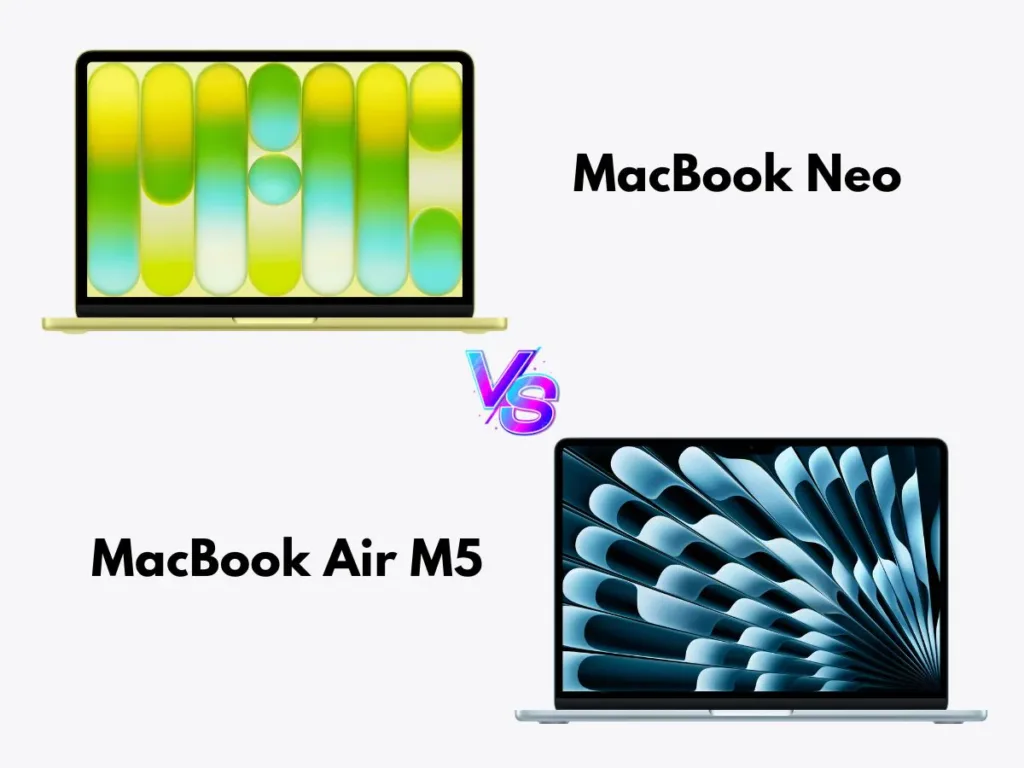
MacBook Neo vs M5 MacBook Air: Full Comparison
| Spec | MacBook Neo | M5 MacBook Air |
|---|---|---|
| Price | $599 / $699 | $1,099+ |
| Chip | A18 Pro (iPhone chip) | M5 (10-core CPU) |
| RAM | 8GB (fixed) | 16GB–32GB |
| Storage | 256GB / 512GB | 512GB–4TB |
| Display | 13″ 2048×1506, sRGB | 13.6″/15″ P3 Wide Color, True Tone |
| Battery | Up to 16 hrs | Up to 18 hrs |
| Ports | 2x USB-C (USB 2/USB 3) | 2x Thunderbolt 4 + MagSafe |
| Wi-Fi | Wi-Fi 6E | Wi-Fi 7 |
| Touch ID | Only on $699 model | Standard on all |
| Keyboard | No backlight | Backlit |
| Colors | Silver, Blush, Citrus, Indigo | Silver, Sky Blue, Starlight, Midnight |
The Performance Gap Is Real
The M5 MacBook Air is 21.45% faster in single-core tasks and a massive 95.78% faster in multi-core — making it nearly twice as powerful for heavy workloads. Memory bandwidth tells the same story: the MacBook Air runs at 153GB/s versus the Neo’s 60GB/s — nearly three times faster.
The Neo’s A18 Pro is perfectly capable for browsing, documents, and light media — but demanding apps, large projects, or heavy multitasking will feel the squeeze at 8GB RAM. For more on Apple’s 2026 lineup, check TechnoSports’ Apple coverage.

Who Should Buy Which
The MacBook Neo is a strong alternative to budget Windows PCs and Chromebooks — especially at $499 with an education discount. The MacBook Air is the better pick for anyone needing multiple external displays, higher specs, or long-term heavy use. Buy directly from Apple and read more at TechnoSports.


