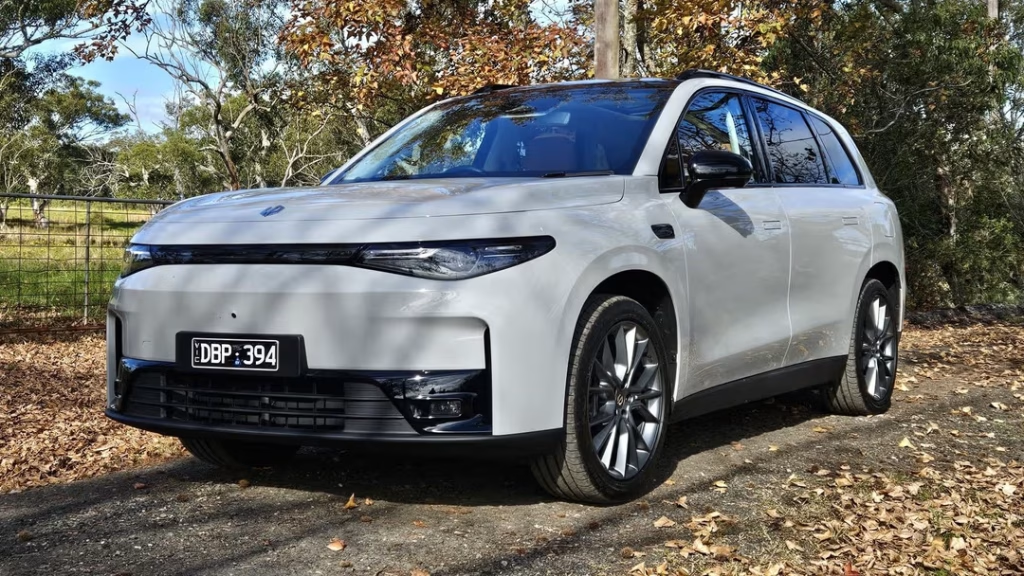
A daily-efficiency headline may sound boring until it actually changes how you drive. Autocar’s late-August 2026 review framed the Leapmotor C10 as a car that makes “overtake-late” feel unnecessary. It does that by pairing relaxed real-world drivability with a notably efficient electric setup.
Overview: what we drove, when, and why the “slow lane” matters
The story comes from Autocar’s feature/review of the Leapmotor C10, published around Sunday, August 16, 2026. The angle isn’t just range anxiety or sprint performance. It’s the lived annoyance of being stuck in the slow lane when traffic compresses and you need response, not stress. In this write-up, the owner’s focus stays consistent: the C10’s efficiency and driving behaviour combine to create confidence in normal commuting, not just on paper.
Worth noting: the author describes a firsthand relationship between how the car returns energy and how quickly the driver feels they can change pace. That matters because efficiency isn’t only about kilometres—it’s also about how often you can “pay” for acceleration without watching the battery bar every time you need to merge.
Key Details: one metric at a time that explains the car’s character
First, the “ultra-efficient” theme is tied to the C10’s electric powertrain behaviour during everyday driving, as described by Autocar. The review’s central claim is that the efficiency envelope doesn’t restrict the driver; instead, it supports smoother throttle use and reduces the mental overhead of constant recalculation. That’s a subtle but important distinction from many EV narratives that split into two extremes: either “fast but thirsty,” or “efficient but dull.”
Second, the write-up links efficiency to driving dynamics—specifically how the car responds when you want to change speed. The owner’s takeaway is that the C10 doesn’t require a “planning mindset” to get moving when gaps appear. In other words, the efficiency isn’t only a range story; it’s part of how the car lets you keep the car’s momentum, then use available performance when the road forces a decision.
Third, the review places emphasis on daily usability, not lab tests. Autocar frames the C10 as a car that stands out in daily commutes because it helps turn short bursts of acceleration and deceleration into a more controlled, less wasteful routine. For many EV owners, that’s the difference between charging “as a habit” and charging “as a worry.”
Efficiency breakdown (how the review connects dots)
| Driving context (per Autocar’s feature) | What the owner noticed | Why it shifts “slow lane” frustration |
|---|---|---|
| Stop-start/urban pace | Smoothness supports calmer throttle inputs | Less needless surging means more confidence to respond |
| Mixed roads | Efficiency holds up during normal pace changes | You don’t feel punished when you need to overtake |
| Real commuting rhythm | Daily usability stays consistent | Fewer mental checks on energy lets you move with traffic |
Context: why this angle is different (and what critics might say)
Here’s the thing: most EV coverage is built around either headline range numbers or performance benchmarks. Autocar’s piece shifts the focus toward the driver experience—how efficiency changes the behaviour of the commute. That approach matters in the UK context where lane discipline can turn a small hesitation into a social bottleneck on two-way roads.
That said, critics could argue that “slow lane” perception is subjective—two drivers can interpret the same response differently depending on expectations and traffic density. The rebuttal is that this feature doesn’t treat efficiency as an abstract promise; it ties it to how quickly the driver feels able to change pace without second-guessing energy use. It’s less about being the quickest EV on a spreadsheet and more about being the EV that makes routine manoeuvres feel natural.
It also reframes an older debate in EV adoption: early adopters were often told they’d “get used to charging.” This review suggests something similar for driving—once the car’s efficiency workflow feels predictable, overtaking stops being a negotiation.
What’s Next: what owners should watch for after the “slow lane” moment
If the C10 truly behaves the way Autocar describes—efficient enough to keep drivers relaxed while still enabling confident pace changes—then the next question for buyers is straightforward: does that confidence remain consistent over repeat days and varied routes? Efficiency in real life can swing with tyre choice, speed discipline, HVAC use, and terrain, so buyers should treat “ultra-efficient” as a starting point, not a guarantee.
Worth noting for Indian and global readers: the biggest gain in everyday EV ownership often comes from predictable behaviour—how often you feel the need to “manage” rather than just drive. If the Leapmotor C10 delivers that pattern, it doesn’t just reduce charging frequency; it can also reduce the emotional cost of driving in dense traffic.
And as the EV market matures, that emotional cost becomes a differentiator. The next wave of customer wins won’t only be about maximum numbers—they’ll be about whether the car makes normal driving feel effortless, even when the road insists you act quickly.
Related Articles
- Volkswagen ID.3 Neo UK 390 Miles Range Launch: What to Know
- Honda Heritage Racing Program 2026: Drive Classic Race Cars
- US EV prices 2026: discounts shrink, transaction prices rise
FAQs
What does “ultra-efficient” mean in the Leapmotor C10 context?
In Autocar’s August 2026 feature, “ultra-efficient” is tied to how the C10 behaves during daily driving—how efficiently it supports pace changes and reduces the driver’s energy anxiety. The review’s emphasis stays on real-world usability rather than only lab metrics.
Will efficiency make the Leapmotor C10 feel slow in traffic?
Autocar’s owner-focused narrative suggests the opposite: efficiency is portrayed as enabling confident acceleration and earlier overtaking rather than forcing hesitation. The key claim is that the car’s efficiency envelope doesn’t restrict response when gaps appear.
Is this mainly a range story?
Not in this feature. The review connects efficiency to driving dynamics and day-to-day confidence—because the “slow lane” problem is about response and timing, not kilometre math.
How can buyers verify whether this fits their routes?
Track energy consumption across repeat commutes and different traffic conditions, then compare it with your expected driving style. Pay attention to how often you feel compelled to manage speed rather than act naturally.
Was this article helpful?
Your feedback directly improves future articles on this site.