NZ180/5
 IND56/2 (8.3/20 ov, target 181)
 NAM156/2 (32/50 ov)
 IRE
 AVL
 MNC
 RAY
 ELC
 GMB
 ZMB
 NGA
 LES
 CAG
 BOL
 COMO
 SAS
 FCA
 FCU
 KOE
 S04
 MOZ19
 UGA23/0 (0.5/20 ov, target 20)
 Ipswich1
 Nottm Forest1
 Alavés1
 Málaga1
 Torino3
 Monza2
 WA
 NSW371/8 (50 ov)
 DEN
 KUW
 KENYA
 QAT
 SWD-W
 EPR-W
 TTN-W
 WPR-W
 NZ-A135/3 (41 ov)
 IND-A113
 DHA
 RAJ
 MYMS
 CHATT
 RAN
 BAR
 SYL
 KHU
 MEX-W
 ARG-W
 UAE
 NED
 PAK
 ENG
 IND-W
 ZIM-W
 AFG170/3 (34.3/50 ov, target 170)
 ZIM169
 CHE0
 DYI0
 CHO1
 QIN0
 HEN1
 BEI0
 LIA1
 ZHE0
 QWC1
 YUN0
 SHX0
 Shanghai Shenh0
 TIG0
 SHP0
 WTT1
 SHT3
 M05
 SVW
 RBL
 ELV
 Brest1
 Nice2
 Stuttgart2
 Gladbach3
 Al Ahli4
 Al Khaleej1

Twenty assists in a single Premier League season. Not since Thierry Henry in 2002/03 had anyone touched that number—until Kevin De Bruyne matched it in 2019/20 and lifted the competition’s Playmaker Award for himself.
The Numbers Behind Kevin De Bruyne’s Greatness
Here’s the thing: creativity at this level is usually fleeting. De Bruyne made it permanent. His 118 Premier League assists sit second in the all-time list, behind only Ryan Giggs’s 162 — a mark once thought untouchable.
No player in the competition’s history had recorded at least 15 assists in three separate campaigns before him. > “The 2019/20 Playmaker Award crowned a season in which the Belgian equalled Thierry Henry’s single-season record of 20 assists.” The efficiency is what separates him.
When he reached 100 Premier League assists, he had done it in just 237 appearances—the quickest ever. The previous benchmark belonged to Cesc Fàbregas, a master creator in his own right, who needed 293 games.
De Bruyne shaved 56 matches off that record, which is roughly a full season and a half of elite output compressed into nothing. Manchester City’s own club feature frames the achievement as sustained excellence across multiple seasons rather than a handful of inspired campaigns. That distinction matters.
Flashy assist tallies can come from one golden year; decade-defining numbers come from repetition, fitness, and a delivery technique nobody in the league has replicated.
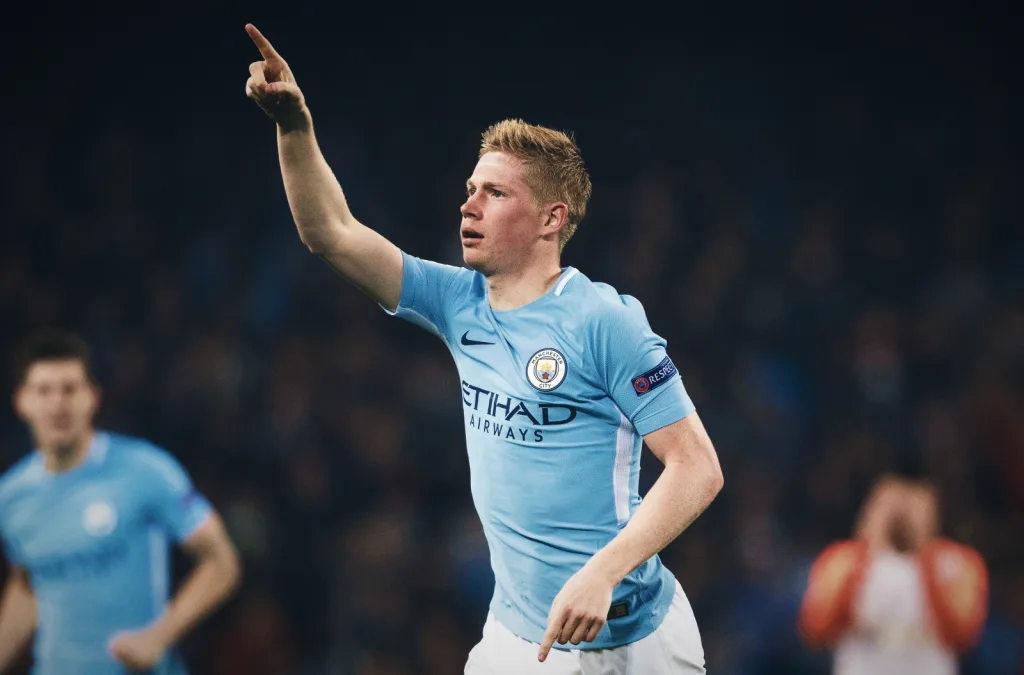
Where Kevin De Bruyne Stands Among the Greats
Context is everything, and the chance-creation data makes the case unanswerable. According to a Premier League feature, De Bruyne has created 827 chances in the competition, comfortably clear of Christian Eriksen’s 533. That is a near-300 chance gap over one of the most consistently creative midfielders of the modern era. Our football coverage has tracked how chance creation, not raw assists, is the fairest measure of a playmaker’s enduring influence — and on that metric, nobody is close. Full coverage via BBC Sport.
One third-party statistical profile lists 121 assists in 287 Premier League games, but that figure conflicts with the competition’s official total of 118 and should be treated as unconfirmed. The official number is the one that belongs in the record books. The Giggs comparison deserves attention too. Giggs built his 162 across two decades of longevity at Manchester United. Kevin De Bruyne’s route to 118 came in a heavier-legged, more physically suffocated league, where passing lanes close in a fraction of a second. Whether he can overtake Giggs depends on the years ahead, but the trajectory alone has already rewritten what a modern creator looks like. Full coverage via BBC Sport.
What Comes Next for the Belgian Maestro
The remaining gap is 44 assists—Giggs’s record minus De Bruyne’s current tally. At his historical rate, that is a chase worth watching rather than a foregone conclusion, and every through-ball from here carries historical weight.
For younger playmakers coming through, the bar has been reset: 15 assists in a season is no longer a career peak, it is a repeating standard.
Numbers fade from memory; records change what the next generation believes is possible.
Kevin De Bruyne did not just accumulate statistics—he redefined the ceiling for what a Premier League playmaker can be, and the record books will carry his name for decades.
FAQs
How many Premier League assists does Kevin De Bruyne have?
He has 118 Premier League assists, the second-highest total in the competition’s history behind Ryan Giggs’s 162.
Whose single-season assist record did he match?
He matched Thierry Henry’s record of 20 assists, set in 2002/03, during the 2019/20 campaign and won that season’s Playmaker Award.
Who was the fastest to 100 Premier League assists before him?
Cesc Fàbregas held the record, reaching 100 assists in 293 games. De Bruyne got there in 237.
How many chances has he created in the Premier League?
A Premier League feature credits him with 827 chances created, well ahead of Christian Eriksen’s 533.
Was this article helpful?
Your feedback directly improves future articles on this site.