Instagram Viral Sexual Video
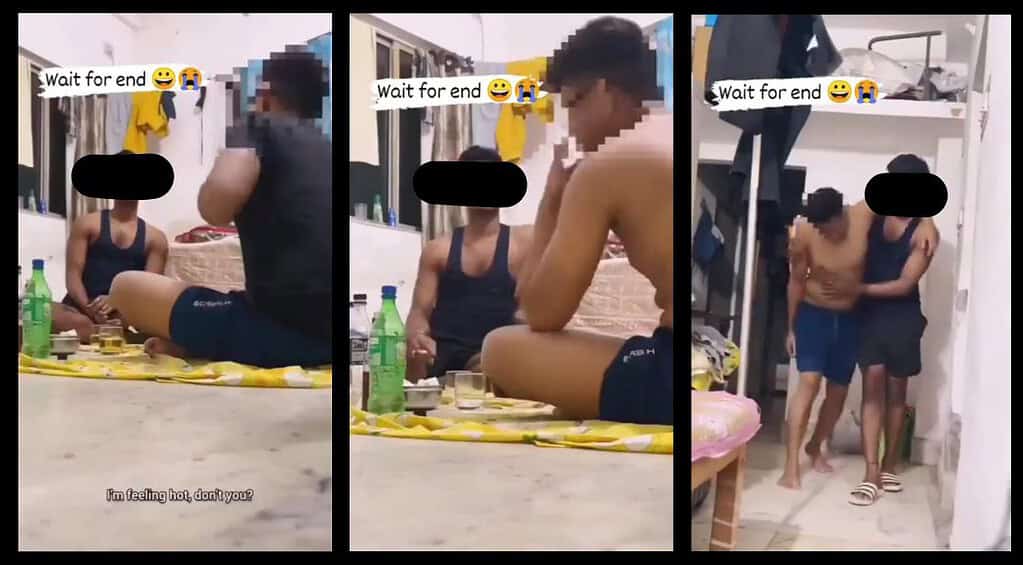
On X and Instagram, a graphic video featuring two people engaging in intimate intercourse has gone popular. Last week, when browsing Instagram, the story’s writers stumbled onto the reel. It depicts a couple of young Indian males enjoying drinks.
At first glance, the footage appears casual and seemingly ordinary, with no clear indication that it was created for promotional or commercial purposes. However, as the video progresses, it reportedly depicts a troubling situation in which one individual—whose identity is obscured through blurring—appears to become unconscious, disoriented, or partially unresponsive. Another person, whose face remains visible, is then shown leading or carrying them into a separate room.
The later portions of the clip have raised serious concerns among viewers because the blurred individual appears unable to respond clearly or fully engage with what is happening. These circumstances have prompted widespread discussion about issues surrounding consent, personal safety, and the ethical implications of sharing or circulating such material online.
At the same time, the authenticity and context of the footage remain uncertain. Observers have pointed to abrupt edits, multiple cuts, inconsistent transitions, and other irregularities that may indicate the content was manipulated, selectively edited, or staged. Because of these inconsistencies, it has become difficult to determine exactly what occurred or whether the footage accurately represents the situation being portrayed.
The controversy also highlights broader concerns regarding misinformation, digital manipulation, and the rapid spread of sensitive content across social media platforms. Experts continue urging users to avoid sharing unverified material and to approach viral videos with caution, particularly when they involve potentially harmful, exploitative, or privacy-related claims.
The controversy highlights the dangers of spreading graphic or unverified material online, particularly when issues of consent, privacy, and potential exploitation are involved. Experts and online safety advocates continue to urge caution, emphasizing the importance of avoiding the circulation of sensitive content that could cause further harm or misinformation.
From a legal standpoint, Bharatiya Nyay Sanhita Section 63 makes it clear that consent is not valid if a person is intoxicated, unconscious, or otherwise incapable of making an informed decision. However, in this case, there is no reliable way to verify whether the footage is real, altered, or entirely staged—making it crucial to approach such content with caution and avoid drawing conclusions without confirmed facts.
Given the sensitive nature of the material and the lack of confirmation, it is crucial not to share or engage with the content. Speculation can lead to misinformation and potentially serious legal and ethical consequences. Always prioritize caution, avoid circulating unverified material, and rely on credible sources when evaluating such content.
The clip, which reportedly violated several of Instagram’s community guidelines, remained on the platform for nearly six days before being removed. During that time, it spread rapidly, amassing close to seven million views and around 2.4 million shares. This widespread circulation has once again raised concerns about how quickly social media platforms respond to sensitive or potentially harmful content.
Adding to the concern are reports that the same video was uploaded multiple times by a single account without facing immediate action, warnings, or restrictions from Instagram’s moderation system. Since platforms like Instagram rely heavily on automated detection tools, this incident has sparked questions about gaps in moderation, consistency in enforcement, and the overall effectiveness of digital safety measures.
Although the original uploads have now been taken down, the issue is far from resolved. Copies of the video, reposted by other users, continue to circulate across the platform. This highlights a persistent challenge for social media companies—once content goes viral, it becomes extremely difficult to fully contain or remove it from the digital ecosystem.
The situation underscores the complexity of moderating large-scale platforms, where even advanced systems can struggle to keep pace with the speed at which content is shared and reshared. With millions of posts being uploaded daily, identifying and removing problematic material in real time remains a significant challenge.

The incident has also reignited debates about the responsibilities of major social media platforms in monitoring and controlling harmful content. Many users and digital safety advocates are calling for faster detection systems, stricter moderation policies, and improved reporting mechanisms to prevent similar situations in the future.
According to Instagram’s community guidelines, certain types of content—including explicit material depicting nudity, intimate acts, or close-ups of fully exposed body parts—are not permitted on the platform, even if they are intended to be artistic or creative.
Despite these policies, it reportedly took six days after users flagged the content through the in-app reporting feature for all versions of the video to be removed. This delay has further fueled concerns about response times and the need for more efficient moderation systems.
Ultimately, the episode highlights the ongoing challenge platforms face in balancing the massive volume of user-generated content with the need for effective oversight. As online communities continue to grow, improving moderation tools and response times will be essential to maintaining a safer and more responsible digital environment.
How Instagram Viral Sexual Video Becomes Viral?
The video is still live and has been uploaded by the same account four times as of the writing of this article. A number of other people have also published it on Instagram; one of those uploads has received 6.7 million views. With just this video on its timeline, a brand-new Instagram account gained nearly 6,800 followers. This specific video was reported by us on July 25.
At the time this piece was published, it had been removed off the platform, but Instagram had not notified us of its removal. Later on, that same account posted something else that sent people to another account where the video was still available. On social media, parodies and sketches based on the disturbing video are currently making the rounds. In addition, screen grabs from the movie have gone viral and became memes.
Additionally, a number of accounts have been made with the user name suffix “Zucc” in order to amplify the video. To increase the number of people who see the video, these accounts are being mentioned in comments on other posts. There’s a great wordplay in the username. When a page gets taken down or disabled in meme culture, it’s called “zucced,” a reference to Mark Zuckerberg. This basically means that Meta’s moderation system was the reason the page was removed. These accounts are frequently used as backup pages for content that Meta is about to delete.
A technique for automatically identifying nude photos and movies was unveiled by Meta in March 2019. An notice stated, “It can be devastating when someone’s private photos are shared without their consent.” When we get reports of non-consensual intimate photographs (also known as revenge porn), we have always removed them to protect the victims. More recently, we have employed photo-matching technology to prevent the re-sharing of these images. We can now proactively identify nearly nude photos or videos that are published without authorization on Facebook and Instagram thanks to machine learning and artificial intelligence. This implies that we are able to locate this content before it is reported.
It is concerning to learn that this specific film was repeatedly uploaded without being reported to the server for being nude. As per Meta’s blog, it additionally employs a technology known as SimSearchNet++, which is an image-matching model taught via self-supervised learning to match picture variations with enhanced recall and high precision. In essence, this technique lessens the dissemination of misleading claims by adding warning labels on duplicates of them. The video’s repeated uploads indicate that Meta’s content control feature is ineffectual, if it is employing a comparable method.
Nudity protection has also been added by Meta to Instagram direct messages. It blurs photos that are detected to contain nudity and advises users to reconsider posting nude photos. The function is intended to shield users from scammers and unsolicited nudity in their direct messages. The quantity of shares the aforementioned video indicates that either nudity protection isn’t intended to function on videos in general or it doesn’t perform on this particular video. This clip wasn’t blurry when we sent it to a demo account on Instagram to test the feature. We weren’t given any prompts regarding possible nudity either. This demonstrates that the nudity protection system for photos is ineffective against videos.
Alt News sent a letter to Meta over this. As soon as we have an answer, we will update the story. We also tried contacting the OnlyFans creator multiple times, but they wouldn’t talk to us.
Instagram Viral Sexual Video Potential for Minor Exposure:
The video in question was reportedly encountered through the Reels section of Instagram. Like many social media platforms, Instagram uses recommendation algorithms that show users videos from accounts they may not follow. These systems rely on various signals—such as viewing habits, interactions, and trending content—to determine what appears on a user’s feed. However, the exact criteria behind these recommendations are not always transparen:t, which means content can sometimes reach audiences in unexpected ways.
Users as young as 13 are allowed to create accounts on Instagram. In recent years, the platform has introduced several parental control features intended to give families more oversight of young users’ online activity. Even so, there remains a possibility that certain types of content may appear in a minor’s feed through automated recommendations.
A 2021 study conducted under contract by the National Commission for Protection of Child Rights examined social media usage among students. The research, which included 3,491 school-age participants, found that many had active profiles on popular social networking platforms. Among them, Instagram was used by about 45.5% of respondents, while Facebook was used by approximately 36.8%, making these two platforms the most widely used among the group.
To better understand how exposure to such material might affect young viewers, Alt News consulted mental health professionals. According to Ananya Sinha, director and primary clinical psychologist at TherapHeal, exposure to explicit or abusive sexual content can significantly influence adolescents’ attitudes and perceptions. She noted that such material may normalize harmful behavior or create unrealistic expectations about relationships and intimacy.
Experts also point out that some adolescents may view explicit content not only out of curiosity but also as a source of information. As a result, encountering such videos online could shape their understanding of relationships in ways that may be inaccurate or harmful without proper guidance and education.
However, if someone is unintentionally exposed to these kinds of videos, they could have a profoundly upsetting psychological effect on them. Witnessing such acts of sexual assault can be traumatic, and the ensuing worry and anxiety can last for years. Community norms on social media networks are in place for this very reason. The fact that the footage is available on the site demonstrates their utter incompetence, she continued.
We also had a conversation with a Delhi-based attorney. The woman stated, “It’s illegal for Instagram to not remove a video for days, and they should have a faster turnaround time,”. Compared to most other platforms, their community restrictions are more stringent. The film, which shows a non-consensual scene, ought to have been removed right away. Section 67 of the Information Technology Act of 2000 prohibits publishing or distributing pornographic or sexually explicit content electronically.
Meta Has Made Content Moderation Less Important–
Meta has previously faced criticism for removing or deactivating whole accounts of pole dancers and makers of pornographic art at will. Additionally, it blocked a creator’s account because it contained pictures of them nursing their child. It’s also important to remember that over the past year, content moderation has lost priority at Meta, the parent company of Facebook and Instagram. In 2023, it let go of around 200 content moderators. In addition, it was alleged that same year over 100 roles pertaining to trust, honesty, and responsibility were eliminated. The actions were taken at a time when 2024 was set to see around 50 elections that would impact half of the world’s population.
While covering stories on topics including shrimp Jesus AI art, pilfered AI-based photos on Facebook, drug-related Instagram advertisements, credit card theft, hacked accounts, counterfeit money, guns, and films of children engaging in sexual conduct, a number of media sites have brought attention to these. Alt News has also written a great deal on Meta’s poor content moderation, especially when it comes to instances of hate speech and violent depictions.
Instagram was listed as a co-accused in an infraction under Section 12 of the Protection of Children from Sexual Offences (POCSO) Act and Section 67 (B) of the Information Technology (IT) Act of 2000 in a police complaint that was submitted in West Bengal earlier this year. A Meta representative then stated in response to questions from the media that they took action about “content that violates our Community Guidelines or when it violates local law.”
Read More: Best Ways to Download Instagram Reels