NED
NED OMA
OMA NZ122/2 (11.4/20 ov)
 IND
IND NAM36/1 (7.3/50 ov)
 IRE
IRE PAK0/0 (0.1/50 ov)
 SL
SL SA
SA AUS
AUS ABH
ABH ALF
ALF AFG
AFG ZIM
ZIM SAS
SAS LAZ
LAZ ROMA
ROMA CAG
CAG TOR
TOR COMO
COMO BAN
BAN WI
WI IND-W
IND-W ZIM-W
ZIM-W Sevilla2
 Osasuna0
 PSG2
PSG2 Lyon0
Lyon0 Mohun Bagan1
 Chennaiyin0
 Flamengo3
 Atlético-MG2
 BIK
BIK CHR115/3 (16.1/20 ov)
 JER
JER KUW
KUW PNG
PNG QAT
QAT SYL575/4 (167.3 ov)
 KHU
KHU MYMS465/7d
 CHATT424/6 (121 ov)
 RAN402 & 5/0 (2.3 ov)
 BAR443/9d
 SIKM184
 NAGA187 & 9/0 (8 ov)
 JHK
JHK DELHI515/5d (130 ov)
 JAB
JAB KAY
KAY DEN
DEN KENYA
KENYA POA
POA SPR
SPR BRB149/5 (16.2/20 ov, target 148)
 MIS147
 MOW107/9
 TOK111/5 (18.4/20 ov, target 108)
 LUL88/3 (9.5/20 ov, target 88)
 GOA
GOA SC Delhi
 Milan
Milan Bologna
 Parma
Parma Udinese
 Venezia
 Inter Milan
 Coritiba0
 Grêmio1
 Santa Clara1
 Benfica2
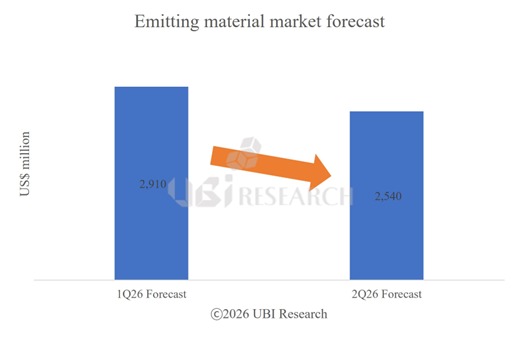
According to UBI Research’s latest “2Q26 AMOLED Emitting Material Market Tracker,” the forecast for global OLED emitting material purchases in 2026 has been revised downward from USD 2.91 billion to USD 2.54 billion — a drop of USD 370 million, or 12.8%.
The main culprit? Rising memory prices are weakening smartphone demand, which in turn is reducing OLED panel shipments. Since emitting materials are consumables directly tied to production volume, any slowdown in panel output hits material makers immediately.
2026 OLED Emitting Material Purchase Forecast
| Period | Forecast (USD Billion) | Change |
|---|---|---|
| 1Q26 Forecast | 2.91 | – |
| Revised 2Q26 Forecast | 2.54 | -12.8% (-$370M) |
Chinese panel makers are expected to feel the pain more sharply. They rely heavily on smartphone OLED panels, a segment now facing softer demand. Korean panel makers, on the other hand, are relatively more stable because they focus on premium smartphones, IT OLED (laptops/tablets), and large OLED TVs.
Korean vs Chinese Panel Makers Impact
| Panel Maker Origin | Expected Impact on Material Purchases | Main Reason |
|---|---|---|
| Korean Makers | Limited decline | Focus on premium & diversified products |
| Chinese Makers | Sharper decline | Heavy reliance on smartphone OLED panels |
This revision highlights how interconnected the electronics supply chain really is. A spike in memory chip prices doesn’t just affect RAM and storage — it ripples all the way to OLED material suppliers.
The news comes at an interesting time. While smartphone OLED demand softens, demand for OLED TVs and IT panels continues to grow, which should help cushion the overall blow for companies like Samsung Display and LG Display.
If you’re planning to buy a new TV or laptop this year, this update is worth noting. We’ve been closely following how these material costs eventually influence final product pricing. For the latest TV recommendations, check our Best OLED TVs of 2026 guide. You may also want to read our recent pieces on Samsung Display Technology Updates and Smartphone Market Trends 2026.
For a deeper understanding of the technology behind these panels, visit the OLED page on Wikipedia.
While a 12.8% downward revision isn’t catastrophic, it’s a clear reminder of how fragile supply chains remain. Korean makers’ focus on premium segments is protecting them better than their Chinese counterparts. For consumers, this could mean slightly slower price drops on mid-range OLED phones, but premium TVs and laptops should remain largely unaffected. The OLED revolution is still very much alive — it’s just hitting a temporary speed bump.
❓ FAQs
Q: Why was the 2026 OLED emitting material forecast revised downward?
Q: Which panel makers are more affected by this forecast cut?
A: Chinese panel makers are expected to see a sharper decline because they depend heavily on smartphone OLED panels, while Korean makers remain relatively stable due to their premium and diversified product mix.