UAE168/3 (37.5/50 ov)
 NED
NED PAK
PAK ENG7/1 (2.2/50 ov)
 IND-W
IND-W ZIM-W
ZIM-W GMB
GMB LES
LES MOZ
MOZ ZMB
ZMB Inter Milan
 Fiorentina
 Churchill
 Punjab FC
 NGA
NGA UGA
UGA Athletic
 Getafe
 MEX-W
MEX-W ARG-W
ARG-W ATM1
ATM1 DEP0
DEP0 LAZ2
LAZ2 PAR1
PAR1 RCL2
RCL2 PAR1
PAR1 MOUNT6/0 (4.5/50 ov)
 TUSK
TUSK ROCKS
ROCKS EAGLE65/0 (8.4/50 ov)
 NZ-A317
 IND-A113 & 106/2 (36 ov)
 SYL
SYL KHU
KHU MYMS299/4 (87 ov)
 CHATT
CHATT DHA293/3 (84.1 ov)
 RAJ
RAJ RAN320/5 (80 ov)
 BAR
BAR LIMWn
LIMWn NW-W
NW-W NCWmn
NCWmn FsWm
FsWm SWD-W
SWD-W EPR-W
EPR-W NAM321/6
 IRE290 (47.3/50 ov, target 322)
 C Palace
 Newcastle
 Hull
Hull Brentford
 Liverpool
 Brighton
 Man United
 Bournemouth
 Atalanta
 Frosinone
 RIY2
RIY2 TAA1
TAA1 CHE0
CHE0 TOT2
TOT2 VAL1
VAL1 VIL2
VIL2
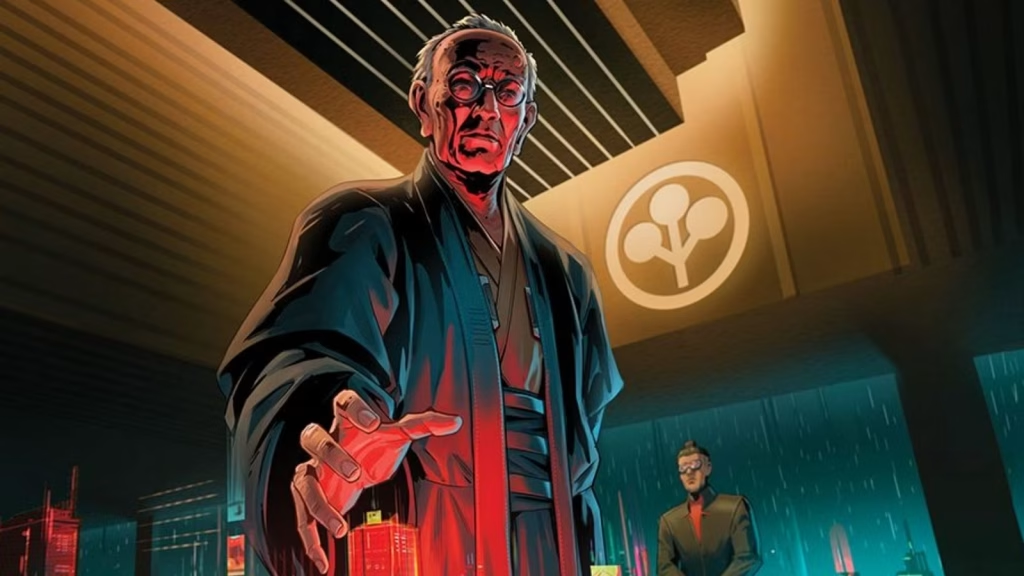
Gen Con 2026 turned into a live stress test for the current Trading Card Game (Cyberpunk TCG) Golden Age, and the clear takeaway was simple: Cyberpunk TCG had the kind of “easy-in, deep-out” design that helps new decks actually stick. That matters because when the floor is crowded with new releases, only the games that welcome newcomers without sanding off strategy get sustained mindshare.
This particular spotlight was covered by DualShockers with a Gen Con 2026 hands-on look published on August 9, 2026, and we’re building from that framing—reporting the ideas, not copying the phrasing.
The problem: TCG saturation makes “approachability” the real differentiator
At Gen Con 2026, walking the expo hall meant seeing TCGs everywhere—heavy hitters and niche experiments side-by-side—so the challenge stopped being “who has the best art?” and became “who makes first turns feel natural?” That problem hits especially hard for players who bounce between genres or platforms and want a game they can learn without a month-long ramp.
Even if a TCG is well-designed, a cluttered launch calendar forces it to prove value quickly. In the Golden Age cycle, hype is cheap, but retention isn’t; if your rulebook feels like homework, newer players drift to the next booth. That’s why Gen Con 2026’s Cyberpunk presence read less like a novelty moment and more like an answer to a market reality.
The root cause: more TCGs, fewer “on-ramps”
The core driver is crowding. When players face dozens of card ecosystems—each with separate deck-building norms, terminology, and meta expectations—learning friction multiplies. In practice, that means many games end up asking too much up front, even when their long-term depth is excellent.
DualShockers put it in a player-friendly lens: Cyberpunk TCG leaned into approachability, depth, and flavour as the trio that keeps a new card game from collapsing under its own complexity.
Candidate solutions (with trade-offs): what Cyberpunk—and others—need to win
Below are the main ways a saturated TCG can still carve out space. None are perfect, and each carries a specific downside that developers usually have to accept.
| Path | What it fixes | Trade-off downside |
|---|---|---|
| Better first-week onboarding | Faster learning curve for new players | Risk of oversimplifying lines that vets want |
| More demo-driven iteration | Converts booth interest into deck confidence | Requires frequent updates that can destabilize metas |
| Theme-forward systems (“flavor”) | Makes decisions feel intuitive | Can limit mechanical variety if theme dominates |
Cyberpunk’s positioning appears to combine the first and second paths—making demos matter, while also keeping depth intact rather than turning the game into a beginner-only version. That blend matters because pure “accessibility-first” design often triggers backlash from competitive players, while depth-first design can lose casual retention. Stay tuned for more on gen con.
10 reasons Cyberpunk TCG looks poised to ride the TCG Golden Age
Here’s the editorial angle others may underplay: the Golden Age isn’t just about more games—it’s about better on-ramps that don’t sacrifice long-term play. Based on what was highlighted around Gen Con 2026’s Cyberpunk TCG demo experience, these are the signals that point to momentum:
- On-ramps beat hype: if a demo explains itself through play, players return for progression instead of curiosity.
- Depth without intimidation: the design goal is to reward skill growth while keeping early turns readable.
- Flavour as decision support: a theme can guide player intuition, not just visuals—especially for narrative-driven tactics.
- Updated demo decks: showing iteration at the event suggests the publisher listens, not just markets.
- Crowd-proof gameplay loops: when many booths compete for attention, the rules need to “click” fast.
- Better retention mechanics: approachability helps new players stick long enough to learn meta culture.
- Deck-building clarity: the smoother the choices, the less likely players feel lost between sessions.
- Community conversation potential: games that teach quickly generate more local chatter and faster social onboarding.
- Tournament readiness pathway: Golden Age winners often cultivate competitive lanes early, not after launch.
- Platform versatility expectations: modern TCG audiences compare experiences across other strategy ecosystems, so usability carries extra weight.
That said, a skeptical view is fair: when multiple TCGs chase “approachable depth”, some end up borrowing patterns too closely from existing ecosystems and feel derivative. Our counter is simple: Cyberpunk’s focus on theme plus updated demos suggests the approach isn’t just cosmetic—it’s aiming at play feel first.
Recommendation: our recommendation for players and what comes next
Gen Con 2026 made one thing plain: TCG Golden Age energy is real, but only the games that turn booth excitement into repeat learning survive the long meta grind. If Cyberpunk continues refining the “first deck” experience while keeping depth expressive, it can become the kind of franchise players recommend without hesitation.
The competitive scene and collectors both want different things, and the winning balance will be the one that keeps both groups engaged. As always, compare how rules feel after the demo—not just how good the cards look—and if the first turns feel natural, that’s your signal to choose the game.
FAQs
What happened at Gen Con 2026 for the Cyberpunk TCG?
Gen Con 2026 was where the Cyberpunk Trading Card Game was highlighted prominently through expo coverage, with attention on how the game approaches new players and showcases depth through gameplay.
Why does “approachability” matter so much right now in TCGs?
Because the market is crowded: players can only learn so many rule systems at once, so a TCG that teaches quickly is more likely to earn long-term retention instead of one-time curiosity.
Is Cyberpunk TCG only for casual players?
No—approachability is typically the on-ramp, while the design goal is to preserve meaningful strategic depth so competitive players still find room to improve.
How can players tell if a TCG is “Golden Age ready”?
Look for demos or starter experiences that clearly explain decision-making during play, and pay attention to whether the game shows real iteration and deck-building clarity over time.
Was this article helpful?
Your feedback directly improves future articles on this site.