Mechanical fingers gently grasp a delicate glass vial without crushing it, showcasing their precision.
On Thursday, July 30, 2026, Google unveiled Gemini Robotics 2.0, a suite of vision-language models aimed at enhancing whole-body Intelligence and safety for general-purpose humanoid robots.
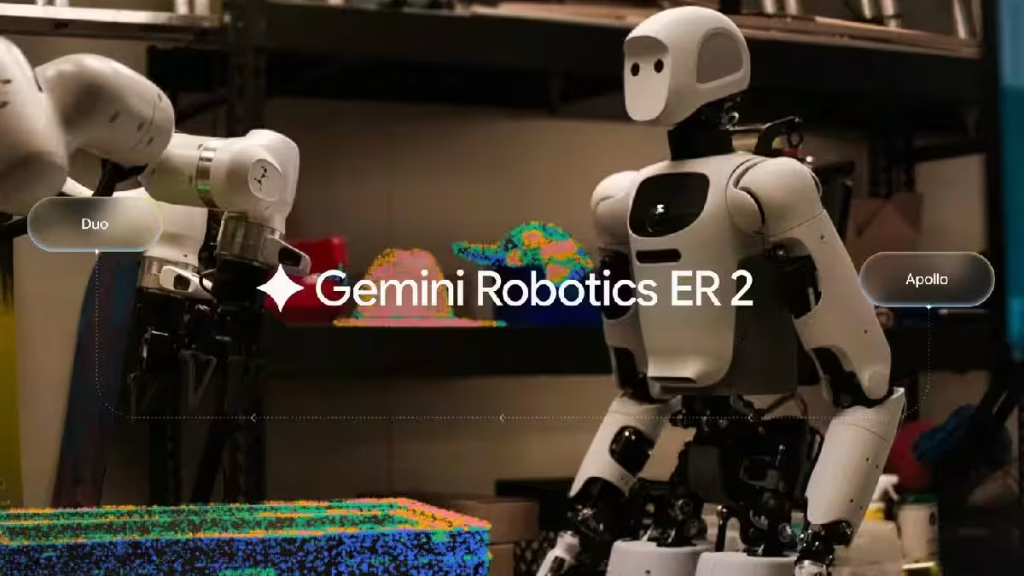
Google’s New Release is Gemini Robotics 2.0
The heart of this new release is Gemini Robotics ER 2, an upgraded embodied reasoning model built on the company’s foundational architecture. DeepMind scientists crafted this system to connect abstract digital instructions with complex physical movements. Instead of just performing isolated tasks like running or jumping, these machines can evaluate dynamic environments and interact in real time.
That said, engineering generalist robots has faced significant challenges due to latency and unexpected physical feedback. To tackle this, Google integrated the model with the Gemini Live API, allowing developers to test real-time reasoning capabilities directly. According to official disclosures, one of these sub-models is already available for external testing, paving the way for software engineers working on spatial computing tasks.
To assess hardware progress, we need to see how these systems manage complex manipulation tasks compared to earlier versions. Previous robotic architectures often struggled with multi-step workflows, requiring hardcoded parameters for every interaction with objects.
Gemini Robotics 2.0 Feature:
| Feature | Gemini Robotics 1.6 | Gemini Robotics 2.0 |
|---|---|---|
| Reasoning Model | Standard embodied reasoning | Gemini Robotics ER 2 |
| API Integration | Restricted access | Gemini Live API |
| Dexterity Focus | Basic arm and gripper control | Complex humanoid hands |
| Environment Adaptation | Static pre-programmed loops | Continuous dynamic analysis |
The drive toward physical artificial general intelligence really hinges on safety mechanisms built into the model. When robots operate alongside people in unpredictable spaces, surprises can lead to serious accidents. By using multimodal sensory inputs, the new software aims to foresee physical hazards before moving. Researchers tracking recent computer science advancements report that these multimodal control systems significantly cut down on unexpected collisions.
Looking ahead, integrating advanced reasoning models into physical hardware should speed up the timeline for commercial humanoid deployment. As software developers begin to use the newly released APIs, the focus shifts from raw Intelligence to durable hardware manufacturing. Those mechanical hands gently closing around that glass vial are just the start of a much bigger industrial shift.
Related Articles
FAQs
What is Gemini Robotics 2.0?
Gemini Robotics 2.0 is an advanced AI system created by Google to control general-purpose humanoid robots with better dexterity, safety, and whole-body Intelligence.
What is Gemini Robotics ER 2?
It’s an upgraded embodied reasoning model that serves as a vision-language model, enabling robots to grasp complex human instructions and interact dynamically with their surroundings.
Is Gemini Robotics 2.0 available to developers?
Yes, Google made some of the sub-models publicly available for developers starting July 30, 2026, along with integration into the Gemini Live API.
How does this release differ from older robotics software?
Older systems relied on narrow, pre-programmed routines for tasks like running or sorting, while Gemini Robotics 2.0 aims for generalist physical Intelligence.