LAFC0
LAFC0 LA1
LA1 Mohun Bagan
 Chennaiyin
 PSG
PSG Lyon
Lyon Sevilla
 Osasuna
 NED
NED OMA
OMA NZ
NZ IND
IND NAM
NAM IRE
IRE PAK
PAK SL
SL SA
SA AUS
AUS BAR1
BAR1 RMA2
RMA2 UDI0
UDI0 MIL2
MIL2 RSO2
RSO2 LEV1
LEV1 LEC0
LEC0 JUV2
JUV2 BRB76/3 (9/15 ov)
 MOW
MOW NZ-A317
 IND-A113 & 324/4 (82.2 ov)
 SYL280/2 (84 ov)
 KHU
KHU MYMS465/7d
 CHATT134/2 (40 ov)
 DHA521
 RAJ103/6 (26 ov)
 RAN402
 BAR179/3 (56.1 ov)
 LUL
LUL SPR
SPR TOK
TOK MIS
MIS MEX-W51 (12.5/20 ov, target 187)
 ARG-W186/7
 NGA148
 UGA147/9 (20 ov, target 149)
 GMB112/9
 LES109 (19.5/20 ov, target 113)
 MOZ110/7 (19/20 ov, target 110)
 ZMB109/9
 IND-W328/6
 ZIM-W207 (48.5/50 ov, target 329)
 ENG241
 Abha
Abha Al Faisaly
 Neftchi Fergana
 Al Ittihad
 Besiktas
 Istanbul BB
 Caykur Rizespor
 Trabzonspor
 Al Ahli
 Al-Gharafa
 SUN0
SUN0 LEE0
LEE0 SCF1
SCF1 MUN3
MUN3
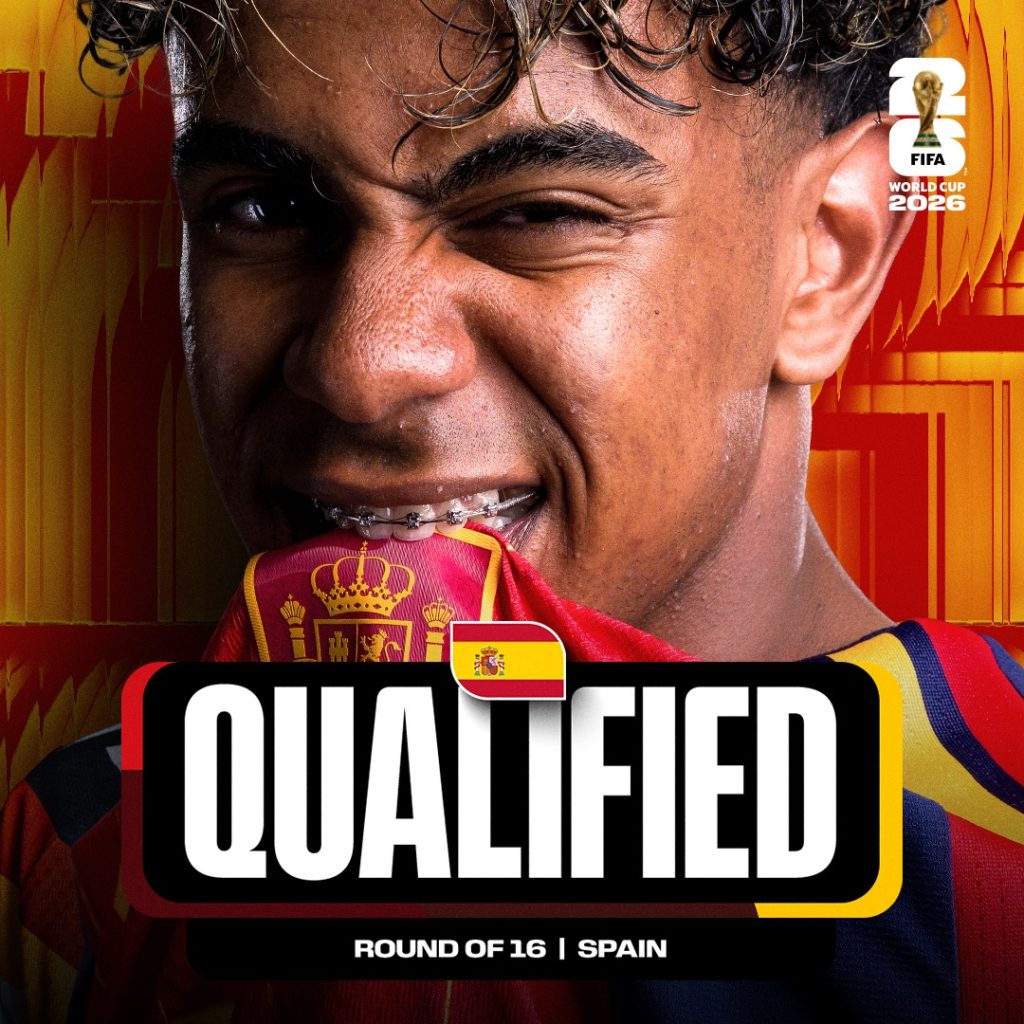
Spain earned their first World Cup knockout-stage win since they lifted the trophy in 2010 as they eased through to the last 16 with a commanding 3-0 win over Austria at Los Angeles Stadium (SoFi Stadium).
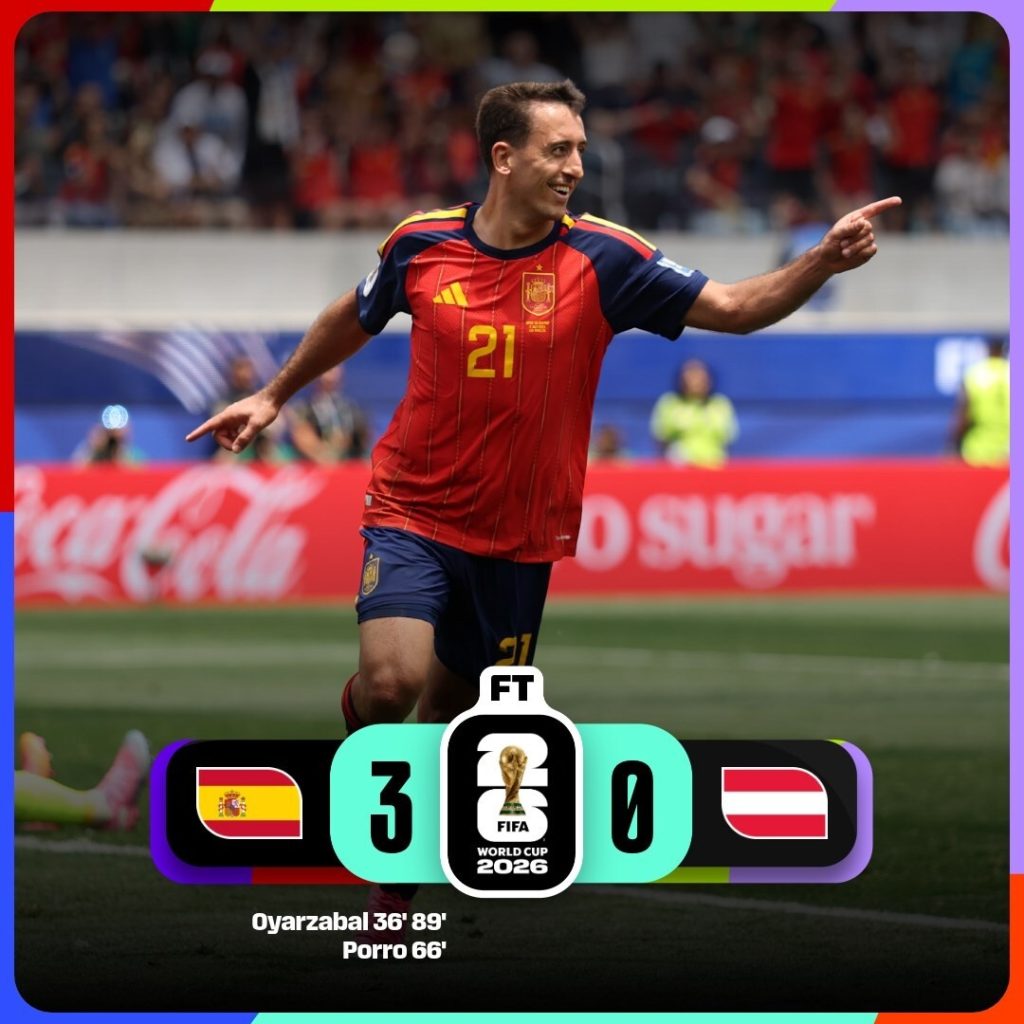
For the first time in exactly 32 years, Spain scored multiple goals in a World Cup knockout match. Mikel Oyarzabal scored twice, Pedro Porro was also on target, and Luis de la Fuente’s side produced a confident, dominant display built on control, width, and relentless chance creation.
Spain will now face Portugal or Croatia in the next round.
Match Overview
| Category | Details |
|---|---|
| Competition | World Cup 2026 – Round of 32 |
| Fixture | Spain vs Austria |
| Venue | Los Angeles Stadium (SoFi Stadium, Inglewood) |
| Attendance | 70,492 |
| Referee | Glenn Nyberg |
| Final Score | Spain 3-0 Austria |
First Half: Spain Find Their Rhythm After a Slow Start
Spain only completed 15 passes in the opening five minutes, their fewest in the first five minutes of a World Cup game since 2014. But once they found their rhythm, Austria struggled to cope.
Lamine Yamal had the contest’s first real chance, drilling a low effort at Alexander Schlager. Stefan Posch then brilliantly blocked Dani Olmo’s path in the box after fabulous play from Yamal and Pedri.
Spain appeared to have made their breakthrough in the 29th minute when a corner from the right caused chaos in Austria’s defence. Marc Cucurella slammed the loose ball in, but referee Glenn Nyberg harshly decided Pau Cubarsí had fouled goalkeeper Schlager, cutting short the celebrations.
Yamal continued to dazzle, forcing another save when he produced slick footwork on the byline before turning a cross-shot from an impossible angle toward goal. Schlager then kept out a crisp Oyarzabal strike.
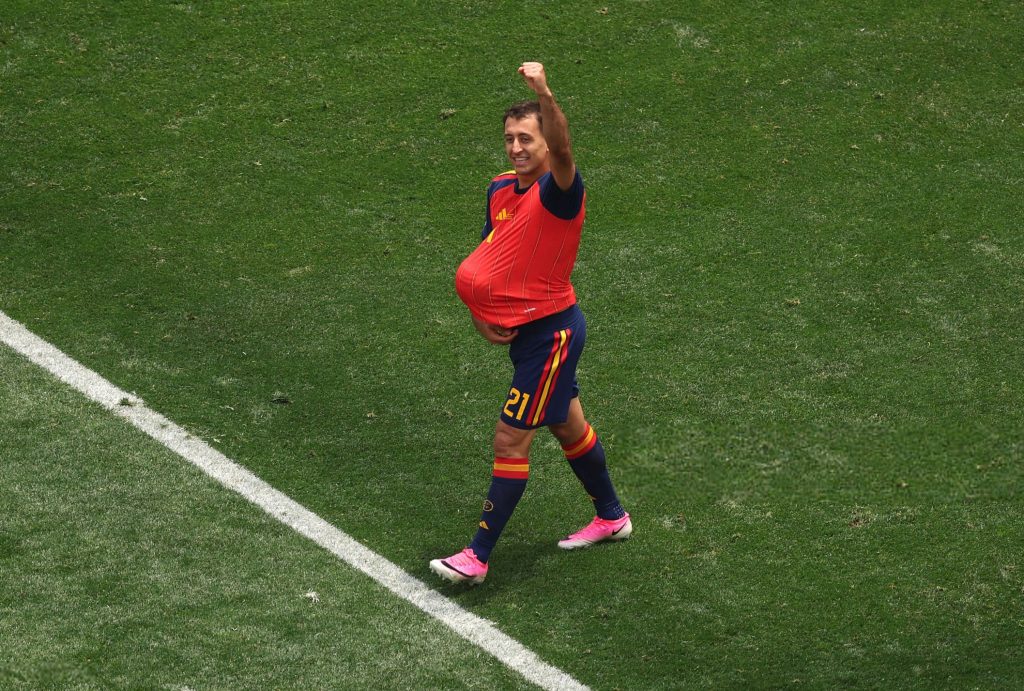
But there was nothing the Austria goalkeeper could do in the 36th minute. Cucurella’s low centre found Oyarzabal, who coolly side-footed home first time from close range. That goal was Spain’s first World Cup knockout goal scored by one of their own players since Andrés Iniesta’s decisive strike in the 2010 final. Their goal against Russia in the 2018 last 16 had been an own goal.
Schlager pulled off a fantastic double save before half-time, first denying Álex Baena’s free-kick and then thwarting Yamal on the rebound after Austria’s defence made a mess of clearing it.
Second Half: Spain Pull Clear
Austria made changes and briefly threatened after the break. Saša Kalajdžić, who had scored the goal that sent Austria into the knockouts, almost equalised just moments after coming on as a 60th-minute substitute, but he could not keep his header down.
Austria were made to pay for that miss in the 66th minute. Cucurella forced the ball into Baena, who supplied a drilled, left-footed cross into the centre of the area. Porro arrived at the back post and met it with a superb header to make it 2-0.
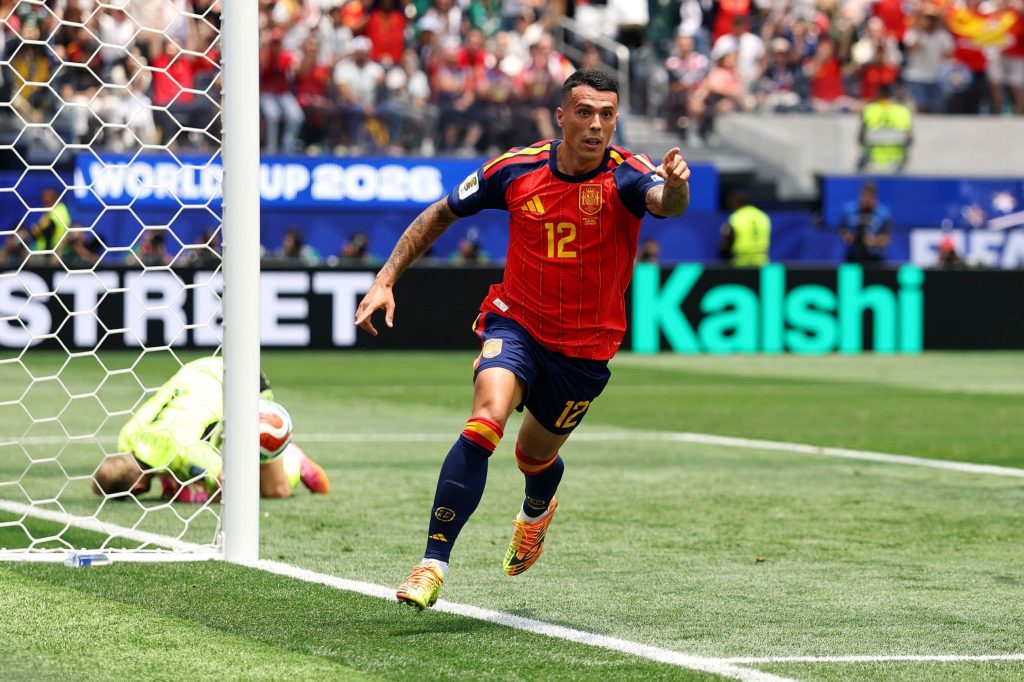
With that goal, Spain scored multiple goals in a World Cup knockout match for the first time since beating Switzerland 3-0 in the round of 16 on July 2, 1994 — exactly 32 years earlier.
Cucurella and Oyarzabal linked up again in the 89th minute. The Chelsea full-back delivered another inch-perfect cross, and Oyarzabal turned it in for his second of the night, capping a superb Spain performance.
Oyarzabal became the first Spain player to score twice in a World Cup knockout fixture since Emilio Butragueño scored four against Denmark in 1986.
Goal Summary
| Minute | Team | Goalscorer | Assist |
|---|---|---|---|
| 36’ | Spain | Mikel Oyarzabal | Marc Cucurella |
| 66’ | Spain | Pedro Porro | Álex Baena |
| 89’ | Spain | Mikel Oyarzabal | Marc Cucurella |

Key Match Statistics
| Statistic | Spain | Austria |
|---|---|---|
| Possession | 65% | 35% |
| Shots | 23 | 5 |
| Shots on Target | 10 | 0 |
| Expected Goals | 2.84 | 0.32 |
| Touches in Opposition Box | 51 | 11 |
| Corners | 9 | 0 |
| Final-Third Entries | 53 | 29 |
| Accurate Passes | 570/630 | — |
| Big Chances | 4 | — |
Spain’s dominance was total. They produced 23 shots, 2.84 expected goals and 51 touches in Austria’s box. Austria did not manage a single shot on target.
This was also the first time a team had failed to allow a shot on target in a World Cup knockout match since Germany did so against Argentina in the 2014 final.

Spain’s defensive record is now becoming one of the stories of the tournament. They are the first European team to keep a clean sheet in their first four matches at a World Cup since Switzerland in 2006. Unai Simón has now kept a clean sheet in five consecutive World Cup starts, equalling the longest such run by a goalkeeper in the competition, alongside Italy’s Walter Zenga in 1990.
Full-Backs Lead the Way
Spain’s full-backs were central to everything good about their performance. Cucurella assisted both of Oyarzabal’s goals with accurate low deliveries from the left and created two big chances. On the opposite flank, Porro scored the second, produced five key passes and repeatedly stretched Austria’s back four.

Baena also played a major creative role. His assist for Porro came from one of five chances he created, making him the first Spain player to create five chances in a World Cup knockout match since Xavi did so in the 2010 final.
Rodri dictated from midfield with a huge passing volume, while Yamal continued to be Spain’s most electrifying one-v-one threat. At 18 years and 354 days old, he became the youngest player on record to register at least 10 dribbles and at least 10 touches in the opposition box in a World Cup match. He finished with 10 dribbles and 14 touches in Austria’s area, while also having a late strike cleared off the line by David Alaba.
Player of the Match: Lamine Yamal
Lamine Yamal was named Player of the Match after another dazzling display. He did not score, but he was central to Spain’s attacking rhythm from the first whistle. His dribbling repeatedly unsettled Austria, his movement dragged defenders out of shape, and his directness helped Spain maintain pressure throughout.

He fired six shots, four of them on target, and produced two key passes while constantly attacking the right flank. His combination play with Pedri and Olmo in the first half nearly unlocked Austria even before the opening goal.
While Oyarzabal will rightly take the headlines for his brace, Yamal’s ability to unbalance Austria’s defensive structure was crucial to Spain’s dominance.
Austria’s Limitations Exposed
Austria arrived with belief after reaching the knockout stage, but they struggled to impose themselves. Their 4-2-3-1 shape looked stretched by Spain’s wide overloads, and although David Alaba tried to progress play with long diagonals, Austria rarely managed to sustain possession in dangerous areas.

Sabitzer created one big chance and supplied some threat with crosses, but Spain’s back line, led by Cubarsí and Laporte, handled almost everything. Kalajdžić’s headed chance just after coming on was their clearest moment, but the failure to test Simón summed up their night.
Austria committed 21 clearances and seven interceptions, but they were defending far too often and too deep.
Spain’s Bigger Statement
Spain remain unbeaten under Luis de la Fuente at major tournaments, winning 10 of their 11 matches with one draw. Only Aimé Jacquet and Louis van Gaal have overseen more matches across the World Cup and European Championship without losing.
They came into the World Cup as one of the favourites, and this was the sort of performance that showed why. France and Argentina had been fancied more by predictive models heading into the round of 32, but Spain made a clear statement.
They are controlled, deep, technically excellent and defensively secure. After years of frustration in World Cup knockout football, La Roja finally look built for a deep run again.
Read More: Portugal Have the Talent But What’s Missing From Their World Cup Campaign?
Also Read: 29 Shots, Zero Goals: Why Cristiano Ronaldo Has Never Scored a World Cup Knockout Goal