NAM321/6 (50 ov)
 IRE
IRE GMB
GMB ZMB
ZMB NGA
NGA LES
LES CAG
CAG BOL
BOL COMO
COMO SAS
SAS FCA
FCA FCU
FCU KOE
KOE S04
S04 M05
M05 SVW
SVW RBL
RBL ELV
ELV MOZ19
MOZ19 UGA23/0 (0.5/20 ov, target 20)
 NZ180/5
 IND181/6 (19.5/20 ov, target 181)
 Ipswich1
 Nottm Forest1
 Alavés1
 Málaga1
 WA105/3 (18.5/50 ov, target 372)
 NSW371/8
 DEN
DEN KUW
KUW KENYA
KENYA QAT
QAT SWD-W
SWD-W EPR-W
EPR-W TTN-W
TTN-W WPR-W
WPR-W BOR
BOR WAR15/1 (2.5/20 ov)
 LIONS
LIONS Limpo21/1 (2.5/20 ov)
 NZ-A135/3 (41 ov)
 IND-A113
 DHA293/3 (84.1 ov)
 RAJ
RAJ MYMS
MYMS CHATT
CHATT RAN320/5 (80 ov)
 BAR
BAR MEX-W
MEX-W ARG-W
ARG-W UAE
UAE NED
NED PAK
PAK ENG
ENG IND-W
IND-W ZIM-W
ZIM-W AFG170/3 (34.3/50 ov, target 170)
 ZIM169
 SCP
SCP HSV
HSV ARS
ARS EVE
EVE Torino3
 Monza2
 Brest1
 Nice2
Nice2 Stuttgart2
 Gladbach3
 Al Ahli4
 Al Khaleej1
Every major statistical forecast model had Portugal among the favourites for World Cup 2026 before a ball was kicked. That was hardly a reach. Roberto Martínez’s squad is stacked with technical quality, positional flexibility and depth — arguably second only to Didier Deschamps’ France in pure individual talent.
And yet, after three group games, the answer is still awkwardly unresolved: are Portugal actually any good?
They reached the knockout stage with two draws and one win, finishing second in Group K and setting up a round-of-32 meeting with Croatia. The tournament is not over for them by any means. In fact, they are still live contenders. But there is enough unevenness in what we have seen to ask whether Portugal are genuinely elite or simply elite on paper.
The short answer? A bit of both.
What Portugal Want to Be
Martínez’s Portugal want the ball. They want control. They want to dominate possession, compress the game, and win the ball back quickly when it is lost. In theory, the midfield trio of Vitinha, João Neves and Bruno Fernandes should allow them to do that against almost anyone.
That trio can dominate the ball. The problem is that domination and penetration are not the same thing.
Portugal’s Group-Stage Summary
| Match | Result | Key Note |
|---|---|---|
| vs DR Congo | Draw | Only one shot on target |
| vs Uzbekistan | Win 5-0 | Best attacking display |
| vs Colombia | Draw | No goals; attack became static |
Portugal’s best performance was the 5-0 win over Uzbekistan. But against DR Congo they managed only one shot on target, and against Colombia they drew a blank entirely. That is a warning sign, because World Cup knockouts are often decided by the kind of moments Portugal have so far struggled to create against compact, well-organised opponents.
This has not been a case of Portugal failing to dominate. It has been a case of domination becoming sterile.
Possession Is Not the Problem — What Portugal Do With It Is
Portugal’s build-up structure is sensible. With Vitinha sitting at the base of midfield, the centre-backs split wide, or a full-back tucks in to help form a back three. That allows Martínez’s side to push five players onto the opposition back line and stretch the pitch.
When the plan works, it creates width, passing lanes and central overloads. When it does not, the attack turns flat.
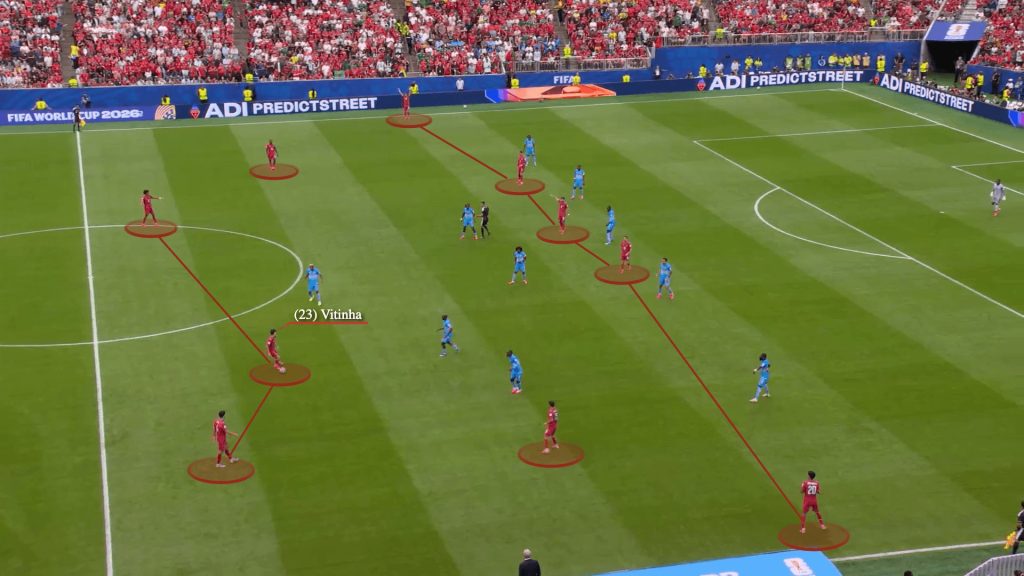
Against DR Congo, Portugal used this method effectively early on. As the match progressed, however, the game became increasingly static with everything taking place in front of the opposition block rather than behind it. That is the central issue with Martínez’s side against low blocks: they can circulate the ball beautifully without necessarily asking enough questions vertically.
Portugal’s Structural Build-Up
| Phase | Shape | Purpose |
|---|---|---|
| First line | Centre-backs split, or full-back inverts | Build through pressure |
| Midfield | Vitinha at base, Neves and Fernandes ahead | Control rhythm |
| Final line | Five players pushed high | Stretch opposition block |
Against stronger, more proactive opponents, the same possession-heavy framework could become a strength. Against deeper blocks, it can look a little over-engineered.
That is the challenge Portugal now face at World Cup 2026: they have elite control, but not always elite incision.
The Cristiano Ronaldo Question
No assessment of Portugal can avoid the Cristiano Ronaldo-shaped elephant in the room.
The 41-year-old scored twice against Uzbekistan, but otherwise he has been kept largely quiet in the group stage. That has triggered the familiar debate over whether his reduced mobility is limiting Portugal’s attack.
The criticism deserves context.

According to FIFA data, 50% of Ronaldo’s total distance covered this tournament has been walking. That sounds stark — until you remember that Lionel Messi’s share is 62%. Ronaldo’s sprint percentage is 2%; Messi’s is 0.9%. The point is not that Ronaldo is flying around the pitch or that he is suddenly a high-press forward. The point is that elite star players have to be used in ways that accentuate their strengths and protect their weaknesses.
Portugal know that. Martínez knows that.
Ronaldo vs Messi — Movement Profile at World Cup 2026
| Metric | Cristiano Ronaldo | Lionel Messi |
|---|---|---|
| Walking as % of total distance | 50% | 62% |
| Sprinting as % of runs | 2% | 0.9% |
Ronaldo is no longer a constant mobile threat, but he remains an elite reference point. He can still create space, draw defenders, and occupy centre-backs in ways that matter. Some of the criticism aimed at him for being offside in the opening game against DR Congo missed the point entirely.
That positioning was often smart centre-forward play: staying outside the defenders’ field of view, acting as a decoy, and opening space elsewhere. On more than one occasion, it nearly worked perfectly.
How Ronaldo Helps Portugal Without Touching the Ball
| Action | Effect |
|---|---|
| Holds high offside line | Occupies centre-backs |
| Makes decoy runs | Opens space for midfielders and wide players |
| Stays central | Forces defenders to protect the middle |
| Attacks loose balls | Turns movement into box presence |
One example came when Ronaldo was clearly offside and unmarked, but the double movement from Bruno Fernandes and Pedro Neto created the opening for Neto to get in behind. As he prepared to square the ball, Ronaldo had drifted back onside and was now ahead of the defenders to attack the cross.
That is not a flaw. It is choreography.
The Real Issue: Portugal’s Attack Can Become Too Similar
This is where the more interesting tactical question emerges. The issue is not simply Ronaldo versus Gonçalo Ramos. It is whether too many of Portugal’s attacking players want the same kind of ball.
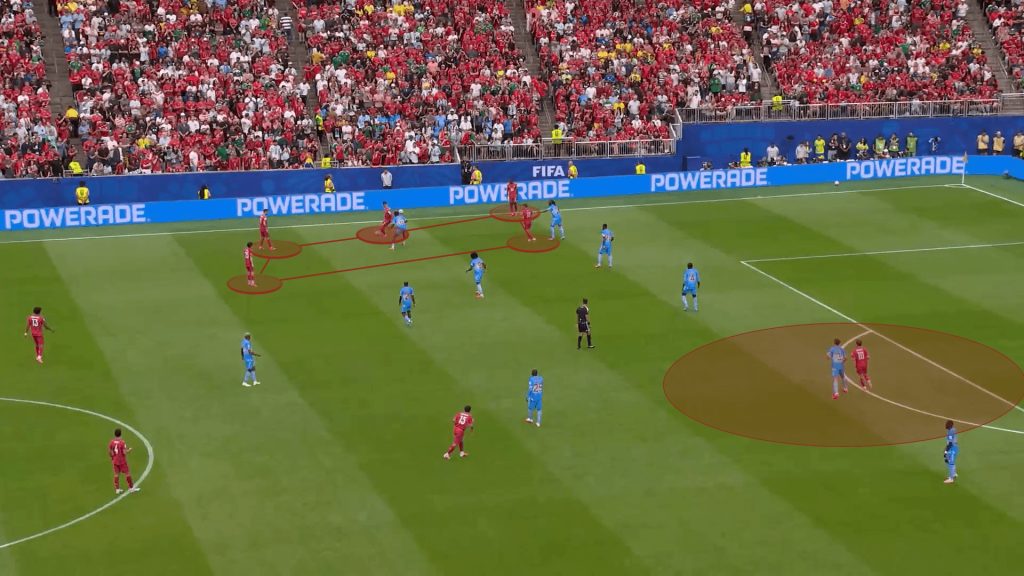
Bernardo Silva, João Félix and Bruno Fernandes are all gifted technicians. But if everyone wants the ball to feet, Portugal can become predictable. They can shuffle opponents across the pitch, retain the ball in tight spaces, and still fail to generate enough runs beyond the defence.
That has been the recurring pattern.
Portugal’s Attacking Profiles
| Player | Tendency | Effect |
|---|---|---|
| Bernardo Silva | Ball to feet, tight-space retention | Helps control possession |
| João Félix | Technical link player | Can slow verticality |
| Bruno Fernandes | Creative, central distributor | Best when given runners |
| Ronaldo | Static central reference | Creates space, but less fluid |
| Pedro Neto | Vertical runner | Gives depth |
| Nuno Mendes | Left-side runner | Adds athleticism |
When Portugal were at their most dangerous against Uzbekistan, it was not because of patient probing alone. It was because they got the ball into wide areas early and attacked with runners. Neto and Nuno Mendes provided the athleticism that makes a possession side dangerous rather than merely neat.
That is why a more direct wide player like Rafael Leão — with Neto on the opposite flank — might bring better balance. It is not about benching the technicians. It is about giving them runners to find.
Martínez’s side can sometimes resemble a team of all receivers and not enough penetrators.
The Defensive Side: Better Than the Attack, But Not Perfect
If there is one area where Portugal can claim genuine strength, it is out of possession. They conceded just once in the group stage. That is a decent defensive return.
But the warning signs were there.
In the opening match against DR Congo, the opposition were able to break free on the counter-attack. Portugal also showed a tendency to defend man-to-man high up the pitch, with Ronaldo central to covering the goalkeeper and far-side centre-back if the ball was turned over. That is aggressive and can work — but it leaves no room for error if the press is bypassed.
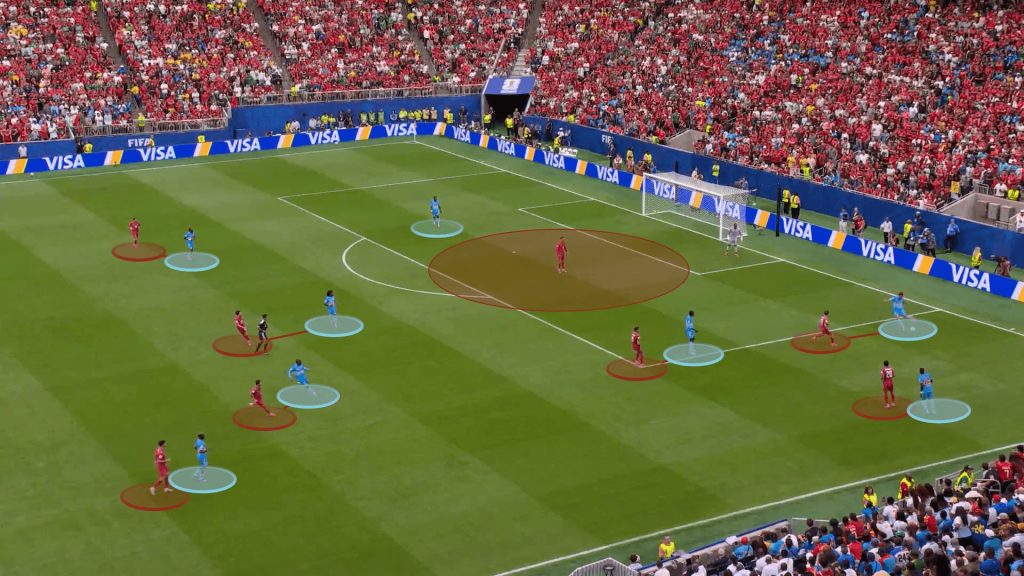
When Portugal drop into a deeper block, they often form a 5-4-1 with Neto pulling back to make the back five more secure.
Portugal’s Defensive Structure
| Situation | Shape | Key Feature |
|---|---|---|
| High press | Man-to-man, aggressive | Ronaldo central in pressing line |
| Mid-block | Compact staggered lines | Controls central zones |
| Deep block | 5-4-1 | Neto drops to make back five |
This structure is useful against opponents who like to build slowly. But against a strong possession side, the cracks become more visible.
That was the issue against Colombia. They managed 24 shots, Portugal’s highest such concession in a World Cup match. Colombia found it relatively easy to build through the middle third, where Portugal’s pressing shape was too easily bypassed. The spacing between lines was simply too large.
Portugal vs Colombia — Defensive Concerns
| Metric | Figure |
|---|---|
| Shots allowed | 24 |
| Defensive shape | Staggered front three |
| Midfield issue | Too much space between lines |
| Result | Portugal struggled to control the game |
This is the real problem for Martínez. Against low blocks, Portugal can look static. Against strong possession sides, they can look open. Neither version yet screams tournament winner.
What Croatia Changes
Croatia offer a more interesting test than the group stage did. They are not a low block in the same mould as DR Congo or Colombia. They should give Portugal a better chance to counterpress and attack more directly in transition.
That may actually suit Portugal better.
One of the clearest examples of how this side can hurt teams came in Ronaldo’s second goal against Uzbekistan. Portugal got six bodies around the ball after a loose phase. João Félix found Bruno Fernandes, who drove forward and picked out Ronaldo in transition. That is the kind of sequence Martínez should be hoping for against Croatia.
What Portugal Need Against Croatia
| Need | Why It Matters |
|---|---|
| Faster transitions | Avoid sterile possession |
| More vertical running | Stretch Croatia’s defensive line |
| Better use of Neto/Leão-type profiles | Add pace and depth |
| Cleaner box presence | Turn possession into chances |
This is where the Croatia game could become a better fit. Rather than asking Portugal to break down a deep, compact block for 90 minutes, it may give them space to counterattack and exploit the spaces behind.
That would also reduce the burden on Ronaldo to be the main creator and allow him to do what he still does best: arrive in scoring positions.
So, Are Portugal Any Good?
Yes — but with qualifications.
They are good in the sense that they have an elite squad, strong midfield control, defensive structure and enough individual quality to beat anyone. They are good in the sense that they know how to win major tournaments after slow starts; Euro 2016 is proof of that.
But they are not yet convincing in the sense that a true title favourite usually is. Their attack can be too static. Their movement can be too similar. Their best players can sometimes want the ball in the same places. And Ronaldo, for all his genius, remains part of a tactical puzzle that is only partly solved.
Portugal at World Cup 2026: Pros and Cons
| Pros | Cons |
|---|---|
| Elite midfield quality | Can become static against low blocks |
| Strong possession control | Not enough depth in behind at times |
| Good pressing and counterpressing | Vulnerable when bypassed centrally |
| Experienced tournament mentality | Ronaldo’s role can reduce fluidity |
| Can win without playing perfectly | Need another gear to reach latter stages |
The encouraging news for Portugal is that they do not need to be perfect to go deep. They have been here before. They have also shown, historically, that a slow start does not preclude a long run — Euro 2016 being the clearest example, where they drew all three group matches before going on to win the tournament.
The less encouraging news is that the evidence from World Cup 2026 suggests they still need to sharpen up markedly if they are going to stay in it beyond the round-of-32.
So, are Portugal any good?
Yes. But not yet as good as their squad list suggests they should be.
Read More: 29 Shots, Zero Goals: Why Cristiano Ronaldo Has Never Scored a World Cup Knockout Goal