NAM321/6 (50 ov)
 IRE
 GMB
 ZMB
 NGA
 LES
 CAG
 BOL
 COMO
 SAS
 FCA
 FCU
 KOE
 S04
 M05
 SVW
 RBL
 ELV
 MOZ19
 UGA23/0 (0.5/20 ov, target 20)
 NZ180/5
 IND181/6 (19.5/20 ov, target 181)
 Ipswich1
 Nottm Forest1
 Alavés1
 Málaga1
 WA105/3 (18.5/50 ov, target 372)
 NSW371/8
 DEN
 KUW
 KENYA
 QAT
 SWD-W
 EPR-W
 TTN-W
 WPR-W
 BOR
 WAR15/1 (2.5/20 ov)
 LIONS
 Limpo21/1 (2.5/20 ov)
 NZ-A135/3 (41 ov)
 IND-A113
 DHA293/3 (84.1 ov)
 RAJ
 MYMS
 CHATT
 RAN320/5 (80 ov)
 BAR
 MEX-W
 ARG-W
 UAE
 NED
 PAK
 ENG
 IND-W
 ZIM-W
 AFG170/3 (34.3/50 ov, target 170)
 ZIM169
 SCP
 HSV
 ARS
 EVE
 Torino3
 Monza2
 Brest1
 Nice2
 Stuttgart2
 Gladbach3
 Al Ahli4
 Al Khaleej1
Mistral AI released Timestral on October 19, 2026. The time-series forecasting model has 209 million parameters. The company didn’t disclose API pricing at launch, so commercial costs remain unclear.
Why Mistral released Timestral for forecasting
Forecasting teams often need to predict what comes next in data that changes over time. That can mean tracking demand patterns or operational measurements. Fitting a model separately to every dataset can add work before teams know whether its forecasts are useful.
Mistral positions Timestral as a zero-shot option, pretrained to forecast series it hasn’t seen during training. That doesn’t mean teams can skip checking its forecasts against their own business data. A general model may be easier to try, but benchmark results can’t guarantee accuracy across every sector, time horizon or data quality level. For companies, the real question is whether a pretrained model cuts setup time without compromising the reliability their decisions require.
What the Timestral model family includes
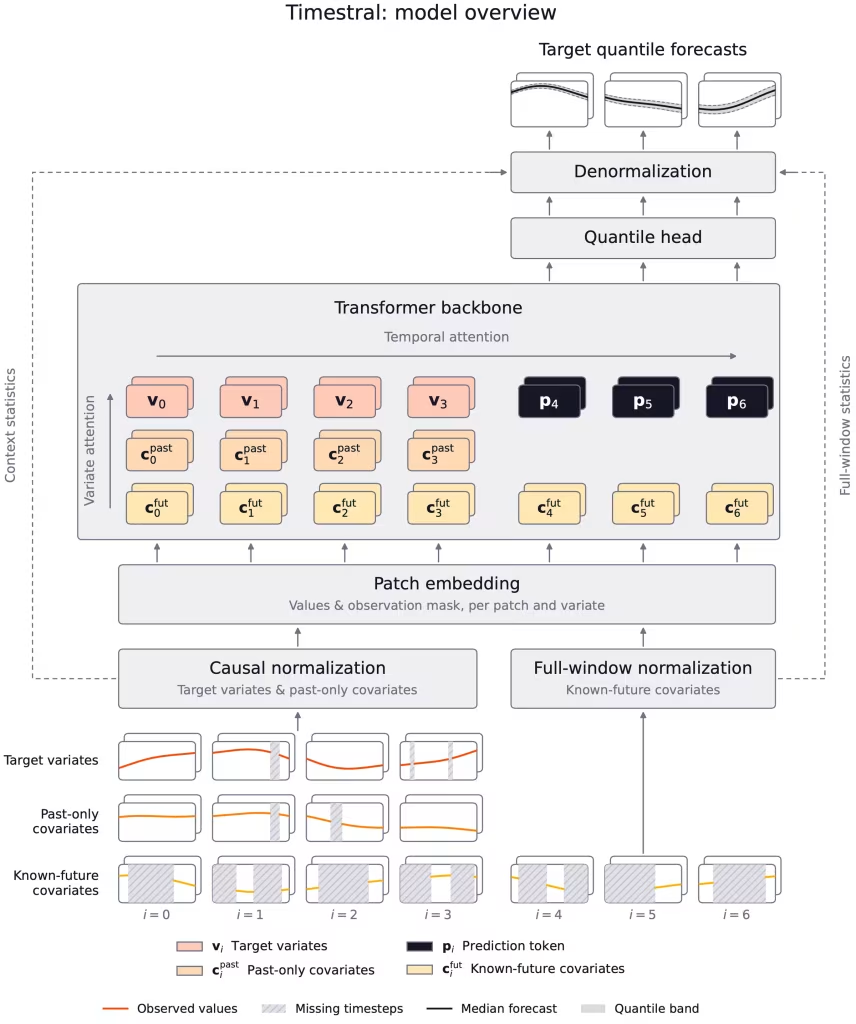
Timestral is a family of time-series forecasting models, including one with 209 million parameters. Marktechpost’s account of the Timestral release says the largest model supports a context of up to 32,768 time steps, and its weights occupy 837 MB in FP32.
The report says teams can run inference on standard server CPUs without a GPU, though they can use one if they choose. Mistral didn’t provide processor, RAM, storage, display or battery specifications. These categories aren’t central to a forecasting model, but without hardware guidance, deployment teams must assess their own server capacity. Marktechpost also reports that Mistral released open weights and inference code, so developers can inspect and run the models instead of relying only on a hosted API.
Timestral performance versus Google’s TimesFM-3
Reported benchmark results suggest the model family may outperform Google’s TimesFM-3 in evaluations. Still, treat the comparison as unconfirmed, not as a promise of production performance. Marktechpost reports a fev-bench SQL skill score of 50.39 for Timestral’s largest model, versus 48.99 for TimesFM-3.
Marktechpost also reports a GIFT-Eval MASE score of 0.658, just ahead of t0-gamma’s 0.661. Timestral’s reported lead on GIFT-Eval is narrow, while the fev-bench results show a larger gap between the two named models. The report says Timestral ranks first among pretrained zero-shot models on GIFT-Eval, time and fev-bench. These scores can help teams shortlist candidates, but they should also test relevant datasets, forecast horizons and error costs before choosing a model.
Which forecasting approach should teams choose?
Timestral may suit teams that want to try zero-shot forecasting and value local inference. But they’ll need to validate its benchmark claims on their own data. Google’s TimesFM-3 provides a direct comparison point, though the supplied launch information doesn’t establish its deployment requirements or performance in individual business use cases.
A benchmark advantage alone can’t settle the choice. Traditional methods such as autoregressive integrated moving average (ARIMA) fit one series at a time. That can make them useful as familiar, series-specific baselines, but teams must fit each series separately. Deep models trained from scratch on each dataset offer another option, with dataset-specific training as the trade-off. The right approach depends on whether a team prioritises quick evaluation, tailored fitting or proven accuracy on its own records.
What happens next for Timestral
Independent evaluations and deployment tests will provide the next useful evidence, especially if they disclose datasets, forecast horizons and inference conditions. API pricing remains undisclosed as of the October 19 launch, so teams can’t yet compare hosted costs with running the open model on their own infrastructure.
That uncertainty matters to buyers weighing CPU access against operating costs. For now, developers can treat Timestral as a new model to benchmark, not a proven replacement for existing forecasting workflows. Teams that need a zero-shot model to evaluate on a standard server CPU may find it worth testing. Those seeking proven performance on a specific business series should wait for validation on that data. The decisive test isn’t a leaderboard: it’s whether the forecast holds up on the series a business actually uses.
Source: Marktechpost
Timestral FAQs
What is Timestral?
Timestral is Mistral AI’s family of time-series forecasting models. It’s designed to make zero-shot forecasts on data it hasn’t seen during training.
Does Timestral require a GPU?
Marktechpost reports that the largest model can run inference on a standard server CPU without a GPU. GPU use is optional.
What are the key features of Timestral?
Mistral AI developed Timestral as a family of time-series forecasting models, including one with 209 million parameters. The model is designed to make zero-shot forecasts on data it hasn’t encountered during training, offering flexibility across forecasting scenarios.
How does Timestral compare to existing forecasting models?
Reports suggest Timestral may outperform Google’s TimesFM-3 on benchmarks, making it a potential forecasting option. But developers should treat it as a model to benchmark, not a definitive replacement for existing workflows, until further validation is available.
Was this article helpful?
Your feedback directly improves future articles on this site.