But does the torque justify the weight, and how does it stack up against rivals? We break down what matters before you commit.
Related Articles
- New Hyundai Bayon Interior Spied With 360-Degree Camera
- Mercedes-AMG CLE Mythos: The 641-HP V8 Super Coupe Is Coming
What Makes the ENGWE E26 3.0 Different From Other E-Bikes?
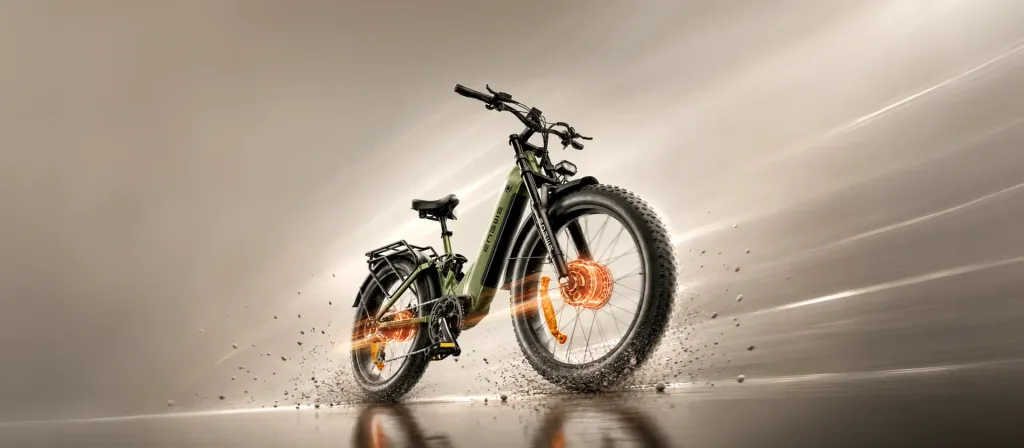
The headline feature is the dual-motor setup, which ENGWE says delivers massive torque across both wheels. That means the E26 3.0 can tackle steep inclines and loose terrain without the front wheel losing grip — a common failure point on single-motor off-road bikes.
Full suspension adds another layer of capability. Both front and rear shocks absorb rough trails, which reduces rider fatigue on long stretches. The combination targets riders who want an e-bike that behaves like a lightweight dirt bike rather than a commuter with pedal assist. The dual-motor architecture is the defining trait here, setting it apart from most sub-$2,000 e-bikes. That said, the added components push the weight up. Riders who plan to carry the bike upstairs or mount it on a car rack should check the official weight figure before ordering.
How Much Torque Does the Dual-Motor System Produce?
ENGWE has not published a single combined torque figure for the E26 3.0 as of September 2026. What we know from the announcement is that each motor contributes independently, and the combined output is intended for hill climbing and off-road use. To put that in context, most commuter e-bikes produce around 40–50 Nm from a single hub motor.
The E26 3.0’s dual setup is expected to exceed that by a wide margin, though the exact number remains unconfirmed. Buyers should watch for the official spec sheet, because torque figures directly affect hill-climbing ability and battery consumption. Here’s the thing: dual motors draw power faster than single-motor designs. If you ride aggressively on full throttle, expect range to drop noticeably. The battery capacity hasn’t been detailed yet, but ENGWE typically fits 48V packs in this class.
Is the Full Suspension Worth the Extra Weight?
For paved city roads, full suspension adds unnecessary bulk. But for gravel paths, pothole-riddled streets, or forest trails, the comfort gain is substantial. The rear shock prevents the jarring impacts that transfer through a rigid frame, which matters on longer rides. Compare this to the Tata Motors European push toward urban EVs — different category entirely, but the same logic applies: suspension quality dictates real-world comfort.
The E26 3.0’s setup is tuned for rough terrain, not just show. The front fork handles steering impact, while the rear damper keeps the wheel planted during acceleration. That said, maintenance costs rise with more moving parts. Seals wear, shocks need servicing, and the added complexity means more potential failure points. Riders who stick to smooth tarmac might prefer a simpler hardtail design.
What’s the Expected Range and Charging Time?
ENGWE hasn’t confirmed the battery capacity for the E26 3.0 in the launch announcement. Based on the company’s existing lineup, the E26 series reportedly ships with a 48V 13Ah battery, offering around 50–60 km of range on pedal-assist mode. Dual-motor operation will cut that figure significantly.
If you run both motors at full power, expect range to drop to roughly half the assisted figure. Charging time typically runs 4–6 hours with the standard 2A charger that ships with ENGWE bikes. For daily commuters, that range is workable if you have charging access at work. For weekend trail riders, carry a spare battery or plan shorter loops. The Legit Moto Bike segment shows how riders prioritize range over raw power — and the E26 3.0 forces a similar trade-off.
How Does the E26 3.0 Compare to the Competition?
The adventure e-bike segment has grown crowded, with brands like Himiway and Aventon offering dual-motor options. The E26 3.0’s full suspension gives it an edge over hardtail rivals like the TVS Jupiter Dual-Tone — though that’s a scooter, not a direct comparison.
What sets ENGWE apart is pricing aggression. The company typically undercuts Western brands by 20–30% on comparable specs. If the E26 3.0 lands near the $1,500–$1,800 mark, it will undercut most dual-motor competitors. The New Mahindra Veero CNG launch shows how value positioning drives market entry, and ENGWE appears to follow the same playbook.
Our Verdict
The ENGWE E26 3.0 targets riders who want genuine off-road capability without spending premium e-mountain-bike money. The dual-motor torque and full suspension address real pain points, but the lack of confirmed battery specs means range remains a question mark.
Watch for the official spec sheet, and weigh the weight penalty against your daily route. If the
More on engwe’s e26 3.0 as the story develops.
FAQs
When was the ENGWE E26 3.0 announced?
ENGWE announced the E26 3.0 on September 8, 2026. Does the E26 3.0 have dual motors? Yes, the e-bike features a dual-motor system designed for high torque output.
Is the suspension fully adjustable? The launch announcement confirms full suspension but doesn’t specify adjustability settings. What is the expected ENGWE hasn’t confirmed pricing yet, but the company typically Can I ride it on city roads? Yes, but the full suspension and weight are better suited to rough terrain.
Was this article helpful?
Your feedback directly improves future articles on this site.