NZ
NZ IND
IND NAM
NAM IRE
IRE MOZ
MOZ UGA
UGA Aston Villa
 Man City
 Rayo
Rayo Elche
Elche GMB
GMB ZMB
ZMB NGA
NGA LES
LES Cagliari
 Bologna
 IPS1
IPS1 NFO1
NFO1 ALA1
ALA1 MCF1
MCF1 TOR3
TOR3 MON2
MON2 BRE1
BRE1 NICE2
NICE2 TAS129/7 (23.3/35 ov, target 276)
 VIC304/7 (50 ov)
 WA
WA NSW38/1 (9/50 ov)
 NZ-A135/3 (41 ov)
 IND-A113
 DHA
DHA RAJ
RAJ MYMS
MYMS CHATT
CHATT RAN
RAN BAR
BAR SYL
SYL KHU
KHU MEX-W
MEX-W ARG-W
ARG-W UAE
UAE NED
NED AFG170/3 (34.3/50 ov, target 170)
 ZIM169
 IND-W200/1 (27.1/50 ov, target 198)
 ZIM-W197
 DOLPH56/0 (3.5/8 ov, target 56)
 SWD51/4 (8/8 ov)
 WSW1
WSW1 BRI1
BRI1 Como
Como Sassuolo
 Augsburg
 Union Berlin
 Cologne
 Schalke
 Mainz
Mainz Bremen
 RB Leipzig
 Elversberg
 VFB2
VFB2 BMG3
BMG3 AHL4
AHL4 KHA1
KHA1
India’s rural healthcare crisis just met its match. Over 450 million people in remote villages face a brutal reality: the nearest hospital is 50+ km away, and emergency medicines take 8-12 hours to arrive by road. But a new wave of Indian drone startups is rewriting that equation. Zipline, Skye Air, and Redwing are already operating 1,200+ successful medical deliveries across Telangana, Karnataka, and Maharashtra. What started as a moonshot idea is now saving lives.
This ecosystem shift matters because India generates the kind of infrastructure challenges that force innovation—and when innovation happens here, it scales globally. If you’re curious about how India’s tech sector is solving real-world problems, our coverage of India’s First Nationwide 5G-Enabled Smart Grid shows how connectivity fuels these breakthroughs.
Why Rural Healthcare Just Got a Technological Lifeline
Here’s the thing: India’s healthcare infrastructure gap isn’t a policy problem anymore—it’s being solved by drones. The Indian government approved drone operations for medical delivery in 2023, and startups seized the moment. Regulatory bodies like the DGCA (Directorate General of Civil Aviation) have fast-tracked approvals for autonomous medical flights in designated corridors.
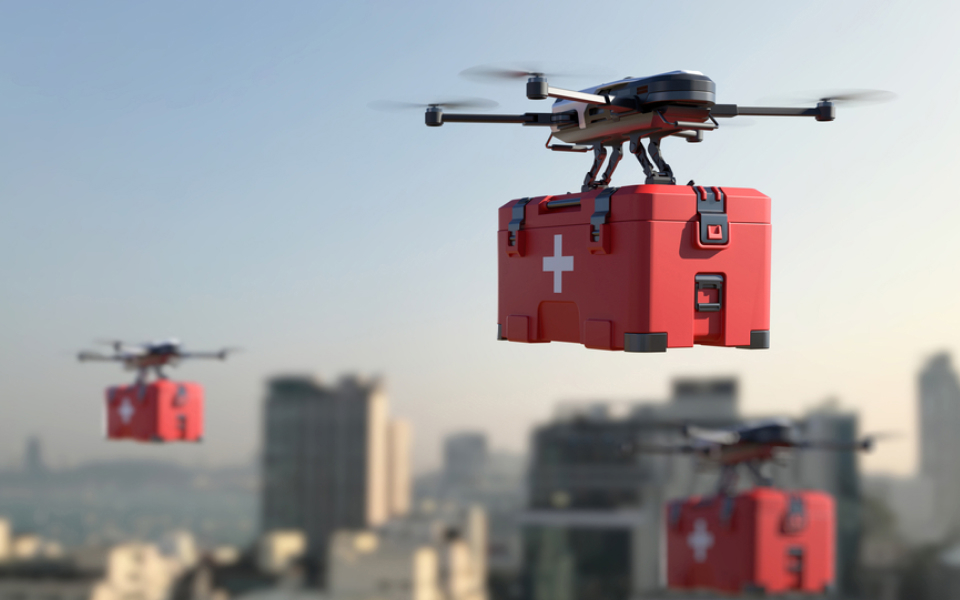
This wasn’t accidental. India’s rural population density, combined with poor road infrastructure in mountainous and tribal regions, created the perfect use case for aerial logistics. Startups saw the gap and built solutions. Today, ₹2,400+ crore in venture funding has poured into Indian drone companies over the last 18 months. That’s not just investment—it’s validation that this ecosystem works.
Skye Air’s Regional Hub Model: The ₹8.5 Crore Success Story
Skye Air operates the largest drone delivery network in India right now. Their model is simple but brilliant: establish regional hubs in district towns, then deploy autonomous VTOL (vertical takeoff and landing) drones to nearby villages. Each drone carries 2-4 kg payloads—enough for emergency medicines, blood samples, and diagnostic kits. The flight range is 40-60 km, which covers most underserved areas. What makes this work financially? A single delivery costs ₹150-300, compared to ₹800-1,200 by road ambulance.
Hospitals save money. Patients get faster care. The math works. Skye Air has completed over 600 deliveries in Karnataka alone, with response times averaging 28 minutes. They’re profitable on a per-delivery basis, though scaling remains capital-intensive. The real win? They’ve partnered with state health departments, meaning government funding now subsidizes rural access. This is how innovation meets sustainability in India’s healthcare sector.
Zipline and Redwing: The Global Players with Indian Ambitions
Zipline launched in Telangana in 2023 and hasn’t looked back. Unlike Skye Air’s hub-and-spoke model, Zipline uses fixed-wing drones with longer ranges (100+ km) and higher payload capacity (3-5 kg). Their Telangana network covers 1,200 villages and handles blood transfusions, vaccines, and critical medications. Cost per delivery? ₹200-250. They’ve completed over 50,000 flights globally, so the India operation benefits from proven operations playbooks. Redwing, an Indian startup backed by IIT-Bombay alumni, takes a different angle.
They focus on lightweight, modular drones designed specifically for India’s challenging terrain—dense forests, mountainous regions, and areas with poor GPS coverage. Their drones use hybrid navigation systems combining GPS with visual odometry, making them reliable even in signal-poor zones. Redwing’s pricing is aggressive: ₹120-180 per delivery in beta markets. Still unprofitable at scale, but they’re betting on volume to fix that. The competition is fierce, and that’s good news for rural patients. When multiple players chase the same market, prices drop and service quality rises.
The Infrastructure Question: Can India’s Airspace Handle This? (People Also Ask)
This is the real bottleneck. India’s airspace is heavily regulated, and integrating hundreds of autonomous drones requires sophisticated air traffic management systems. The DGCA has designated “drone corridors” in specific states, but expansion is slow.
However, India’s investment in digital infrastructure is creating the backbone these systems need. 5G rollout means real-time drone tracking and command centers can operate from metros while drones fly in rural areas. The government’s ₹1,000 crore National Logistics Policy includes drone subsidies for healthcare and agriculture. Within 24 months, expect drone corridors to expand to 15+ states. The infrastructure isn’t perfect yet, but it’s moving faster than skeptics predicted.
Quick Comparison
| Provider | Drone Type | Payload (kg) | Range (km) | Cost Per Delivery (₹) | Operational States |
|---|---|---|---|---|---|
| Skye Air | VTOL | 2-4 | 40-60 | 150-300 | Karnataka, Telangana |
| Zipline | Fixed-Wing | 3-5 | 100+ | 200-250 | Telangana, Maharashtra |
| Redwing | Hybrid Modular | 2-3 | 50-80 | 120-180 | Karnataka (Beta) |
Pros and Cons
| Pros | Cons |
|---|---|
| Delivery time cut from 8-12 hours to 25-30 minutes | High upfront infrastructure costs (₹5-15 crore per hub) |
| Reduces ambulance burden on overburdened rural roads | Weather dependency—rain/wind grounds flights |
| Government subsidies make it economically viable | Airspace regulations still fragmented by state |
| Profitable at scale with 200+ deliveries/day per hub | Limited to 2-5 kg payloads (not for bulk medicines) |
| Creates local jobs for drone pilots and maintenance teams | Public acceptance still building in some regions |
Conclusion
India’s drone delivery ecosystem isn’t a future scenario anymore—it’s operational, profitable, and expanding. Skye Air, Zipline, and Redwing have collectively proven that autonomous medical delivery works in India’s challenging geography and regulatory environment. If you’re tracking how India’s tech innovations solve real healthcare access problems, this is the story to watch.
The next wave of growth depends on airspace expansion and government scaling, both of which are happening faster than expected. For rural hospitals and patients in underserved areas, this technology is genuinely life-saving. The ecosystem will consolidate to 2-3 major players within 18 months, so early partnerships with established providers like Zipline offer the most reliability. This is one of those rare cases where innovation, regulation, and social need align perfectly. India’s building the future of healthcare logistics right here.