Do Deewane Seher Mein Review: What happens when two emotionally scarred souls collide in India’s most chaotic city? Can love grow between insecurities, speech impediments, and the crushing weight of modern expectations? Do Deewane Seher Mein dares to answer these questions with refreshing honesty—trading Bollywood’s grand gestures for whispered vulnerabilities and silent glances that speak louder than dialogues ever could.
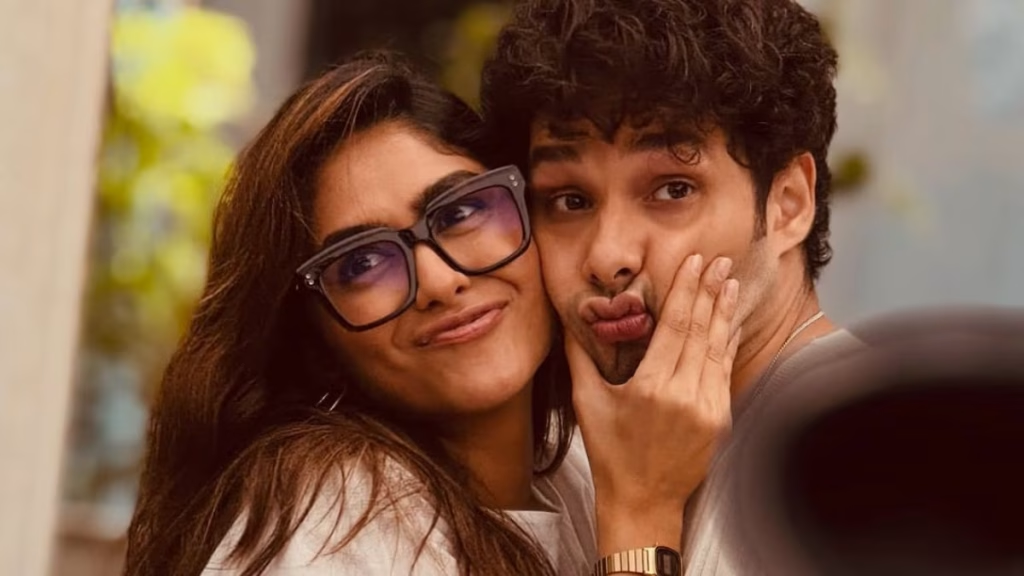
Table of Contents
Quick Verdict: Do Deewane Seher Mein Review
| Aspect | Rating/Consensus |
|---|---|
| Overall Rating | 2-3/5 (Mixed to Positive) |
| Lead Performances | Outstanding – Mrunal & Siddhant shine |
| Pacing | Slow-burn; second half drags |
| Genre | Urban romance, slice-of-life drama |
| Runtime | 2h 18m (needs trimming) |
| Director | Ravi Udyawar |
| Producer | Sanjay Leela Bhansali |
| CBFC Rating | U/A |
| Release Date | February 20, 2026 |
| Best For | Fans of quiet, emotionally honest romances |
The Story: Two Misfits, One Chaotic City
Do Deewane Seher Mein follows Shashank Sharma (Siddhant Chaturvedi), a marketing professional from an affluent Patna family who struggles with a speech impediment—he can’t pronounce “Sh” and says “S” instead. This seemingly minor issue profoundly impacts his confidence, preventing him from giving presentations or sales pitches despite working for a washing machine manufacturer.
Enter Roshni Srivastav (Mrunal Thakur), a self-doubting magazine employee carrying her own invisible wounds. When their families arrange a meeting, the interaction goes well—until Roshni abruptly rejects him without explanation. Convinced his lisp cost him the relationship, Shashank becomes determined to understand why. What unfolds is a tender, messy exploration of how two imperfect people navigate love in an age of Instagram filters and carefully curated perfection.
The film is set in Mumbai—the restless heartbeat where fast trains, crowded cafés, and emotionally distant modern lives become the backdrop for an unconventional love story that quietly blossoms through hesitation, self-doubt, and vulnerability.
The Title Explained: Seher vs. Sheher
Sharp-eyed viewers might notice something peculiar: the film is titled “Seher,” not “Sheher.” This isn’t a spelling error but a deliberate creative choice. The film loosely alludes to the old Gharaonda (1977) song “Do Deewane Sheher Mein,” but addresses this detail early in the narrative as part of Shashank’s speech impediment journey—framing their quest for both self-acceptance and romantic love.
The wordplay works on multiple levels: “sheher” means city, while “seher” has different meanings, including magic or dawn, suggesting that love itself becomes the magic these two discover amidst urban chaos.
The Performances: Where Do Deewane Seher Mein Truly Shine
Siddhant Chaturvedi’s Career-Defining Turn:
Every Do Deewane Seher Mein review agrees on one thing: Siddhant delivers one of his most nuanced performances to date. As he avoids playing the character’s speech difficulty for sympathy or drama. Instead, he internalizes it—showing how it quietly impacts confidence, professional presence, and romantic expression.
Siddhant captures a specific body language of someone who has learned to take up less space in a room—a performance that feels genuinely inhabited rather than performed. He moves beyond his typical aggressive roles (Gully Boy, Gehraiyaan) to convincingly portray a restrained, sensitive character.
Mrunal Thakur’s Powerhouse Performance:
If Siddhant impresses, Mrunal steals the show. This is a Mrunal Thakur film—her expressions and reactions are fabulous, indicating an actress getting better with each project. Her mercurial moods and whims are perfectly delivered, and without her, the stretched narration would have made for tedium.
She captures the contrast between a working woman’s outward confidence and inner struggle with care. Her eyes do much of the talking, especially in scenes where words are few, conveying Roshni’s pain and insecurity with remarkable ease.
The Chemistry:
The organic chemistry between Siddhant and Mrunal feels like a slow, evolving comfort between two strangers. Their romance doesn’t feel rushed but grows gradually—exactly as modern relationships do.
What Works: The Strengths of Do Deewane Seher Mein
1. Emotional Authenticity
OTT Play’s Arpita Sarkar rated it 3/5 stars, noting that the film “is a gentle, emotionally aware romance that chooses vulnerability over spectacle.” In a cinematic landscape dominated by action and high drama, it dares to slow down and sit with insecurities, hesitations, and self-doubt.
2. Mumbai as a Character
Beautifully describes how director Ravi Udyawar uses Mumbai not just as a backdrop but as a third character—one that is indifferent to its inhabitants in exactly the way modern loneliness feels. The city becomes witness to the vulnerable act of falling in love.
3. Relatable Modern Romance
It highlights what many urban romances miss: love today rarely begins with certainty. It begins with confusion, insecurity, and two people trying to look more “together” than they actually feel.
4. Supporting Cast Excellence
Sandeepa Dhar leaves a huge mark despite limited screen time. Her breakdown in the second half is memorable. Ila Arun adds warmth, Viraj Ghelani brings laughs, and Joy Sengupta, Ayesha Raza, and others lend solid support.
5. No Villain, No Drama—Just Life
Abhiruchi Chand’s script shows warmth without manufactured conflict. There’s no villain spoiling things, no act of God stonewalling the happy ending. Just two people navigating their own demons while trying to connect.
What Doesn’t Work: The Cracks in the Foundation
The Pacing Problem:
Nearly every Do Deewane Seher Mein review mentions this critical flaw. At 2 hours and 18 minutes, the film feels bloated. “compilation of random scenes stitched together”—some films aren’t bad per se, but need judicious trimming to make for a good watch.
The screenplay moves deliberately slowly in the first half (which works), but gets repetitive during the second half. For viewers conditioned by mainstream Hindi cinema’s heightened emotional grammar, this restraint may feel uneventful.
Censorship Overreach:
Questioning how you can expect passion when the censors have excised ridiculous numbers of words from the mouths of adults. NDTV’s Radhika Sharma pointed out that for a film preaching self-acceptance, it can’t even use expletives—with terms like “boobs” muted out.
Logic Leaps:
While the script claims to be realistic (and mostly is), it’s suffused with dollops of illogic, according to critics. The execution, while heartfelt, needed a more practical approach to truly soar.
Missing Deewanapan:
Despite the title promising two crazy lovers, the film sometimes lacks that wild passion. It’s so committed to restraint and realism that it occasionally forgets romance also needs spontaneity and fire.

The Critical Divide: A Film That Polarizes
The Do Deewane Seher Mein review landscape reveals fascinating splits:
The Appreciators (2.5-3/5 stars):
- Bollywood Hungama: “Like a breath of fresh air.”
- India.com: “Siddhant Chaturvedi–Mrunal Thakur shine”
- India TV: “Worth a watch for the performances.”
The Disappointed (1.5-2/5 stars):
- The Indian Express: “Just doesn’t have enough deewanapan.”
- The Hindu: “Siddhant and Mrunal fail to rise above flimsy conflicts.”
Fan Reactions:
Social media users gave the film 4 stars on average, appreciating the lead pair’s chemistry and the feel-good vibe, suggesting a disconnect between professional critics and regular audiences.
The Bhansali Touch: What His Production Means
Produced by Sanjay Leela Bhansali (along with Prerna Singh, Umesh Kumar Bansal, and Bharat Kumar Ranga), Do Deewane Seher Mein carries expectations. However, unlike his directorial projects (Heeramandi, Gangubai Kathiawadi), this is a restrained, small-scale romance that prioritizes emotional truth over visual grandeur.
Interestingly, Bhansali’s involvement might have actually hurt the film commercially—audiences expecting his trademark spectacle got intimate realism instead, creating a marketing mismatch.
Who Should Watch Do Deewane Seher Mein?
PERFECT FOR:
- Fans of slow-burn, character-driven romances
- Viewers who loved Wake Up Sid, I Hate Luv Storys, or Laila Majnu
- Mrunal Thakur and Siddhant Chaturvedi’s admirers
- Those seeking quiet, emotionally honest storytelling
- Anyone tired of loud, action-heavy Bollywood fare
SKIP IF:
- You prefer fast-paced, high-drama narratives
- Slow second halves test your patience
- You need grand romantic gestures and sweeping declarations
- Restrained performances feel “underwhelming” to you
Final Thoughts: An Imperfect Film About Imperfect Love
The most fitting Do Deewane Seher Mein review might be this: it’s a film that mirrors its protagonists—flawed, hesitant, occasionally frustrating, but ultimately sincere.
“There is no melodrama here. The film operates within a contemporary emotional grammar: silent quarrels, strategic disappearances, moments that are felt more than declared.”
In an industry obsessed with larger-than-life romance, Do Deewane Seher Mein offers something rarer—the recognition that love isn’t always fireworks. Sometimes, it’s just two broken people deciding that together, they’re slightly less broken.
“It may not offer grand cinematic highs, and its slow-burn storytelling won’t work for everyone, but it does reflect the anxieties and tenderness of modern love with sincerity.”
Our Rating: ⭐⭐⭐ (3/5) – Imperfect but heartfelt. Watch for the performances, stay for the quiet moments, and forgive the pacing issues. Sometimes, that’s enough.
Have you watched Do Deewane Seher Mein? Did the slow-burn romance work for you, or did you find it tedious? Share your thoughts!
Read More- Katrina Kaif and Vicky Kaushal Net Worth: Inside Bollywood’s Power Couple’s Multi-Crore Empire