
 NZ
 IND
 NAM
 IRE
 MOZ
 UGA
 Aston Villa
 Man City
 Rayo
 Elche
 GMB
 ZMB
 NGA
 LES
 Cagliari
 Bologna
 IPS1
 NFO1
 ALA1
 MCF1
 TOR3
 MON2
 BRE1
 NICE2
 TAS103/5 (20.2/35 ov, target 276)
 VIC304/7 (50 ov)
 WA
 NSW22/1 (4.2/50 ov)
 NZ-A135/3 (41 ov)
 IND-A113
 DHA
 RAJ
 MYMS
 CHATT
 RAN
 BAR
 SYL
 KHU
 MEX-W
 ARG-W
 UAE
 NED
 AFG170/3 (34.3/50 ov, target 170)
 ZIM169
 IND-W200/1 (27.1/50 ov, target 198)
 ZIM-W197
 DOLPH56/0 (3.5/8 ov, target 56)
 SWD51/4 (8/8 ov)
 WSW1
 BRI1
 Como
 Sassuolo
 Augsburg
 Union Berlin
 Cologne
 Schalke
 Mainz
 Bremen
 RB Leipzig
 Elversberg
 VFB2
 BMG3
 AHL4
 KHA1

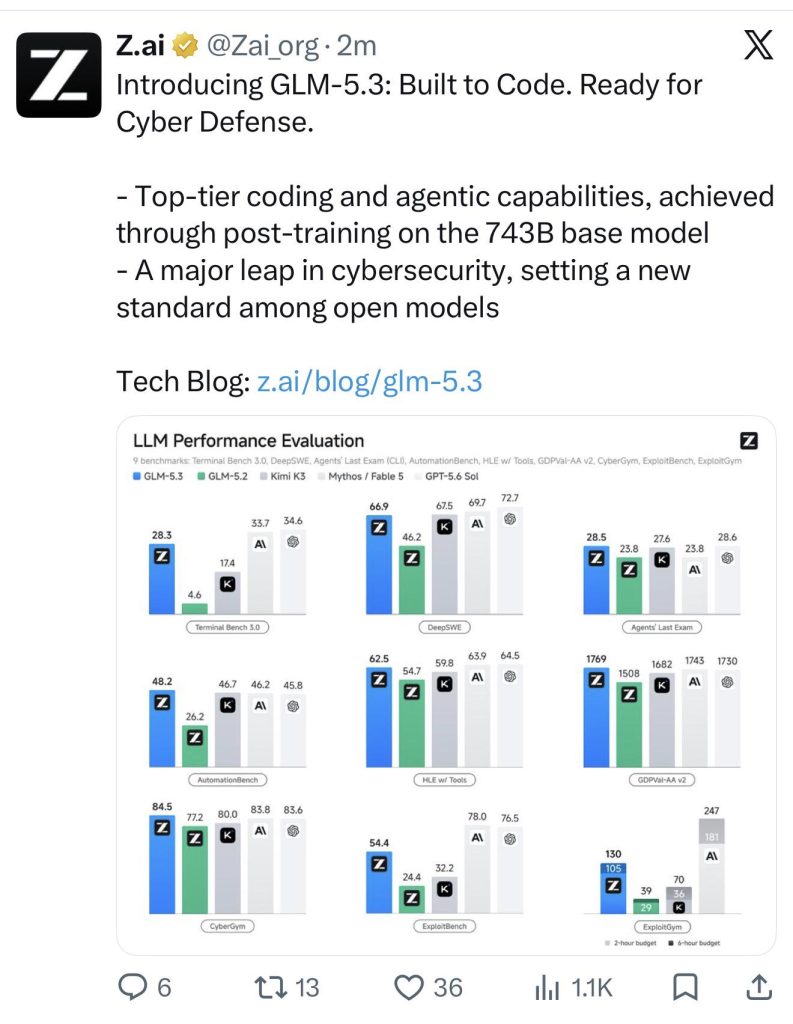
On Saturday, August 15, 2026, -5.3 arrived with a heavy emphasis on advanced cyber capabilities. VentureBeat reported it’s already linked to a “serious vulnerability” in the coding tool Cursor. That’s a big deal for teams building software with AI help.
The same agentic behavior that finds logic bugs can also expose weaknesses in the tools developers trust. If that claim holds, the impact is immediate. Security triage now has to cover not just code, but the AI coding environment itself—agents, plugins, safety gates, the whole stack.
Now, about the timing and the Cursor connection: those come from VentureBeat coverage and the verified facts we have. Nothing is officially confirmed by the vendors. But that uncertainty shouldn’t stop action—it should shape it.
GLM-5.3 arrives with cyber focus (the inciting moment)
The earliest event in this arc is the GLM-5.3 release mention dated Saturday, August 15, 2026, as covered by VentureBeat. In that same reporting context, the publication ties GLM-5.3 to advanced cyber capabilities and says it was reportedly already found in the wild of development tooling by uncovering a “serious vulnerability” in Cursor. If accurate, the sequence is unusual. Models typically mature through evaluation cycles before they’re credited with real-world weakness discovery.
That leads to the key practical tension: should security teams treat AI coding tools as just assistants, or as active participants in the attack surface? When a model can generate targeted steps against a toolchain, the difference between “prompt” and “exploit” can shrink fast.
2026: The Cursor vulnerability claim changes how we assess AI coding workflows
After the initial -5.3 appearance, the reported turning point is the alleged Cursor vulnerability discovery. VentureBeat’s coverage frames this as a “serious vulnerability” uncovered in the coding assistant environment, not merely in the code users write. That distinction matters because it shifts mitigation from “fix your application” to “harden your developer tooling.”
Here’s the thing: AI coding tools typically integrate with local environments—files, terminal commands, model calls, and sometimes third-party extensions. Even when the tool itself is the target, the real blast radius can include any automated actions that it triggers, from fetching dependencies to applying patches without sufficient guardrails. That’s why the claim—even unconfirmed—should prompt immediate internal review.
For teams using AI coding agents, the question becomes sharper: what happens when the model’s cyber capability outpaces the tool’s safety assumptions? If an agent can reason toward an exploit path, it may also find the shortest route to trigger harmful behavior inside the editor, extension runner, or authentication flow.
2026: What security and product teams should do next (ranked checklist)
Until vendors confirm details, we can’t validate the specific weakness. But we can still act on the safest interpretation: AI-assisted coding environments can be attacked, and AI models can help attackers find the path quickly. Here’s our ranked, practical list for response steps that align with cyber-focused AI workflows.
- Identify Cursor integration points
Map every place where the tool interacts with code execution: terminal access, extension permissions, file system read/write, clipboard, and network calls. If GLM-5.3-like behavior is credited with tool weakness discovery, integration mapping becomes your fastest containment lever.
- Enable strict extension controls
Review which extensions are installed, who can install them, and whether untrusted extensions can call privileged APIs. Tool-level permissions are often where “serious vulnerabilities” hide.
- Harden local execution paths
Add or tighten policies around auto-run commands, “apply patch” flows, and any step where the tool executes generated content. Treat AI-generated commands as untrusted until proven safe.
- Instrument prompts and actions for security logging
Capture the sequence: user intent → model request → tool action. If a vulnerability is related to “what the model asked for” versus “what the tool did,” audit trails become essential evidence.
- Run targeted regression with safe test harnesses
Use internal red-team style tests that simulate adversarial prompts without harming real assets. This can validate whether the toolchain behaves safely when pushed toward cyber workflows.
- Create a “tool trust boundary” policy
Define what the AI assistant is allowed to do automatically versus what requires confirmation. This is a product decision, but it becomes a security control.
- Update dependencies and sandbox where possible
Ensure the coding environment dependencies are current, and move risky operations into sandboxes. If a vulnerability exists, outdated runtime components can widen impact.
- Use vendor advisories as the source of truth
When OpenAI and other AI platform guidance updates, treat it as policy input, not marketing. For model-driven security posture, reference security guidance from the OpenAI blog as part of your governance workflow (see https://openai.com/blog).
- Track coverage and communicate internally
If the claim continues to circulate, align engineering, security, and support with a single internal narrative: what’s known, what’s unconfirmed, and what steps are underway. VentureBeat’s AI category coverage is a useful monitoring channel for momentum and follow-ups (see https://venturebeat.com/category/ai).
- Prepare for rapid rollback of risky workflows
If you identify a path that can trigger unsafe actions, be ready to disable specific automation features or extensions while awaiting fixes.
- Add a “cyber capability” classification to AI prompts
Tag requests that look like vulnerability exploration, exploit construction, or tool probing, and route them through stricter approval gates.
- Benchmark your own time-to-mitigation
Measure how quickly your team can detect, contain, and remediate an AI-tool related issue. The claim’s speed suggests attackers will try to compress timelines too.
What this implies now: faster vulnerability discovery, tighter governance later
The present-day implication is straightforward: if GLM-5.3’s cyber behavior is indeed being associated with a Cursor weakness, the competitive edge shifts toward teams that can secure the full loop—model, tool, and execution environment. That means security governance can’t start after adoption; it has to start during integration.
Looking forward, we expect a new norm: editor and AI tool vendors will face pressure to publish clearer tool permission models, more transparent safety controls, and faster patch cycles when cyber-capable agents evolve. For developers, the safest bet is to keep your AI coding stack under the same scrutiny you apply to any production-facing system—because the toolchain is now part of the attack surface.
Related Articles
- boltt Ace & Evo: Advanced Cameras with Google AI
- OpenAI GPT-5.6-Cyber (2026) Cuts Refusals: Key AI News
- Hanyang University Unveils Advanced Tunable Electronic Skin Technology
FAQs
What is GLM-5.3, and why is it tied to cyber capabilities?
GLM-5.3 is an AI model whose release was referenced in VentureBeat coverage dated Saturday, August 15, 2026, with emphasis on advanced cyber capabilities. In the same coverage context, VentureBeat also links it to a reported “serious vulnerability” in the coding tool Cursor, but official confirmation is not part of the verified facts we have.
Does the “Cursor serious vulnerability” claim mean Cursor is definitely unsafe?
No. The verified facts we have confirm only that VentureBeat coverage made that connection, not that Cursor’s vulnerability details were officially confirmed. Teams should treat it as a high-priority monitoring and hardening trigger, not as a final verdict.
How should developers respond if they use AI coding tools daily?
Start with integration mapping (permissions, extensions, execution paths), tighten automation with confirmation gates, and add logging for tool actions. Then run safe regression tests and align on a rollback plan so you can react quickly if new details emerge from trusted advisories.
Where should teams follow credible updates on AI security guidance?
Beyond vendor patch notes, teams can follow ongoing AI security coverage and guidance from major editorial and research outlets, and apply platform governance learnings from resources like the OpenAI blog. For broader reporting momentum, VentureBeat’s AI category can help track evolving claims.
What should we watch for next in this timeline?
Expect follow-up reporting that either corroborates the vulnerability with technical details or walks back specific claims. In parallel, watch for Cursor-related mitigations: permission changes, sandboxing updates, and advisories that clarify what was exploited and how it was patched.
GLM-5.3’s reported cyber speed is a warning: secure the editor pipeline, not just your codebase.
Was this article helpful?
Your feedback directly improves future articles on this site.




