Mohun Bagan
 Chennaiyin
 PSG
PSG Lyon
Lyon Sevilla
 Osasuna
 NED
NED OMA
OMA NZ
NZ IND
IND NAM
NAM IRE
IRE PAK
PAK SL
SL SA
SA AUS
AUS BAR1
BAR1 RMA2
RMA2 UDI0
UDI0 MIL2
MIL2 RSO2
RSO2 LEV1
LEV1 LEC0
LEC0 JUV2
JUV2 BRB76/3 (9/15 ov)
 MOW
MOW NZ-A317
 IND-A113 & 272/4 (73 ov)
 SYL280/2 (84 ov)
 KHU
KHU MYMS465/7d
 CHATT134/2 (40 ov)
 DHA521
 RAJ103/6 (26 ov)
 RAN402
 BAR179/3 (56.1 ov)
 LUL
LUL SPR
SPR TOK
TOK MIS
MIS MEX-W51 (12.5/20 ov, target 187)
 ARG-W186/7
 NGA148
 UGA147/9 (20 ov, target 149)
 GMB112/9
 LES109 (19.5/20 ov, target 113)
 MOZ110/7 (19/20 ov, target 110)
 ZMB109/9
 IND-W328/6
 ZIM-W207 (48.5/50 ov, target 329)
 ENG241
 Abha
Abha Al Faisaly
 LAFC
LAFC LA
LA Neftchi Fergana
 Al Ittihad
 Besiktas
 Istanbul BB
 Caykur Rizespor
 Trabzonspor
 SUN0
SUN0 LEE0
LEE0 SCF1
SCF1 MUN3
MUN3
Seoul, South Korea – Researchers at Hanyang University ERICA (https://www.hanyang.ac.kr/web/eng/research-excellence-e?p_p_id=kr_ac_hanyang_bbs_web_portlet_BbsPortlet&p_p_lifecycle=0&_kr_ac_hanyang_bbs_web_portlet_BbsPortlet_action=view_message&_kr_ac_hanyang_bbs_web_portlet_BbsPortlet_messageId=115801) in South Korea have developed a novel electronic skin technology capable of detecting both touch and proximity. The innovation is designed to enhance human-robot and human-prosthetic interactions through electrically tunable sensitivity.
The study, published in *Nano Energy*, introduces a vertically integrated dual-gated tribotronic transistor. This architecture enables the electrical tuning of sensor sensitivity while supporting high-density, large-area integration, addressing a significant challenge in the development of advanced electronic skin systems.
Hanyang University: Key Capabilities and Applications
The newly developed electronic skin demonstrates several key functionalities:
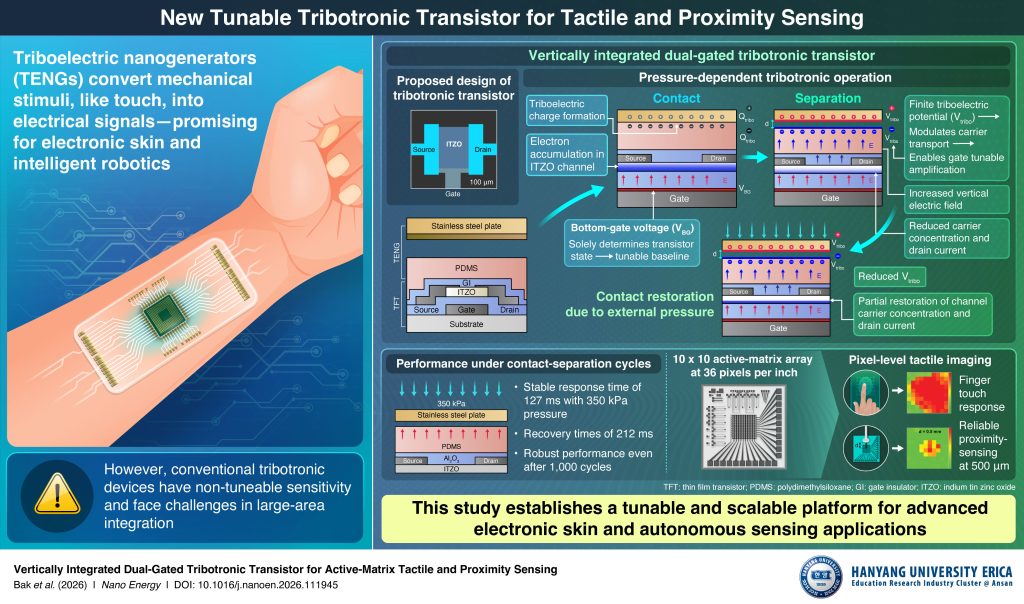
Multi-Modal Sensing: The technology can detect touch, pressure, and proximity, offering a comprehensive sensory input for various applications.
Tunable Sensitivity: A core feature of the design is its electrically tunable sensitivity, allowing the sensor to adapt to different environmental requirements and interaction types.
High-Density Integration: The compact vertical design facilitates the creation of high-density sensor arrays, crucial for intricate robotic and prosthetic interfaces.
Demonstrated Performance: Researchers successfully demonstrated finger-touch sensing using a 10 × 10 array. The system was also able to detect objects up to 500 micrometers away, indicating fine spatial resolution.
Durability: The electronic skin maintained stable performance over 1,000 operational cycles, suggesting reliability for long-term use.
This advancement is poised to impact several fields, including robotics, where it could lead to more responsive and safer interactions; prosthetics, by providing users with a more natural sense of touch; and wearables and healthcare systems, enabling new forms of physiological monitoring and human-machine interfaces. The continuous development in this sector is a significant part of the latest tech appliance news (https://technosports.co.in/) and ongoing industry developments.