
 SA329 (82.3 ov)
 AUS
AUS SAS2
SAS2 LAZ4
LAZ4 ALS0
ALS0 HIL0
HIL0 ROMA
ROMA CAG
CAG TOR
TOR COMO
COMO BAN
BAN WI
WI IND-W
IND-W ZIM-W
ZIM-W GOA
GOA SC Delhi
 Milan
Milan Bologna
 Parma
Parma Udinese
 Venezia
 Inter Milan
 AFG177
 ZIM140 (19.1/20 ov, target 178)
 ABH0
ABH0 ALF1
ALF1 PAK110
 SL114/2 (18.1/50 ov, target 111)
 NAM316/7
 IRE253 (44.5/50 ov, target 317)
 SIKM184
 NAGA187 & 46/4 (34 ov)
 JHK131/4 (47 ov)
 DELHI515/5d
 ODSA194
 SVCS13/0 (5 ov)
 BRODA616
 J & K6/0 (4 ov)
 CHD685/5d
 HP49/0 (14 ov)
 CGR216/8 (95 ov)
 AP231
AP231 HYD193/2 (54 ov)
 PNJB431
 KNTKA297/7 (95 ov)
 TPURA194
 KER101/6 (35 ov)
 BENG350
 MAHA278/9 (100 ov)
 GUJ223
 MNPR364
 ARP111 & 95/2 (36 ov)
 UAE
UAE OMA
OMA AUCK
AUCK CANT
CANT CD
CD ND
ND DEN
DEN QAT
QAT KENYA
KENYA KUW
KUW POA
POA SPR
SPR NZ198/3
 IND199/4 (13.2 ov)
 NED371/5
 JAB113 (19.3/20 ov, target 133)
 KAY132/9
 HSV0
HSV0 SGE1
SGE1 RWE1
RWE1 RBL0
RBL0 SGS2
SGS2 FCA2
FCA2 BOC1
BOC1 M050
M050 CUA0
CUA0 GIR1
GIR1 EXC0
EXC0 ADO0
ADO0 APN0
APN0 ELC0
ELC0 CF 0
CF 0 CEE0
CEE0 SES0
SES0 ESP1
ESP1 AIK0
AIK0 ELF0
ELF0 Genoa
Genoa Juventus
 Monza
Monza Napoli
 Sevilla2
 Osasuna0
 PSG2
PSG2 Lyon0
Lyon0 Mohun Bagan1
 Chennaiyin0
 SAA2
SAA2 EST0
EST0 BEI2
BEI2 JHM2
JHM2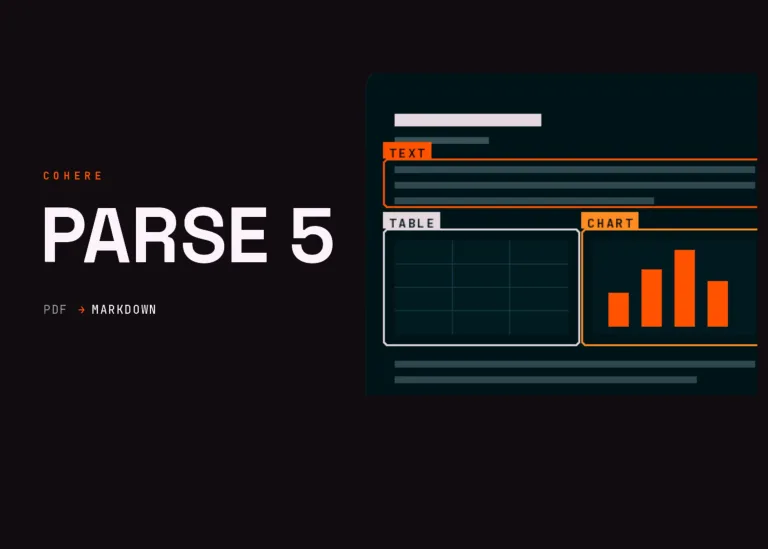
A 2.3-billion-parameter model just walked into the world’s most unglamorous office problem — the scanned PDF — and decided to leave it in Markdown.
On August 27, 2026, Cohere reportedly released Parse 5 (parse-v5.0), a vision language model built specifically to convert messy enterprise documents into clean, structured Markdown.
The launch lands at a moment when every CFO, claims handler, and compliance officer has been begging for exactly this: a single endpoint that reads contracts, invoices, and policy PDFs the way a human does, then hands back text a downstream LLM can actually consume.
Here’s the thing: the bottleneck in enterprise AI has quietly shifted. The hard part is no longer writing the agent — it’s feeding the agent trustworthy source data. A vendor onboarding form arrives as a 47-page scanned PDF with rotated tables and a coffee stain on page 12.
Traditional OCR chokes on the layout. Pure LLMs hallucinate the missing numbers. Cohere’s bet is that a smaller, purpose-built vision language model can read the page like a person, then output Markdown that preserves the hierarchy, the tables, and the footnotes.

How Parse 5 Actually Works
Parse 5 is not a general-purpose multimodal assistant wearing a document costume. It is a compact 2.3B-parameter vision language model trained on the specific task of page-level document understanding. The input is a document image or PDF page; the output is structured Markdown that retains headings, lists, tables, and inline emphasis.
The pitch is simple — accuracy without operational drag. At 2.3 billion parameters, Parse 5 is reportedly designed to fit in a single high-memory GPU, which keeps inference costs low enough to run across thousands of pages without a hyperscaler bill. For India, where rupee-sensitive teams at Infosys, TCS-adjacent BPOs, and mid-market SaaS companies process millions of invoices monthly, that cost profile is the real headline.
Worth noting: the model targets Markdown specifically, not JSON or proprietary XML. That choice matters because Markdown is the lingua franca of modern LLM pipelines — RAG systems, agent frameworks, and code-aware tools all parse it natively. Drop Parse 5’s output into a LangChain splitter or a LlamaIndex node parser, and downstream retrieval works on the first try.
Why a Dedicated Model, Not a Prompt
The natural question is: why not just prompt GPT-4o or Claude with the PDF and ask for Markdown? Cohere’s implicit answer is latency, cost, and control. A 2.3B specialist reportedly runs in tens of milliseconds per page on commodity hardware. A frontier multimodal model costs orders of magnitude more per call and introduces vendor lock-in for what should be a commodity preprocessing step.
There’s also a privacy angle. Enterprises handling patient records, loan agreements, or shipping manifests often cannot route documents through third-party APIs with vague data-retention policies. Parse 5 is rumoured to be self-hosted on private infrastructure, which keeps regulated documents inside the firewall. For healthcare and BFSI teams in Mumbai, Bengaluru, and Singapore, that is the difference between a six-month compliance review and a four-week pilot.
Where Parse 5 Fits in the Stack
Think of Parse 5 as the ingestion layer that sits between a document store and a reasoning engine. A typical flow now looks like: PDF in, Markdown out, chunked, embedded, retrieved, answered.
The new model reportedly replaces the brittle OCR-plus-rules-engine combo that data teams have been patching for years. Parse 5 also slots neatly into the agentic AI workflows that AWS and NVIDIA have been scaling.
When an agent needs to extract line items from 10,000 supplier contracts, it can call Parse 5 first, then run a lighter LLM over the clean Markdown for reasoning.
That division of labour cuts the cost of a single document-processing pipeline dramatically, and it lets teams swap reasoning models without retraining the document reader.
What’s Next for Parse 5 and Enterprise Document AI
The competitive response will be fast. Expect open-source challengers — Qwen, DeepSeek, and the Llama 4 family — to release their own document-tuned vision models within weeks.
The differentiation battle will move from raw parameter count to benchmark performance on messy real-world PDFs: handwriting, multi-column layouts, mixed languages, and the kind of stamped, signed, coffee-stained pages that dominate Indian administrative workflows. For Cohere, Parse 5 is also a strategic foothold.
The company has been steadily repositioning from a foundation-model provider to an enterprise data platform, and a model that owns the front door of every document workflow is a durable piece of real estate.
The next release will likely add handwriting recognition, better table-merging across page breaks, and tighter hooks into RAG frameworks. Teams evaluating Parse 5 today should benchmark it against their worst real-world documents — not the clean samples in the marketing deck — before committing to a production rollout.
Cohere reportedly released Parse 5 at a moment when every AI team is learning the same lesson: the model is only as smart as the text you feed it, and clean Markdown is the difference between an agent that works and one that hallucinates.
Related Articles
FAQs
What is Cohere Parse 5?
Cohere Parse 5 (parse-v5.0) is a 2.3-billion-parameter vision language model reportedly released on August 27, 2026, designed to convert enterprise documents into structured Markdown.
How is Parse 5 different from a regular LLM?
Parse 5 is a specialist document-understanding model with 2.3B parameters, not a general-purpose assistant. It reportedly runs on a single GPU and outputs clean Markdown tuned for downstream RAG and agent pipelines.
Can Parse 5 be self-hosted?
Yes. At 2.3B parameters, Parse 5 is rumoured to fit on a single high-memory GPU, which could make private, on-premise deployment feasible for regulated industries like BFSI and healthcare.
What document types does Parse 5 support?
Cohere positions Parse 5 for enterprise documents — invoices, contracts, policy PDFs, and scanned forms — preserving headings, tables, lists, and footnotes in Markdown.
When did Cohere release Parse 5?
Cohere reportedly released Parse 5 on August 27, 2026, though full availability has not been officially confirmed.
Was this article helpful?
Your feedback directly improves future articles on this site.


