MBSG
MBSG CFC
CFC PSG
PSG LYON
LYON SEV
SEV OSA
OSA NED
NED OMA
OMA NZ
NZ IND
IND NAM
NAM IRE
IRE PAK
PAK SL
SL SA
SA AUS
AUS Barcelona1
 Real Madrid2
 Udinese0
 Milan2
 Real Sociedad2
 Levante1
 Lecce0
 Juventus2
 LUL
LUL SPR64/7 (12/20 ov)
 NZ-A317
 IND-A113 & 488/8 (119 ov)
 SYL575/4 (167.3 ov)
 KHU
KHU MYMS465/7d
 CHATT424/6 (121 ov)
 DHA521
 RAJ162 & 215/5 (59.1 ov) (f/o)
 RAN402 & 5/0 (2.3 ov)
 BAR443/9d
 SIKM30/1 (15 ov)
 NAGA187
 JHK
JHK DELHI309/5 (90 ov)
 ODSA194
 SVCS13/0 (5 ov)
 BRODA259/6 (86 ov)
 J & K
J & K CHD363/2 (87 ov)
 HP
HP CGR35/1 (14 ov)
 AP231
AP231 MOW
MOW TOK
TOK BRB
BRB MIS
MIS BIK
BIK CHR
CHR MEX-W51 (12.5/20 ov, target 187)
 ARG-W186/7
 NGA148
 UGA147/9 (20 ov, target 149)
 GMB112/9
 LES109 (19.5/20 ov, target 113)
 MOZ110/7 (19/20 ov, target 110)
 ZMB109/9
 IND-W328/6
 ZIM-W207 (48.5/50 ov, target 329)
 ENG241
 Abha
Abha Al Faisaly
 Sassuolo
 Lazio
Lazio AS Roma
 Cagliari
 Torino
 Como
Como NEF
NEF ITT
ITT Sunderland0
 Leeds0
 Freiburg1
 Bayern3
Every few months, one AI release resets the benchmark for what’s possible. On June 9, 2026, Anthropic didn’t just move the benchmark — they detonated it.
Anthropic has officially launched Claude Fable 5 and Claude Mythos 5 — two models that represent the company’s most significant capability leap since the original Claude release. Fable 5 is a Mythos-class model made safe for general public use. Mythos 5 is the same underlying model with safeguards lifted — available exclusively to a restricted group of cybersecurity defenders and infrastructure providers through Project Glasswing.
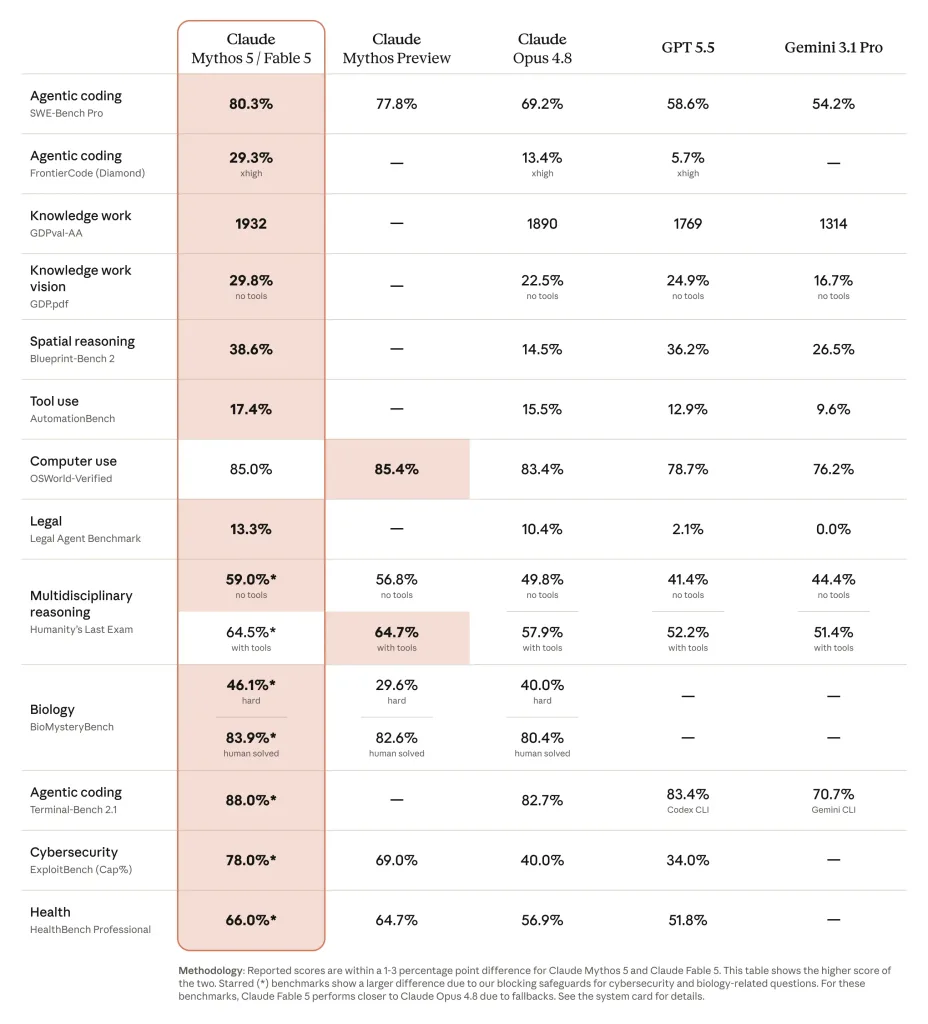
The headline: Fable 5’s capabilities exceed those of any model Anthropic has ever made generally available, with exceptional performance in software engineering, knowledge work, vision, scientific research, and many other areas. The longer and more complex the task, the larger Fable 5’s lead over other models.
Anthropic’s Claude Fable 5 & Mythos 5: Everything at a Glance
| Detail | Specification |
|---|---|
| Launch Date | June 9, 2026 |
| Model Tier | Mythos-class (above Opus) |
| Input Token Pricing | $10 per million tokens |
| Output Token Pricing | $50 per million tokens |
| Free Access Window | Pro, Max, Team, Enterprise plans — until June 22 |
| After June 22 | Usage credits required |
| Fallback on Sensitive Queries | Claude Opus 4.8 |
| Fallback Rate | Less than 5% of sessions |
| Mythos 5 Access | Project Glasswing partners only |
| Data Retention Policy | 30-day retention on all Mythos-class traffic |
| API Model String | claude-fable-5 |
What Makes Fable 5 Different: Four Capability Leaps
1. Software Engineering — Months of Work in Days
The most jaw-dropping real-world result in the launch announcement comes from Stripe. Stripe reported that Fable 5 compressed months of engineering into days. In a 50-million-line Ruby codebase, the model performed a codebase-wide migration in a day that would otherwise have taken a whole team over two months by hand.
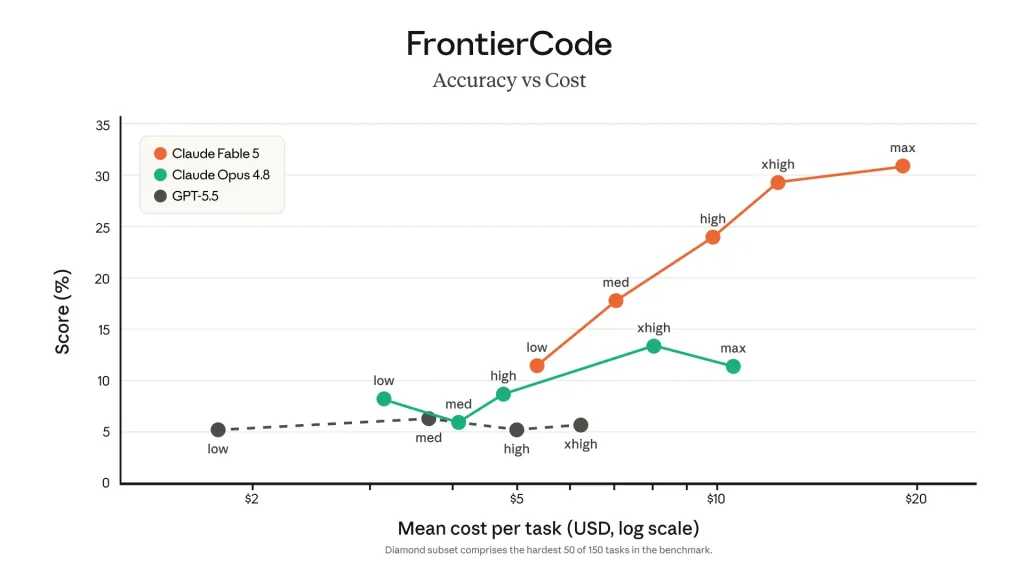
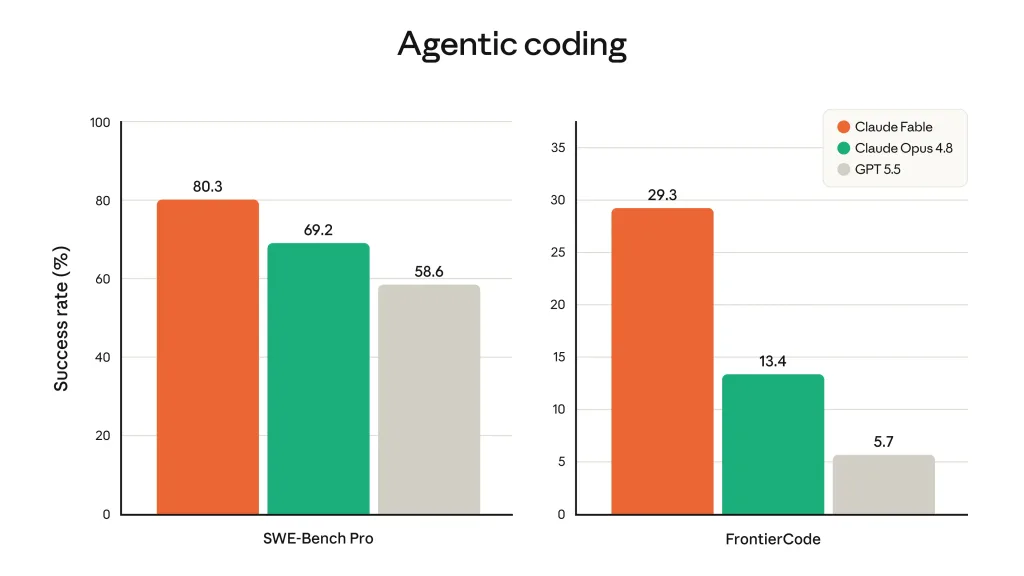
On Cognition’s FrontierCode evaluation — which tests whether models can pass difficult coding tasks while meeting the standards of high-quality production codebases — Fable 5 scores highest among frontier models, even at medium effort.
2. Vision — State of the Art, No Contest
Fable 5 is the new state-of-the-art model for tasks involving vision. It can extract precise numbers from detailed scientific figures and can perform complex vision-based tasks like rebuilding a web app’s source code from screenshots alone. Previous Claude models struggled to play Pokémon FireRed even with harnesses that gave them additional helpful tools — Fable 5 beat FireRed with a minimal, vision-only harness.
3. Memory and Long-Context — A Different Beast at Scale
Fable 5 stays focused across millions of tokens in long-running tasks and improves its outputs using its own notes. When tested on the deck-building game Slay the Spire, giving it access to persistent file-based memory improved its performance three times more than for Opus 4.8.
4. Life Sciences — Drug Design in Hours, Not Months
The Mythos 5 results in biology are extraordinary. Using Mythos 5, Anthropic’s internal protein design experts accelerated aspects of the drug design process by around ten times. Mythos 5, with protein design and bioinformatics tools but no human assistance, matches or beats skilled human operators — executing all of the tasks normally completed by a scientist: choosing binding sites, selecting and running protein design tools, and recovering from failures along the way.
For context on Anthropic’s broader AI acceleration story, read our coverage of their recursive self-improvement report which laid the groundwork for understanding why a leap like Fable 5 was imminent.
The Safeguards: Why Fable 5 Is Not Mythos 5
This is the most important distinction in the entire announcement — and it’s one that every developer and user needs to understand clearly.
Releasing a model this capable comes with risks. Without safeguards, Fable 5’s capabilities in areas like cybersecurity could be misused to cause serious damage. Anthropic has therefore launched the model with safeguards that mean queries on some topics will instead receive a response from Claude Opus 4.8.
The three areas covered by Fable 5’s safety classifiers are:
Cybersecurity — Mythos-class models excel at discovering and exploiting software vulnerabilities and can make cyberattacks substantially easier and cheaper to commit. The cybersecurity classifiers cover both exploitation and offensive cyber tasks. One external partner found that Fable 5’s safeguards against harmful cyber queries were the most robust of any model tested — complying with zero harmful single-turn requests relating to planning a cyberattack, exploit development, or defense evasion, whether or not the requests used any of 30 different public jailbreak techniques.
Biology and Chemistry — Models now have a greater ability to accomplish real-world scientific tasks. Mythos-class models outperformed sophisticated dedicated protein models using biological reasoning alone when tested on predicting properties of a simple virus — demonstrating promising ability for gene therapy research but also highlighting the dual-use risk.
Distillation — Anthropic has previously identified large-scale attempts to extract Claude’s capabilities to train competing models in authoritarian countries. Requests flagged as part of such distillation attempts will fall back to Opus 4.8.
Critically, more than 95% of Fable sessions involve no fallback at all. For the vast majority of users in the vast majority of use cases, Fable 5 and Mythos 5 are functionally identical.
Pricing and the Critical June 22 Deadline
Fable 5 and Mythos 5 are priced at $10 per million input tokens and $50 per million output tokens — less than half the price of Claude Mythos Preview.
The access rollout has a specific structure that every paid Claude user needs to understand:
From today through June 22, Fable 5 is included on Pro, Max, Team, and seat-based Enterprise plans at no extra cost. On June 23, Fable 5 will be removed from those plans — using it after that will require usage credits. After this point, when sufficient capacity allows, Anthropic aims to restore Fable 5 as a standard part of subscription plans.
The window closes in less than two weeks. If you’re on a paid plan and want to experience the most capable AI model ever released to the public without paying per-token, the clock is running.
What Customers Are Saying
The early access testimonials in Anthropic’s announcement paint a consistent picture of a model that operates in genuinely different territory:
- Cursor CEO Michael Truell: Fable 5 has opened a class of long-horizon problems that were out of reach for earlier models
- GitHub CPO Mario Rodriguez: Took on complex, long-horizon coding tasks with a level of autonomy and reliability that exceeded previous benchmarks
- Cognition CEO Scott Wu: Highest-scoring model on FrontierBench — excels at long-horizon reasoning and generalises to unfamiliar tools out of the box
- Harvey (legal AI): In blind review, lawyers found its redlines matched or beat their current model every time
The Bigger Picture: Where This Leaves the AI Race
Fable 5’s launch arrives at a moment of maximum competitive intensity in AI. Anthropic stated that with more capable models arriving in the coming months, they are working to improve safeguards and reduce false positives as quickly as they can — signalling that the Fable/Mythos 5 generation is not the ceiling.
We recently covered Apple’s WWDC 2026 admission that Siri now runs on Google Gemini — a $230 billion market cap event that underscored exactly how consequential the gap between AI leaders and followers has become. Fable 5 widens that gap further. Also worth reading: our earlier coverage of the Claude Mythos leak that predicted this moment was coming.
For all ongoing Anthropic and AI model launch coverage, follow our AI and technology section on TechnoSports.
Source: Anthropic Official Announcement | Published: June 9, 2026