NED
 OMA
 NAM316/7
 IRE111/4 (20.3/50 ov, target 317)
 SA207/3 (48.4 ov)
 AUS
 ABH0
 ALF0
 BEI1
 JHM1
 RCH0
 KRE0
 AFG
 ZIM
 SAS
 LAZ
 ROMA
 CAG
 TOR
 COMO
 BAN
 WI
 IND-W
 ZIM-W
 GOA
 SC Delhi
 Milan
 Bologna
 PAK110
 SL114/2 (18.1/50 ov, target 111)
 NZ198/3
 IND199/4 (13.2/20 ov, target 199)
 Sevilla2
 Osasuna0
 PSG2
 Lyon0
 JER
 KUW
 PNG
 QAT
 JAB
 KAY129/8 (19.1/20 ov)
 SIKM184
 NAGA187 & 46/4 (34 ov)
 JHK131/4 (47 ov)
 DELHI515/5d
 ODSA194
 SVCS13/0 (5 ov)
 BRODA616
 J & K6/0 (4 ov)
 CHD685/5d
 HP49/0 (14 ov)
 CGR216/8 (95 ov)
 AP231
 AUCK
 CANT
 CD
 ND
 DEN
 KENYA
 POA
 SPR
 BIK149 (19.3/20 ov, target 158)
 CHR157/3
 BRB149/5 (16.2/20 ov, target 148)
 MIS147
 MOW107/9
 TOK111/5 (18.4/20 ov, target 108)
 LUL88/3 (9.5/20 ov, target 88)
 Parma
 Udinese
 Venezia
 Inter Milan
 Genoa
 Juventus
 Mohun Bagan1
 Chennaiyin0
 DHC0
 VIS1
 JDT3
 PORT0
 KYO5
 NEW2
OpenAI has introduced GPT-6.1 Terra, a new AI model designed to handle everyday professional tasks, computer-based workflows and visual reasoning more efficiently. Announced on October 26, 2026, the model builds on GPT-5.6 Terra with improvements in accuracy, coding, computer use and writing, while significantly reducing API costs.
The latest release focuses on making AI agents more practical for businesses and developers that need to automate repetitive work across desktop applications, websites and business software. OpenAI says GPT-6.1 Terra can complete supported tasks more quickly and at a lower cost than its predecessor.
What Is GPT-6.1 Terra?
GPT-6.1 Terra is part of OpenAI’s GPT-6 model family, positioned as a fast and cost-efficient option for professional workflows. It is designed for tasks that require a combination of visual understanding, reasoning and interaction with computer interfaces.
Unlike models used primarily for answering questions or generating text, Terra can help agents interpret technical drawings, navigate application screens, fill out forms, process invoices and edit video projects.
The model also focuses on clearer, more natural writing, making it useful for drafting proposals, revising documents and communicating the results of completed tasks.
According to OpenAI, GPT-6.1 Terra delivers a substantial improvement over GPT-5.6 Terra while retaining a lower cost profile than more expensive models in the GPT-6 family.
Faster Computer Use and Better Visual Reasoning
Computer use is one of the main highlights of GPT-6.1 Terra. AI agents can use visual information from a computer interface to determine what to click, where to enter information and how to complete multi-step workflows.
OpenAI reports that GPT-6.1 Terra scored 15 percentage points higher than GPT-5.6 Terra on its Agents’ Last Exam evaluation at medium reasoning effort, at approximately one-third of the cost.
The company also says the model completed computer-use tasks more than three times faster than GPT-6 Astra and GPT-6.1 Sol in its reported evaluations.
Its visual reasoning capabilities have also improved. On the MMMU-Pro benchmark, which tests multimodal understanding, GPT-6.1 Terra outperformed its predecessor across all tested reasoning settings.
These capabilities could benefit businesses that need to extract information from documents, interpret diagrams or automate work across multiple applications.
GPT-6.1 Terra Shows Improved Coding Performance
OpenAI has also focused on reducing factual errors and improving software engineering capabilities.
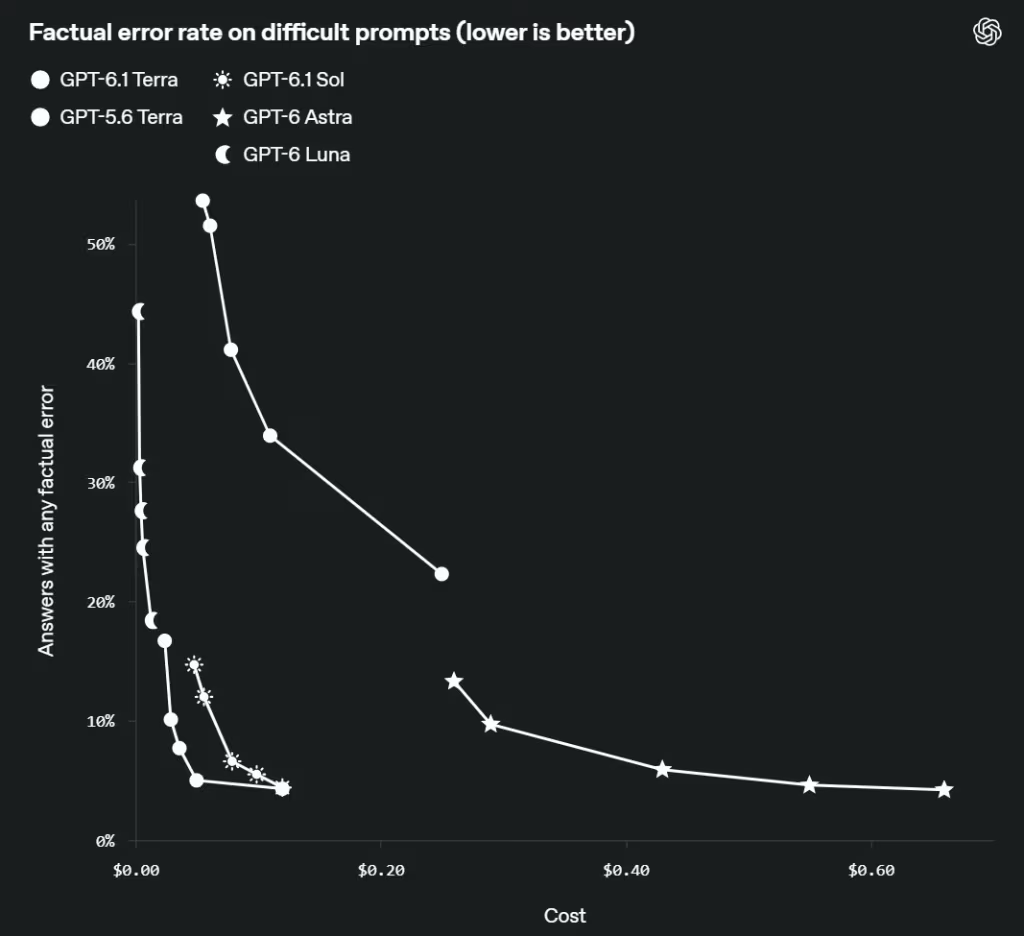
On the company’s internal benchmark for difficult prompts designed to trigger factual mistakes, the reported error rate at low reasoning effort fell from 53.6% with GPT-5.6 Terra to 16.7% with GPT-6.1 Terra.
The model also recorded a score of 50.3% on Terminal-Bench 4.0 at maximum reasoning effort, compared with the previously published 21.5% score for GPT-5.6 Terra.
Terminal-Bench evaluates how effectively AI agents solve command-line tasks, including software debugging and other practical engineering challenges.
However, OpenAI notes that GPT-6.1 Sol and GPT-6 Astra remain better choices for some of the most complex software development tasks. The results also come from OpenAI’s evaluations and should not be interpreted as a guarantee of performance across every coding project.
GPT-6.1 Terra API Pricing
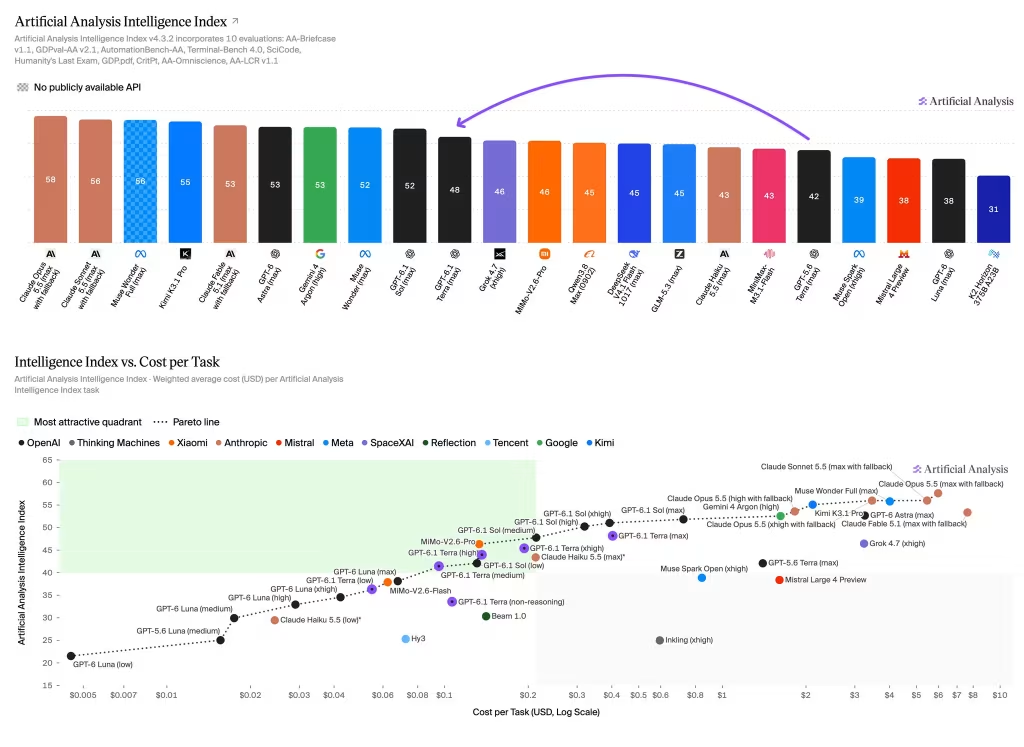
One of the most significant changes is the reduction in API pricing. OpenAI says standard API rates are 50% lower than those of GPT-5.6 Terra and GPT-6.1 Sol.
| API usage | GPT-6.1 Terra price |
|---|---|
| Input tokens | $1 per million |
| Cached input tokens | $0.05 per million |
| Output tokens | $5 per million |
Lower prices could make the model attractive to developers building AI-powered applications that process large volumes of documents, customer requests or business records.
For example, an invoice-processing agent could read incoming bills, extract key information and enter the details into accounting software. A customer support workflow could also use computer interaction to update records or complete repetitive administrative tasks.
Actual costs will depend on token consumption, tool calls and the complexity of each workflow.
Availability: Where Can You Use GPT-6.1 Terra?
OpenAI says GPT-6.1 Terra is available to Plus, Pro, Enterprise and Edu users through ChatGPT Work and Codex.
Developers can also access the model through the OpenAI API using the model identifier gpt-6.1-terra.
For technical documentation and integration details, visit the official GPT-6.1 Terra API documentation.
OpenAI has also continued to strengthen the model’s safeguards, including protections against malicious instructions embedded in content that an agent encounters while carrying out a task.
What GPT-6.1 Terra Means for AI Automation
GPT-6.1 Terra reflects the growing focus on AI agents that do more than generate responses. By combining visual reasoning, computer interaction and lower operating costs, the model could make automated business workflows more accessible to developers and organisations.
Its potential applications range from document processing and data entry to software testing and multi-step administrative work. Nevertheless, businesses should test reliability, permissions and error handling before allowing agents to perform consequential actions without supervision.
Bottom line: GPT-6.1 Terra brings faster computer use, improved visual reasoning, stronger coding results and lower API prices. For developers and businesses building AI agents, it offers another option for balancing capability, speed and operating costs.
Source: OpenAI — Introducing GPT-6.1 Terra.
FAQs
What is GPT-6.1 Terra designed to do?
GPT-6.1 Terra is designed for professional workflows that combine visual understanding, reasoning and interaction with computer interfaces. It can help agents navigate screens, fill out forms, process invoices and edit video projects.
How does GPT-6.1 Terra improve computer use?
It uses visual information from computer interfaces to determine what to click, where to enter information and how to complete multi-step workflows. OpenAI says it completed computer-use tasks more than three times faster than GPT-6 Astra and GPT-6.1 Sol in its reported evaluations.
How did GPT-6.1 Terra perform on coding evaluations?
OpenAI reports a 50.3% score on Terminal-Bench 4.0 at maximum reasoning effort, compared with the previously published 21.5% score for GPT-5.6 Terra. OpenAI notes that GPT-6.1 Sol and GPT-6 Astra remain better choices for some complex software development tasks.