COL0
COL0 VAN0
VAN0 RSL3
RSL3 STL0
STL0 POR1
POR1 CLT1
CLT1 SD0
SD0 SEA0
SEA0 UAE
UAE NED
NED PAK
PAK ENG
ENG IND-W
IND-W ZIM-W
ZIM-W GMB
GMB LES
LES MOZ
MOZ ZMB
ZMB Inter Milan
 Fiorentina
 Churchill
 Punjab FC
 NGA
NGA UGA
UGA MEX-W23 (9.3/20 ov, target 189)
 ARG-W188/5
 ATM1
ATM1 DEP0
DEP0 LAZ2
LAZ2 PAR1
PAR1 RCL2
RCL2 PAR1
PAR1 NZ-A317
 IND-A113 & 33/2 (12.4 ov)
 SYL
SYL KHU
KHU MYMS299/4 (87 ov)
 CHATT
CHATT DHA293/3 (84.1 ov)
 RAJ
RAJ RAN320/5 (80 ov)
 BAR
BAR DEN
DEN PNG
PNG NAM321/6
 IRE290 (47.3/50 ov, target 322)
 WEL0
WEL0 CCM0
CCM0 Athletic
 Getafe
 C Palace
 Newcastle
 Hull
Hull Brentford
 Liverpool
 Brighton
 Man United
 Bournemouth
 Atalanta
 Frosinone
 RIY2
RIY2 TAA1
TAA1 CHE0
CHE0 TOT2
TOT2 VAL1
VAL1 VIL2
VIL2
The United States men’s national team have started with four at the back for their last 20 World Cup games.
During that time, they have reached the knockout stage in four of the five tournaments they qualified for, including one quarter-final appearance. They have come to be seen as a side that shouldn’t be disappointed with reaching the last 16 before bowing out to a team they’re either expected to lose to or is right at their level — the Netherlands in 2022, Belgium in 2014, Ghana in 2010, and Germany in 2002.
Always four at the back, at least on paper. So why does Mauricio Pochettino appear to be heading into the World Cup 2026 on home soil with three central defenders?
The 1998 Trauma and Why It Shouldn’t Define This Decision
Mention a back three to a certain generation of USMNT supporters and one name surfaces immediately: Steve Sampson. His infamous 3-6-1 — or more accurately a 3-4-2-1 — started the 1998 World Cup in France and ended it ten days later with a third consecutive defeat. Those of us who remember it have spent the intervening years trying to suppress the memory.
But comparing Sampson’s 1998 lineup to what Pochettino may deploy on 12 June against Paraguay is not a productive exercise. The game is entirely different. The quality in the US talent pool now compared to 28 years ago is not even worth discussing.
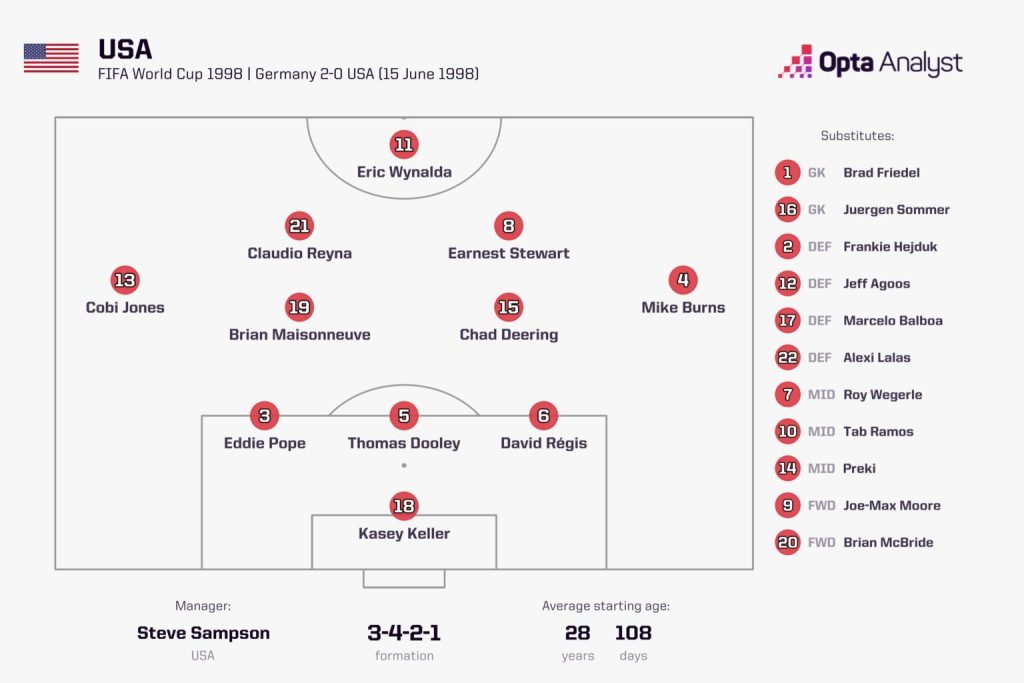
What is worth discussing is this: a back three in 1998 or 2026 is well-suited to working with respectable wing-backs. Sampson’s best wide option, Frankie Hejduk, started that tournament on the bench. Pochettino, by contrast, has Antonee Robinson and Sergiño Dest — two of the players in the US pool with the most minutes against quality European competition in their careers, and two of the certainties for Group D games against Paraguay, Türkiye, and Australia.
The 1998 trauma should not be the lens through which we evaluate a 2026 tactical decision. Context has changed. Personnel has changed. Everything has changed.
The 2022 Blueprint — and Its Limitations
To understand why Pochettino is experimenting with a back three, it helps to revisit what worked and what didn’t in Qatar 2022.
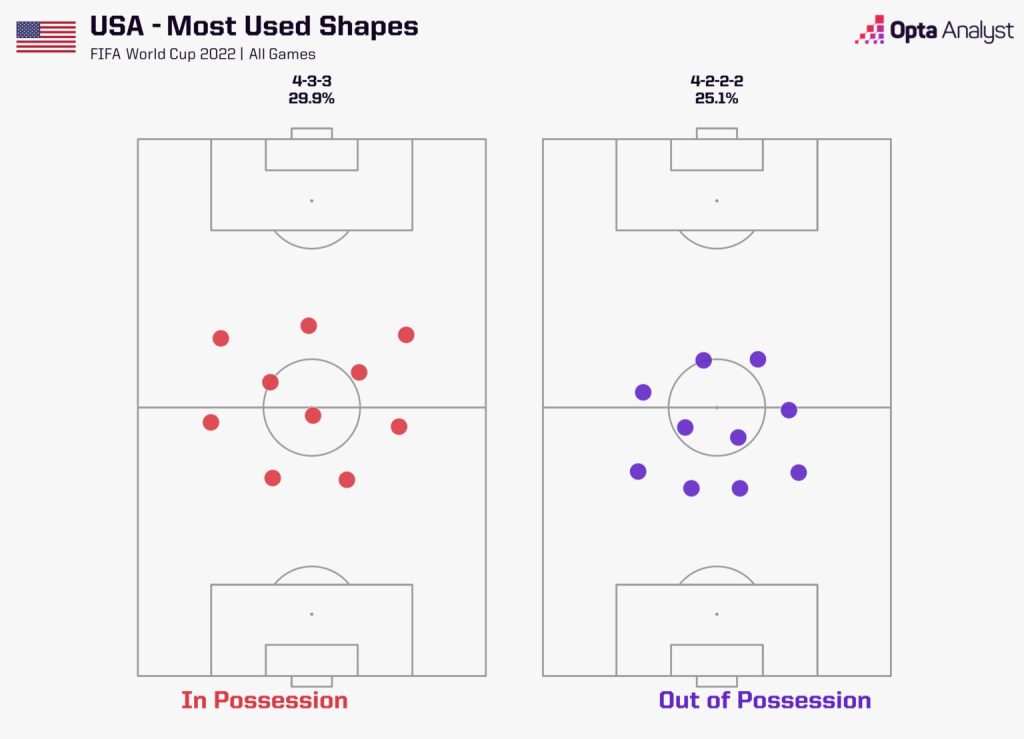
The USA used a 4-3-3 — readable out of possession as a 4-2-2-2 or 4-4-2 depending on the phase — with Robinson and Dest operating as wide players regardless of label. That formation seemed to work for what they were trying to achieve against England, Iran and Wales: get out of the group and let it ride.
| USA Group Stage 2022 | Stat |
|---|---|
| Possession edge | Yes — slight advantage over England, Iran and Wales |
| Shots generated | 28-19 advantage over group opponents |
| xG against (group play) | 2.74 (11th best of 32 teams) |
| Group outcome | Advanced |
They drew with England and Wales, beat Iran, and generally played on the front foot without opening themselves up too much. The 4-3-3 got them out of the group.
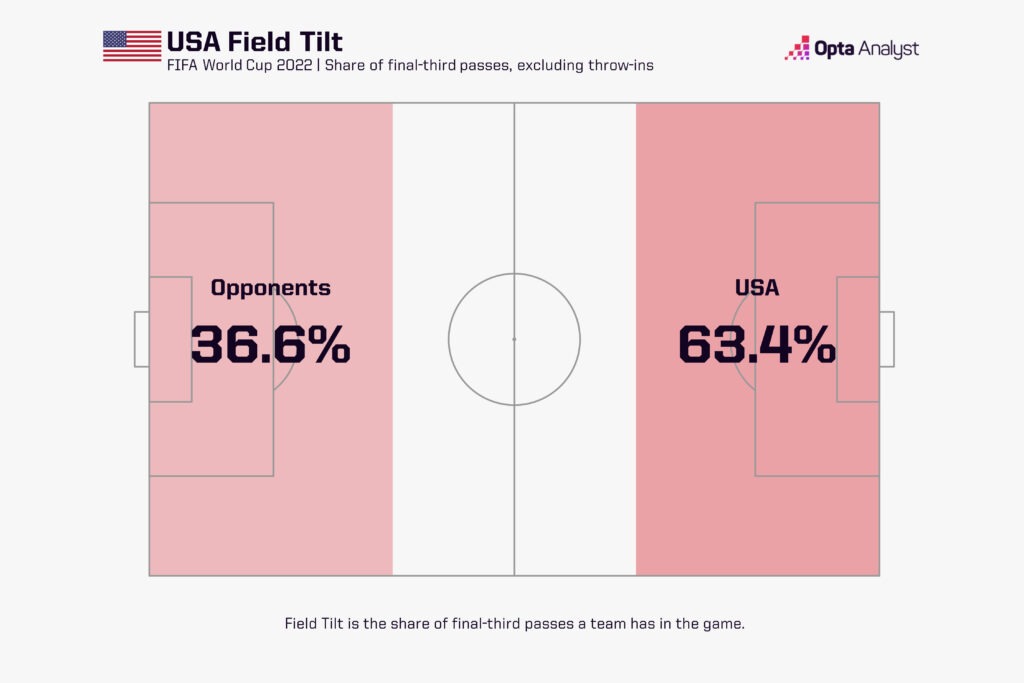
Then came the Netherlands in the last 16.
They conceded in the 10th minute to a goal that, on paper, resulted from an extended sequence they should not have been out of position for. Memphis Depay played out of the defensive half to Cody Gakpo, who carried through the middle and found Denzel Dumfries on the right. Dumfries located a trailing Depay entering the box ahead of Tyler Adams for a one-touch finish.
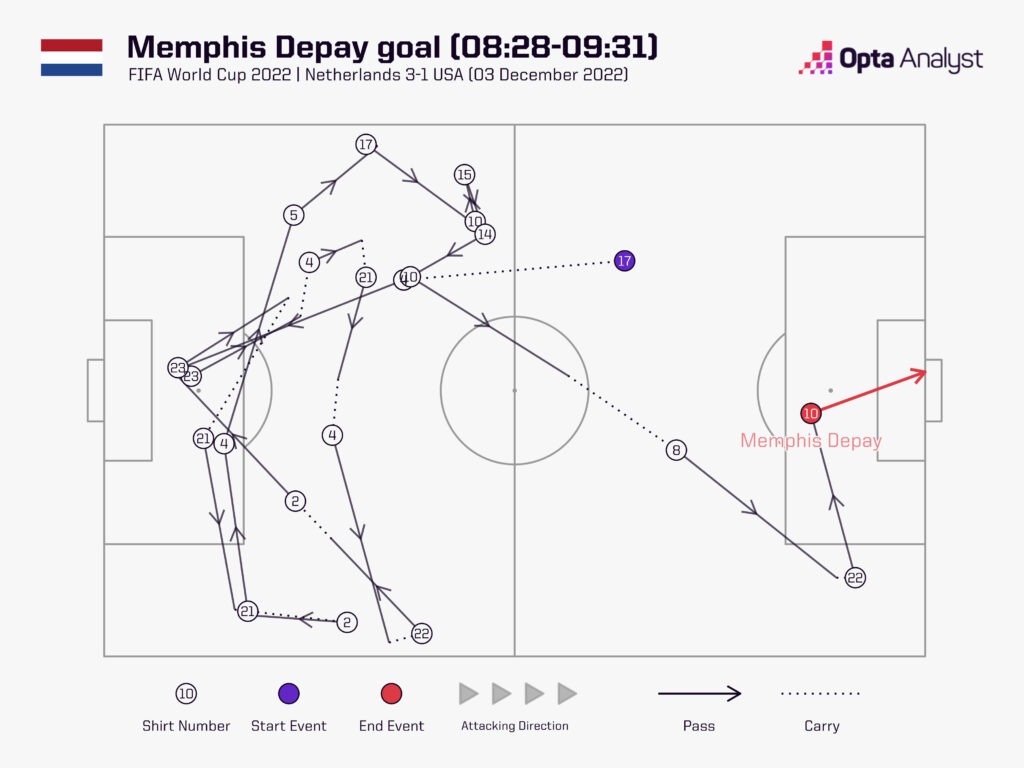
The Dutch took full advantage of the space afforded to them by the US midfield and defence in transition. It is the kind of goal that might have been avoided with another defender on the pitch, rather than relying on Adams — as the USMNT occasionally do — to be everywhere.
The USA ultimately lost 3-1, conceding inexcusable space for all three goals. The 4-3-3 worked to get them there. It did not work when tested by a genuinely elite European opponent. Playing a 4-3-3 seems like the US failing to learn from their defeats.
Why Three at the Back Makes Sense Now
The Personnel Problem
The core of this 2026 squad is strikingly similar to the 2022 version. Pulisic, McKennie, Adams, Dest, and Robinson are all still here. There is a real possibility this side starts six or seven of that core 2022 group. Which raises an uncomfortable question: if the personnel is essentially the same, why would the outcomes be any different if the formation is also the same?
Putting a very similar team out in a 4-3-3 and hoping they are not exposed in the same ways against good teams is not a strategy — it is wishful thinking.
The Centre-Back Situation
Tim Ream has been named captain and will play on the left side of the three-man backline with Robinson outside him. Chris Richards — if healthy after his ankle injury — is the clearest centre option, though Mark McKenzie may start against Paraguay if Richards is not recovered.
The most interesting selection is on the right side of the three. Alex Freeman, since moving to Villarreal in January, has played all 340 of his minutes as a right-back — the same position he occupied exclusively in MLS. In a back-three system, Freeman figures to occupy the right side of that defensive unit, allowing Dest to take a significantly more advanced position on the right wing.
The Formation in Practice
Pochettino’s apparent system is a 3-4-2-1 that offers considerable tactical flexibility. The key nuance, as the USA’s final send-off match against Germany demonstrated, is the asymmetry between the two wide players:
- Robinson on the left operates somewhat deeper — closer to a true left wing-back
- Dest on the right sits in more advanced positions, functioning closer to a right winger
This asymmetry creates a formation that can shift fluidly between a back three, back four, or even back five depending on the phase of play:
| Scenario | Shape |
|---|---|
| Dest stays forward, Freeman wide as right-back | Back four (Ream + Richards/McKenzie as CB pair) |
| Dest pushes higher, Freeman shifts to right CB | Back three proper |
| Both Robinson and Dest tuck in | Back five in defence |
The flexibility is the point. Pochettino is not rigidly committing to three at the back — he is creating a system that can adapt without wholesale personnel changes.
Is Three at the Back Pessimistic Football?
The instinct many USMNT fans will have is to associate a back three with caution — prioritising not losing over trying to win. In the context of this specific team, that instinct should be resisted.
Playing a 4-3-3 with this team asks them to do more with arguably less than they had in Qatar. It asks Adams — who has been frequently injured since 2022 — to single-handedly protect a centre-back partnership that has question marks around it. It asks a central midfield that has lost Yunus Musah (not in this squad) to cover the same ground it covered two years ago. And it asks an attack to generate goals from a system that produced just three goals from 4.09 xG across four games in 2022.
Three at the back gives Robinson and Dest the freedom and space to get forward without leaving the defence exposed behind them. It provides an additional defensive body in a team that has shown — most clearly against the Netherlands — that it can be exploited in transition. Start by eliminating the inevitability of crippling mistakes. Give the talented outside players the freedom and space to get forward and see what happens.
It is oversimplifying things to say three at the back is resigning themselves to pessimistic football. And crucially, it does not have to prevent the kind of attacking combination play that characterised the USMNT’s best moments.
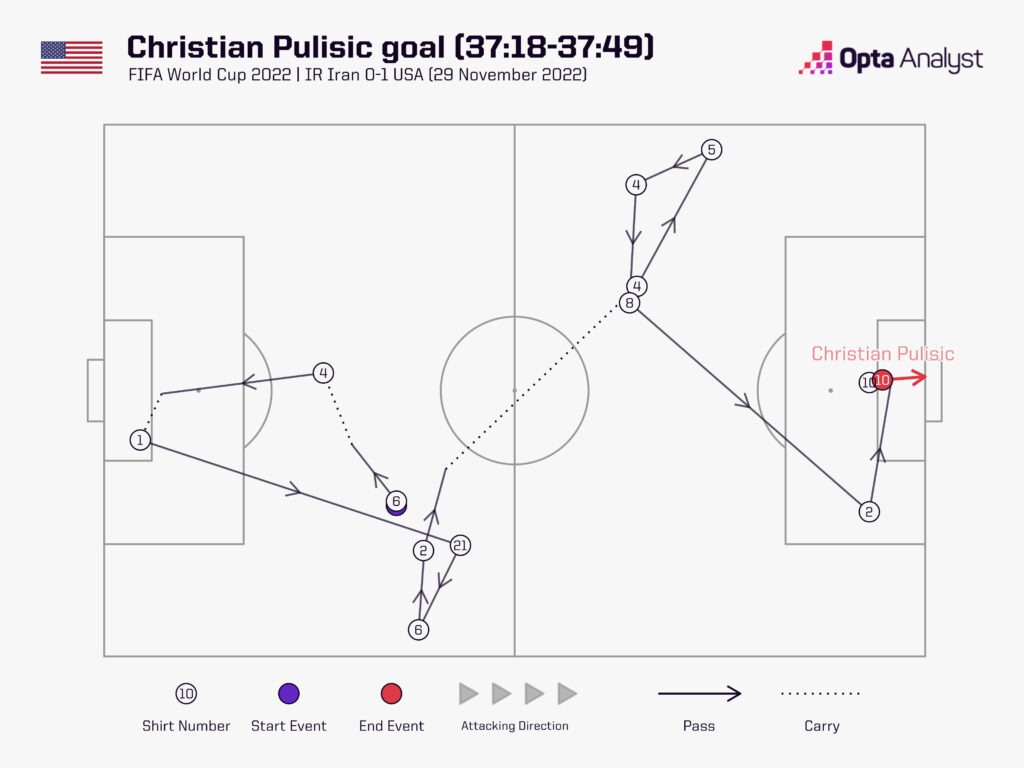
Perhaps the clearest example of that came in the 1-0 win over Iran, when they scored following a 31-second sequence in which Dest covered much of the length of the pitch from a defensive involvement to a headed assist inside the penalty area, with McKennie as the central lynchpin connecting the sequence. That goal can absolutely happen in a 3-4-2-1 or any of its three-back cousins.
The Midfield Question
What made the 2022 USMNT competitive was the combination of a functioning midfield three with dynamic wing-backs and Pulisic’s involvement in all three goals scored. What happened in 2022 seemed like it came down to timing — Adams, McKennie and Musah being somewhere near the top of their games at the same time. While McKennie may now be at the top of his game, Musah is not in this squad and Adams has frequently been injured since Qatar. The midfield chemistry of 2022 cannot simply be assumed to exist again.
The back-three system addresses this by providing flexibility around Adams and McKennie. Timothy Weah could start as a winger in front of Dest on the right, with Pulisic in front of Robinson on the left — a setup Weah could suit given he started all four matches in 2022. Alternatively, Malik Tillman or Sebastian Berhalter may slot in next to Adams in a more central role with McKennie playing a more traditional number 10.
The latter seems more likely given what Pochettino showed against Germany, with Dest in a more advanced role — but it also feels at risk of becoming a 4-3-3 that doesn’t address how a similar team was torched by the Netherlands. That risk needs to be front of mind as Pochettino finalises his approach.
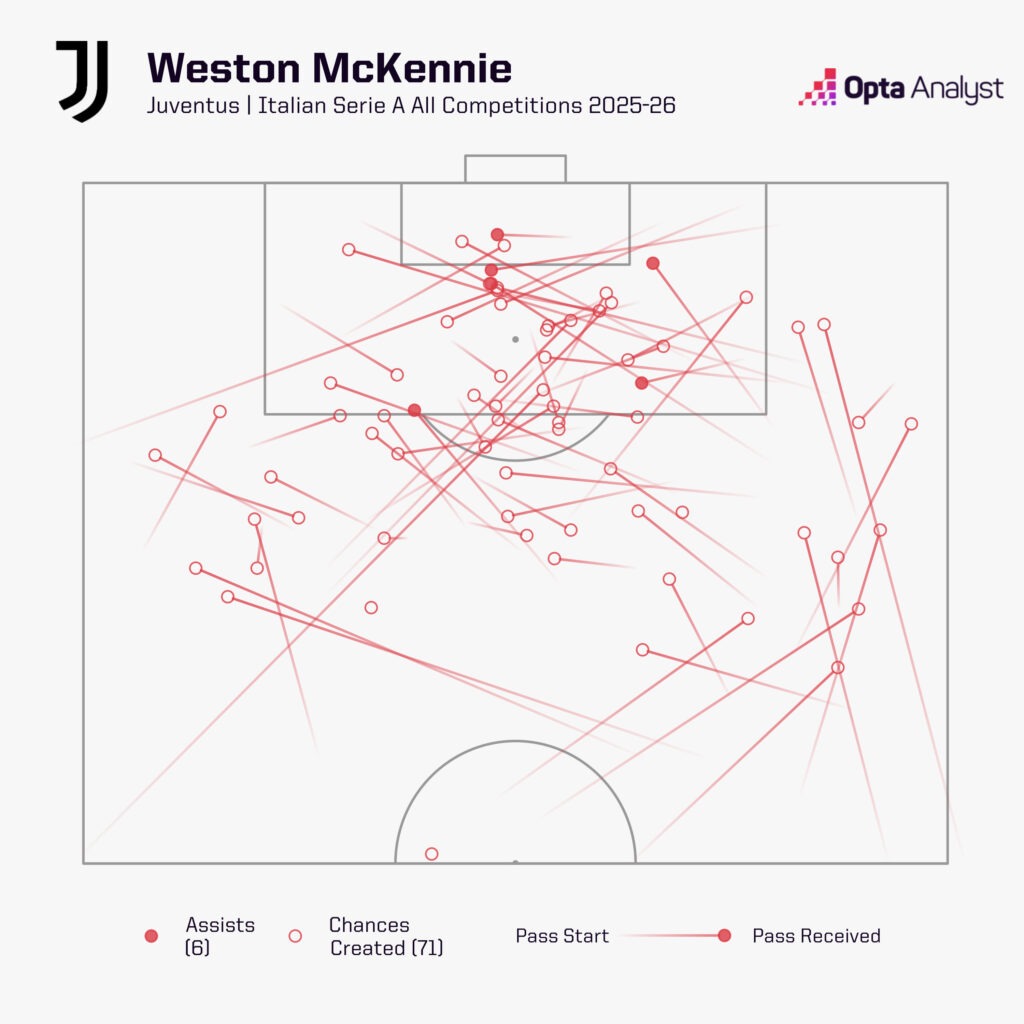
To get the best from the midfield, it makes sense to establish McKennie’s role as a creator. The Juventus mainstay is coming off his best season with the club and should be in a creative attacking role:
| McKennie at Juventus — 2025-26 | Stat |
|---|---|
| Minutes across all competitions | 4,142 (1,000+ more than previous season) |
| Goals | 9 |
| Assists | 6 |
| Chances created | 71 |
The only other Serie A player with 15+ goal involvements and 70+ chances created across all competitions was Juventus teammate Kenan Yildiz. McKennie should be in a creative attacking role — and a back-three system is probably the best way to give him that freedom without sacrificing defensive structure.
The Striking Question: Balogun Over Pepi and Wright
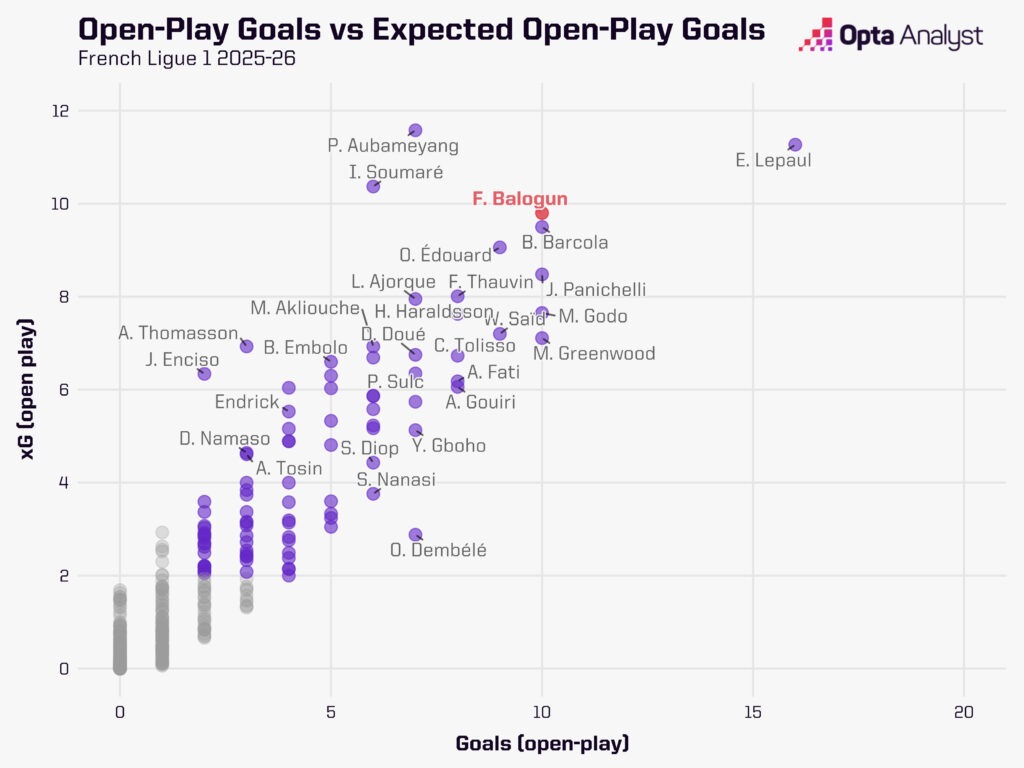
For perhaps the first time entering a major tournament, the USMNT appears to have settled on a striker rather than debating between options. Folarin Balogun seems to be Pochettino’s first choice ahead of Ricardo Pepi and Haji Wright.
The choice appears to come down to what the striker is being asked to do. If it has been a Balogun vs. Pepi decision, it seems to be a question of whether Pochettino would rather have that striker create opportunities to score or finish opportunities created for him. Pepi may be the more clinical finisher, but Balogun is seen as a forward capable of doing more than getting on the end of an opportunity — which fits more with the likeliest starting XIs in a back-three system.
A front-of-mind concern about playing three at the back is whether there will be less to work with in the attack. But going back to 2022, it is not as if that squad got to where they did by pouring in goals from a 4-3-3. They scored three in four games from 4.09 xG. They were threatening with their wing-backs getting forward and combining with McKennie and Pulisic. That can still happen with three at the back — and perhaps more sustainably, because the defensive foundation is more secure.
The Group D Picture
The USA are not necessarily favourites to win Group D. We predicted Türkiye marginally ahead of the USA for group winners that underlines how competitive all four sides are.
| Group D Win Probability | % |
|---|---|
| Türkiye | 33.3% |
| USA | 32.1% |
In a genuinely competitive group, building from a secure defensive foundation and allowing the wing-backs to be the primary attacking impetus is not pessimism — it is pragmatism.
The Bigger Picture: More Than Getting Out of the Group
It is easy at this stage to reach for platitudes. One game at a time. All that matters is getting out of the group. But the reality of hosting a World Cup — of trying to show the world how the USA has grown as a football nation since 1994, when they last hosted and advanced to the last 16 — is that it is not only about getting out of the group or winning one knockout game.
It is about finding a suitable way to play that gives the United States a genuine chance of advancing through the round of 32 and potentially beyond the last 16. The back three is not just a group-stage decision. It is a tournament-wide philosophy.
Making the Back Three Work at Last
It is 28 years since the United States last attempted a back-three system at a World Cup. The attempt in 1998 was disastrous. But the game, the players, and the system are fundamentally different now.
Pochettino has Robinson and Dest — genuine quality at wing-back with extensive European experience. He has McKennie at the peak of his club form. He has Adams, when fit, as one of the best holding midfielders the USMNT have produced. He has Pulisic. And he has a striker in Balogun who can do more than simply finish chances.
Playing a 4-3-3 with this group and hoping for better results than 2022 seems like hoping for a different outcome from similar inputs. The back three — done properly, with the flexibility Pochettino appears to be building in — offers something genuinely new. A more secure foundation. Greater freedom for the best attacking players. And perhaps, on home soil, at a World Cup the entire country is watching, the chance to finally go deeper than the last 16.
Now, 28 years after they last tried, it seems like it’s time to finally make a back-three system work. It is the most realistic way to do something memorable.
Read More: World Cup 2026: Canada Preview – Why Jesse Marsch’s Side Believe They Can Finally Reach the Knockout Stage
Also Read: World Cup 2026: Group D Predictions and Preview