MEX-W
MEX-W ARG-W
ARG-W RBNY1
RBNY1 MIA0
MIA0 Palmeiras1
 Bragantino0
 Vasco1
 Corinthians2
 Chapecoense1
 Fluminense0
 UAE
UAE NED
NED PAK
PAK ENG
ENG IND-W
IND-W ZIM-W
ZIM-W GMB
GMB LES
LES MOZ
MOZ ZMB
ZMB Inter Milan
 Fiorentina
 Churchill
 Punjab FC
 NGA
NGA UGA
UGA ATM1
ATM1 DEP0
DEP0 LAZ2
LAZ2 PAR1
PAR1 RCL2
RCL2 PAR1
PAR1 RIY2
RIY2 TAA1
TAA1 NZ-A171/5 (53 ov)
 IND-A113
 SYL
SYL KHU
KHU MYMS299/4 (87 ov)
 CHATT
CHATT DHA293/3 (84.1 ov)
 RAJ
RAJ RAN320/5 (80 ov)
 BAR
BAR DEN
DEN PNG
PNG NAM321/6
 IRE290 (47.3/50 ov, target 322)
 NZ180/5
 IND181/6 (19.5/20 ov, target 181)
 Athletic
 Getafe
 C Palace
 Newcastle
 Hull
Hull Brentford
 Liverpool
 Brighton
 Man United
 Bournemouth
 Atalanta
 Frosinone
 CHE0
CHE0 TOT2
TOT2 VAL1
VAL1 VIL2
VIL2
When the 2026 FIFA World Cup was awarded to Canada, Mexico, and the United States, it was easy to assume Canada’s role was largely symbolic — a co-host nation gifted a place at the tournament without having to earn it through qualifying. The football-sceptic view: a country where ice hockey and lacrosse traditionally come first, filling a group-stage slot before making a polite exit.
That view is wrong. Under manager Jesse Marsch, Canada have become a genuinely difficult side to beat, and their goal in Group B — where they face Bosnia-Herzegovina, Qatar, and Switzerland — is not merely participation. It is knockout-stage qualification for the first time in the country’s World Cup history.
The System: Compact, Direct, and Relentless
Marsch, who signed a new four-year contract ahead of the tournament in a clear statement of mutual commitment from both coach and Canadian FA, has built a team with a clear and recognisable identity.
Canada typically operate in either a flat 4-4-2 or a narrow 4-2-2-2 — compact in defence, rarely taking risks with the ball, and lethal on the counter-attack. When out of possession, they fall into two banks of four, frustrating opponents with an organised defensive block. The evidence of this defensive solidity is considerable: they have kept seven clean sheets in their last nine matches and have not conceded more than one goal in the same game since a 4-2 victory over Ukraine in June 2025 — a run that now spans 14 matches.
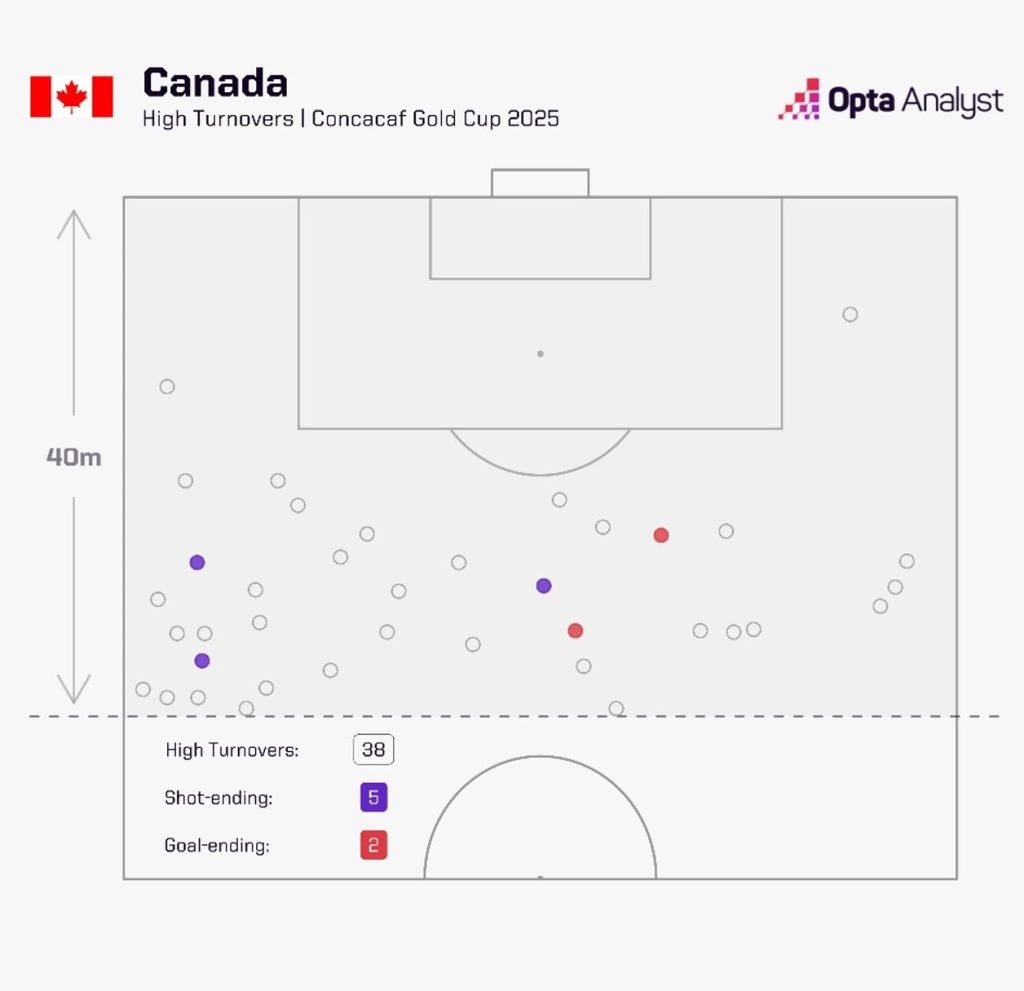
The attacking identity is equally well-defined. At the 2025 CONCACAF Gold Cup, their most recent competitive tournament, Canada scored nine goals across three group stage matches against Honduras, El Salvador, and Curaçao. Two specific statistics from that competition capture how they operate at their best.
| Canada at the 2025 CONCACAF Gold Cup | Stat |
|---|---|
| High turnovers per match (regains within 40m of the opposition’s goal) | 9.5 (most of any nation in the competition) |
| High turnovers leading to a shot | 5 |
| High turnovers leading to a goal | 2 |
| Average speed of attack | 2.32 m/s (fastest of any nation in the competition) |
| Proportion of offensive play down the left flank | 41.8% |
| Proportion of offensive play down the right flank | 32.4% |
No side in the competition averaged more high turnovers per match. No side attacked upfield at a higher average speed. Their left-side dominance — 41.8% of offensive play down that flank — is not accidental. It is a direct reflection of where their best player operates.
Alphonso Davies: The Heartbeat of Canada’s Attack
The most important player in Canada’s squad is Alphonso Davies (Bayern Munich, 25). Despite spending most of the 2025-26 season injured and making just 23 appearances for the German champions, he remains Canada’s most talented and most dangerous individual — and the reason their left-sided attacking dominance is so pronounced.
Davies is likely to miss their opening match but his importance will be felt the moment he returns to the XI. Now on 58 caps with 15 international goals, including one against Croatia at the 2022 World Cup, he brings a combination of pace, carrying ability, and crossing quality that creates a different kind of problem for any defence.
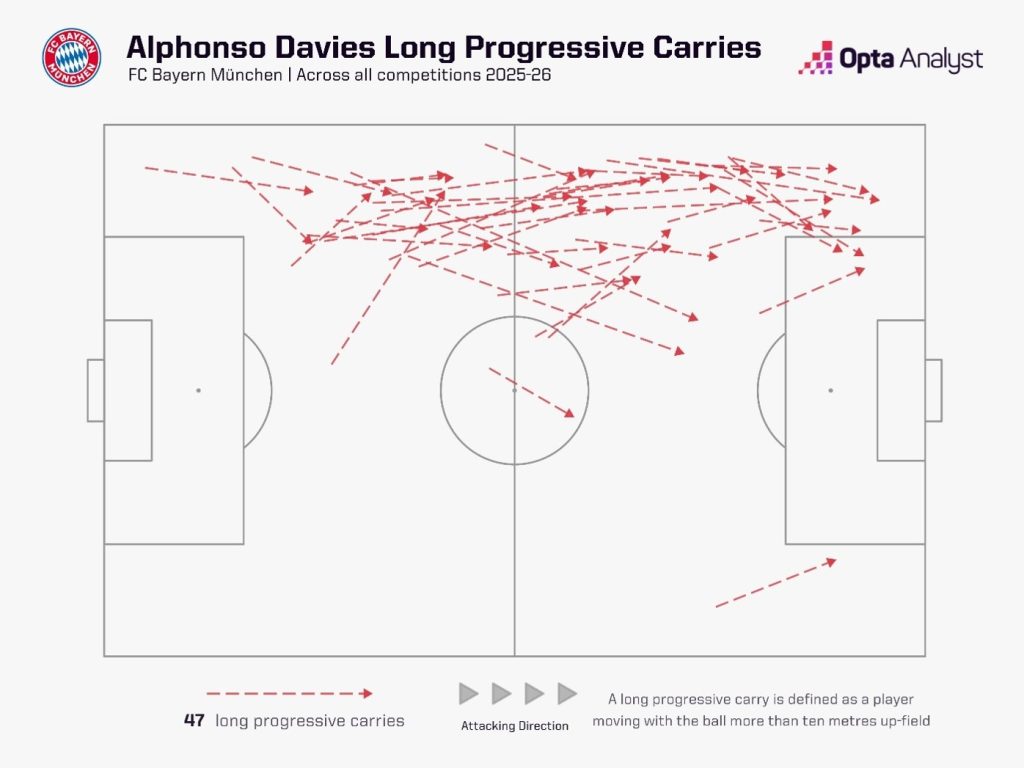
His ball-carrying numbers for Bayern this season underline just how devastating he can be at his best.
| Alphonso Davies — Ball Carrying Statistics (2025-26) | Stat |
|---|---|
| Carries per 90 | 19.2 |
| Long progressive carries per 90 (10m+ towards goal) | 5.0 |
| Ranking among top-five league defenders in Europe | Top 30 (both metrics) |
When Davies is fit and running at defenders in those left-side channels, Canada become a significantly more dangerous proposition — and Switzerland, in particular, will have planned for exactly that scenario.
Stephen Eustáquio: The Engine Room
If Davies provides the explosive left-side threat, Stephen Eustáquio provides the cerebral control from central midfield. The 29-year-old — on loan at LAFC from Porto — operates as either a number six or a box-to-box number eight, dictating tempo and enabling Canada’s rapid transitions.
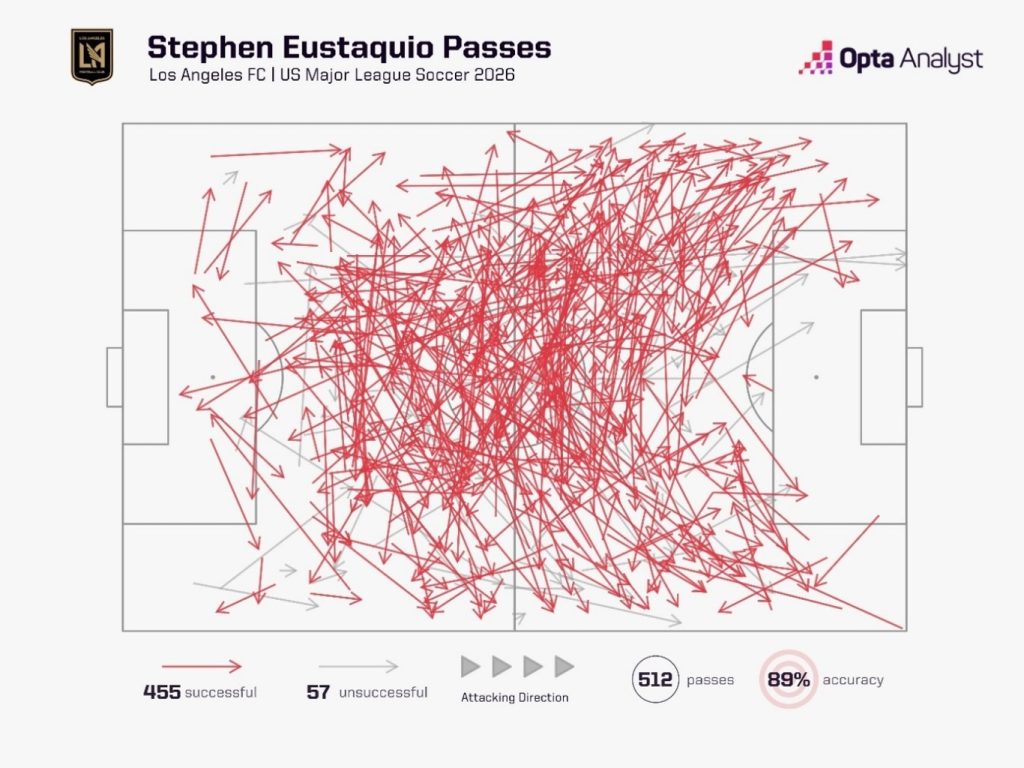
His numbers in MLS since arriving in February — just 602 minutes — are already striking.
| Eustáquio in MLS 2026 (Midfielders with 500+ minutes) | Stat | Ranking |
|---|---|---|
| Successful passes per 90 | 68.0 | 5th in MLS |
| Successful passes into opposition’s half per 90 | 17.3 | 7th in MLS |
| Tackles per appearance | 2.5 | — |
| Ball recoveries per appearance | 5.7 | — |
| Combined tackles + recoveries ranking | Top 7 among MLS midfielders |
The combination of elite passing quality and defensive work rate in the same player is exactly what Marsch’s system demands. Eustáquio can both spark transitions and protect the defensive structure when Canada are without the ball — a dual function that makes him arguably their most important contributor over 90 minutes.
Jonathan David: Redemption at the World Cup
The third key figure in Canada’s attacking structure is Jonathan David — and the 2026 World Cup represents an opportunity for one of the world’s most prolific club strikers to finally deliver on the international stage.
At Qatar 2022, the experience was painful. David attempted eight shots without scoring — only five goalless players attempted more at the entire tournament. It was a deeply frustrating return for a forward who had been among Europe’s most clinical finishers in Ligue 1.
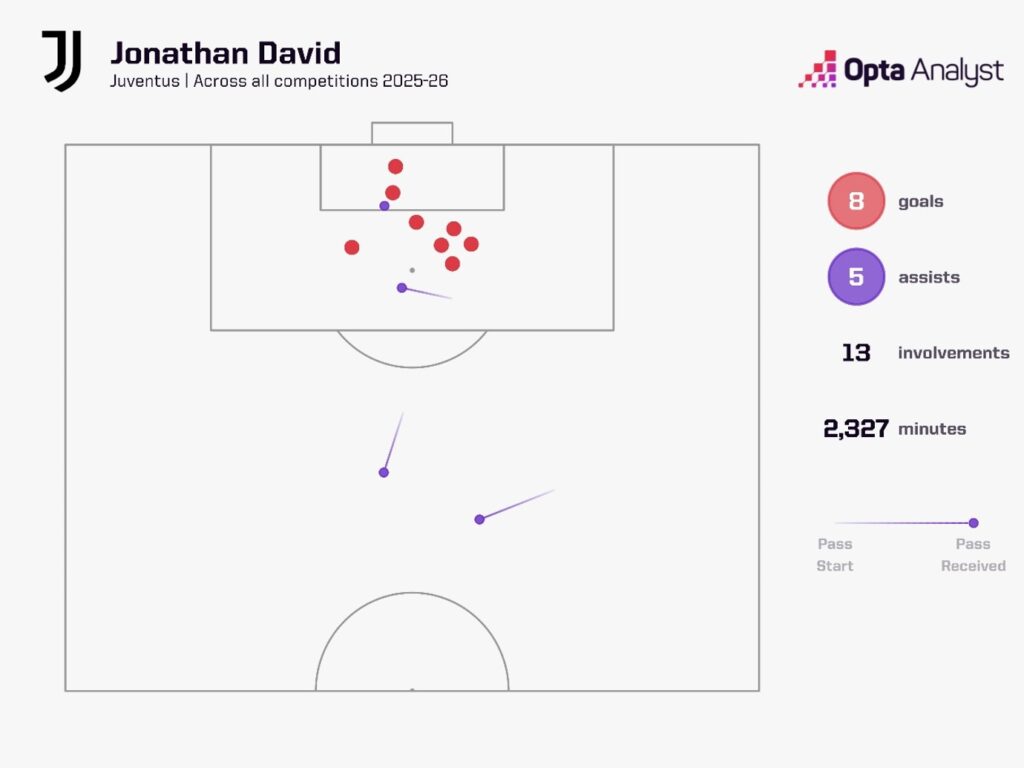
The trajectory since then, however, has been encouraging. David has recorded seven goal contributions across his last eight competitive internationals (four goals, three assists) — a return that suggests his World Cup form was an anomaly rather than a pattern.
Now at Juventus following his prolific Lille career, David has had a solid 2025-26 campaign: eight goals and five assists across 2,327 minutes in all competitions. In Serie A specifically, he joined an elite group of eight players to achieve all three of the following markers simultaneously:
| David’s Serie A 2025-26 Benchmarks | Figure |
|---|---|
| Goal contributions from open play | 10+ |
| Chances created from open play | 32 (30+ threshold) |
| Touches in opposition penalty area | 122 (120+ threshold) |
The other players on that list include Lautaro Martínez, Rasmus Højlund, and Christian Pulisic — company that confirms David is operating at a genuinely elite level when functioning at his best.
Why Canada Can Reach the Knockout Stage
Group B is not straightforward. Switzerland are the clear favourites with vast World Cup experience and a squad capable of beating anyone on their day. But Bosnia-Herzegovina and Qatar represent opportunities for Canada to take maximum points — and the home advantage, the crowd support, and the clarity of Marsch’s system give them a genuine chance of finding the results they need.
The co-host advantage in the expanded format — with home matches potentially running through to the round of 16 for group winners — is not to be underestimated. Canada playing knockout football on home soil, in front of their own supporters, with the entire nation watching a football team for perhaps the first time with genuine collective pride, is a scenario that could produce something remarkable.
Marsch is the first coach with a genuine opportunity to make it happen. The players — Davies, Eustáquio, David, and a supporting cast built for exactly this style of football — are ready.
Canada are not there just to make up the numbers. They are there to progress.
Read More: FIFA World Cup 2026 Group A: South Korea vs Czechia Match Report – Hwang In-Beom Inspires Stunning Comeback to Cancel Out Krejci’s Opener
Also Read: FIFA World Cup 2026 Group A: Mexico vs South Africa Match Report – Quinones and Jimenez Give Mexico Win
FAQs
1. How has Canada performed in recent competitive fixtures under Jesse Marsch?
Canada have kept seven clean sheets in their last nine matches and have not conceded more than one goal in any game since a friendly against Ukraine in June 2025 — a run of 14 matches without conceding multiple goals in a single game.
2. What makes Canada’s attacking style distinctive?
Canada attack at the fastest average speed of any team at the 2025 CONCACAF Gold Cup (2.32 m/s), generate the most high turnovers per match (9.5), and direct 41.8% of their offensive play down the left flank — where Alphonso Davies operates.
3. Why is Alphonso Davies so important to Canada?
Davies is Canada’s most talented player — a left-sided attacker whose 19.2 carries per 90 and 5.0 long progressive carries per 90 rank him in the top 30 defenders across Europe’s top five leagues. His injury this season means he may miss the opening match but will be critical to Canada’s group-stage ambitions once fit.
4. What is Jonathan David’s recent form ahead of the World Cup?
David struggled at the 2022 World Cup (eight shots, zero goals) but has since recorded seven goal contributions in his last eight competitive internationals. At Juventus in 2025-26, he is one of eight Serie A players to record 10+ goal contributions, 30+ open-play chances created, and 120+ penalty-area touches.
5. Which group is Canada in at the 2026 World Cup?
Canada are in Group B alongside Switzerland, Bosnia-Herzegovina, and Qatar. Their opener is against Bosnia-Herzegovina in Toronto on 12 June.